
Love and liberty
Alexandre Dumas
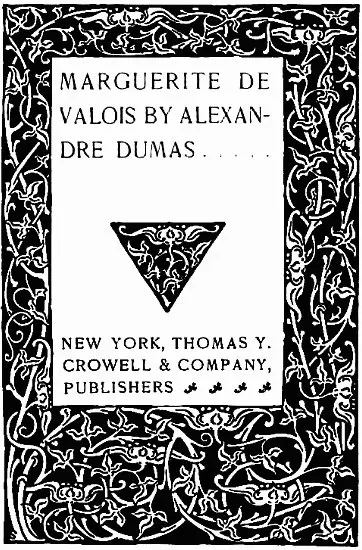
THE CLASSIC COLLECTION · 1900
"Marguerite de Valois" by Alexandre Dumas and Auguste Maquet is a historical novel written in 1845. Set during the French Wars of Religion in 1572 Paris, it follows Marguerite de Valois, daughter of Henry II, whose marriage to Protestant Prince Henri de Bourbon is meant to bring peace. But her mother, Catherine de Medici, schemes to orchestrate the St. Bartholomew's Day Massacre. As court intrigues multiply and poisonings follow, Margot begins a dangerous affair with the soldier La Môle while Catherine plots to secure power for her own son.
Introduction adapted from the source catalogue; source summaries may be automatically generated.
Free to read · English · 203,835 words · No account needed
MAKE TIME FOR A GOOD BOOK
On by default. Untick to stop anonymous reading totals. Each page counts after 10 seconds in view. How this works.
Anonymous counting is on unless you have switched it off.
Marguerite leaned against a table, and seeing the pale brow, the worn features, and deep-sunken eyes of her brother, could not repress a sigh and a tear.
Charles, whom nothing escaped, saw the tear and heard the sigh, and with his head made a slight motion to Marguerite.
This sign, slight as it was, lighted the face of the poor Queen of Navarre, to whom Henry had not had time or perhaps had not wished to say anything.
She feared for her husband, she trembled for her lover. For herself she had no fear; she knew La Mole well, and felt she could rely on him.
"Well, my dear son," said Catharine, "how do you feel?"
"Better, mother, better."
"What do your physicians say?"
"My physicians? They are clever doctors, mother," said Charles, bursting into a laugh. "I take great pleasure, I admit, in hearing them discuss my malady. Nurse, give me something to drink."
The nurse brought Charles a cup of his usual beverage.
"What do they order you to take, my son?"
"Oh! madame, who knows anything about their preparations?" said the King, hastily swallowing the drink.
"What my brother needs," said François, "is to rise and get out into the open air; hunting, of which he is so fond, would do him a great deal of good."
"Yes," said Charles, with a smile, the meaning of which it was
impossible for the duke to understand, "and yet the last hunt did me
great harm."
Charles uttered these words in such a strange way that the conversation, in which the others present had not taken part, stopped. Then the King gave a slight nod of his head. The courtiers understood that the audience was over, and withdrew one after another.
D'Alençon started to approach his brother, but some secret feeling stopped him. He bowed and went out.
Marguerite seized the wasted hand her brother held out to her, pressed it, and kissed it. Then she, in turn, withdrew.
"Dear Margot!" murmured Charles.
Catharine alone remained, keeping her place at the side of the bed. Finding himself alone with her, Charles recoiled as if from a serpent.
Instructed by the words of Réné, perhaps still better by silence and meditation, Charles no longer had even the happiness of doubt.
He knew perfectly to whom and to what to attribute his approaching
death.
So, when Catharine drew near to the bed and extended to him a hand as cold as his glance, the King shuddered in fear.
"You have remained, madame?" said he.
"Yes, my son," replied Catharine, "I must speak to you on important
matters."
"Speak, madame," said Charles, again recoiling.
Your reading position is saved on this browser. Take it to another device with a library code. Reading pages adapt to text, rather than matching a printed edition.
Alexandre Dumas
Alexandre Dumas & Auguste Maquet
Alexandre Dumas
Alexandre Dumas
BEHIND THE BOOK
This eBook is for the use of anyone anywhere in the United States and most other parts of the world at no cost and with almost no restrictions whatsoever. You may copy it, give it away or re-use it under the terms of the Project Gutenberg License included with this eBook or online at www.gutenberg.org. If you are not located in the United States, you will have to check the laws of the country where you are located before using this eBook. Read the source licence.
The original source file, including credits and licence, is retained by this library. Request an original-format copy at no charge. Please include the book title and Project Gutenberg identifier #33609.
KEEP YOUR CURIOSITY GOING
Cécile Tormay

Moritz Busch
Coulson Kernahan
John L. Ransom

Maurice Baring
Frances Wright