
Love and liberty
Alexandre Dumas
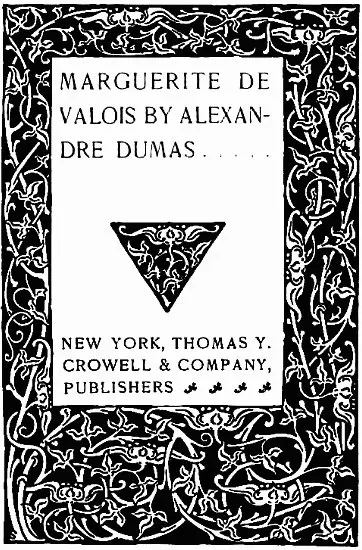
THE CLASSIC COLLECTION · 1900
"Marguerite de Valois" by Alexandre Dumas and Auguste Maquet is a historical novel written in 1845. Set during the French Wars of Religion in 1572 Paris, it follows Marguerite de Valois, daughter of Henry II, whose marriage to Protestant Prince Henri de Bourbon is meant to bring peace. But her mother, Catherine de Medici, schemes to orchestrate the St. Bartholomew's Day Massacre. As court intrigues multiply and poisonings follow, Margot begins a dangerous affair with the soldier La Môle while Catherine plots to secure power for her own son.
Introduction adapted from the source catalogue; source summaries may be automatically generated.
Free to read · English · 203,835 words · No account needed
MAKE TIME FOR A GOOD BOOK
On by default. Untick to stop anonymous reading totals. Each page counts after 10 seconds in view. How this works.
Anonymous counting is on unless you have switched it off.
"Well, I will walk, too, and wander with you. That will be charming. Then, if you are attacked, there will be two of us, and we will give them no end of trouble. Let him come, your duke! I will pin him to the wall like a butterfly!"
"But, at least, say that you are going to leave his service!"
"Yes, I am."
"In that case, tell him so."
"Well, that seems only right. I will do so. I will write to him."
"Write to him! That would be discourteous, Coconnas, to a prince of the
blood."
"Yes, of the blood! of the blood of my friend. Take care," cried Coconnas, rolling his large, tragic eyes, "lest I trifle with points of etiquette!"
"Probably," said La Mole to himself, "in a few days he will need neither the prince nor any one else, for if he wants to come with us, we will take him."
Thereupon Coconnas took the pen without further opposition from his friend and hastily composed the following specimen of eloquence:
"Monseigneur: There can be no doubt but that your highness, versed as you are in the writings of all authors of antiquity, must know the touching story of Orestes and Pylades, who were two heroes celebrated for their misfortunes and their friendship. My friend La Mole is no less unfortunate than was Orestes, while I am no less tender than Pylades. At present he has affairs of importance which demand my aid. It is therefore impossible for me to leave him. So with the consent of your highness I will take a short vacation, determined as I am to attach myself to my friend's fortune, whithersoever it may lead me. It is with the deepest grief that I tear myself away from the service of your highness, but for this I trust I may obtain your pardon. I venture to subscribe myself with respect, my lord,
"Your highness's very humble and very obedient servant,
"The inseparable friend of Monsieur de la Mole."
This masterpiece finished, Coconnas read it aloud to La Mole, who merely
shrugged his shoulders.
"Well! what do you say to it?" asked Coconnas, who had not seen the shrug, or who had pretended not to see it.
"I say," replied La Mole, "that Monsieur d'Alençon will laugh at us."
"At us?"
"Both of us."
"That will be better, it seems to me, than to strangle each of us
separately."
"Bah!" said La Mole, laughing, "the one will not necessarily prevent the
other."
"Well! so much the worse. Come what may, I will send the letter to-morrow morning. Where shall we sleep when we leave here?"
Your reading position is saved on this browser. Take it to another device with a library code. Reading pages adapt to text, rather than matching a printed edition.
Alexandre Dumas
Alexandre Dumas & Auguste Maquet
Alexandre Dumas
Alexandre Dumas
BEHIND THE BOOK
This eBook is for the use of anyone anywhere in the United States and most other parts of the world at no cost and with almost no restrictions whatsoever. You may copy it, give it away or re-use it under the terms of the Project Gutenberg License included with this eBook or online at www.gutenberg.org. If you are not located in the United States, you will have to check the laws of the country where you are located before using this eBook. Read the source licence.
The original source file, including credits and licence, is retained by this library. Request an original-format copy at no charge. Please include the book title and Project Gutenberg identifier #33609.
KEEP YOUR CURIOSITY GOING
Cécile Tormay

Moritz Busch
Coulson Kernahan
John L. Ransom

Maurice Baring
Frances Wright