
Love and liberty
Alexandre Dumas
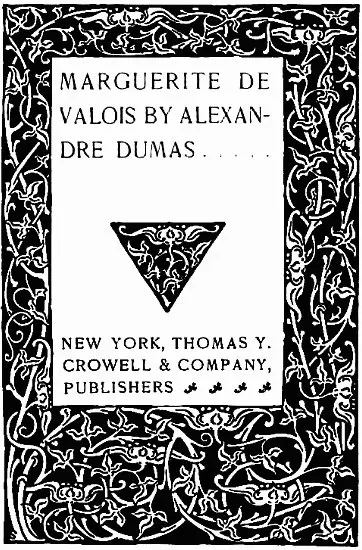
THE CLASSIC COLLECTION · 1900
"Marguerite de Valois" by Alexandre Dumas and Auguste Maquet is a historical novel written in 1845. Set during the French Wars of Religion in 1572 Paris, it follows Marguerite de Valois, daughter of Henry II, whose marriage to Protestant Prince Henri de Bourbon is meant to bring peace. But her mother, Catherine de Medici, schemes to orchestrate the St. Bartholomew's Day Massacre. As court intrigues multiply and poisonings follow, Margot begins a dangerous affair with the soldier La Môle while Catherine plots to secure power for her own son.
Introduction adapted from the source catalogue; source summaries may be automatically generated.
Free to read · English · 203,835 words · No account needed
MAKE TIME FOR A GOOD BOOK
On by default. Untick to stop anonymous reading totals. Each page counts after 10 seconds in view. How this works.
Anonymous counting is on unless you have switched it off.
The paper was attached to a cord, which came through the broken window.
Marguerite unfolded the letter and read.
"Unfortunate man!" she cried, holding out the paper to La Mole, who stood as pale and motionless as a statue of Terror.
With a heart filled with gloomy forebodings he read these words:
"They are waiting for Monsieur de la Mole, with long swords, in the corridor leading to the apartments of Monsieur d'Alençon. Perhaps he would prefer to escape by this window and join Monsieur de Mouy at Mantes"--
"Well!" asked La Mole, after reading it, "are these swords longer than
mine?"
"No, but there may be ten against one."
"Who is the friend who has sent us this note?" asked La Mole.
Marguerite took it from the young man's hand and looked at it
attentively.
"The King of Navarre's handwriting!" she cried. "If he warns us, the danger is great. Flee, La Mole, flee, I beg you."
"How?" asked La Mole.
"By this window. Does not the note refer to it?"
"Command, my queen, and I will leap from the window to obey you, if I broke my head twenty times by the fall."
"Wait, wait," said Marguerite. "It seems to me that there is a weight
attached to this cord."
"Let us see," said La Mole.
Both drew up the cord, and with indescribable joy saw a ladder of hair and silk at the end of it.
"Ah! you are saved," cried Marguerite.
"It is a miracle of heaven!"
"No, it is a gift from the King of Navarre."
"But suppose it were a snare?" said La Mole. "If this ladder were to
break under me? Madame, did you not acknowledge your love for me
to-day?"
Marguerite, whose joy had dissipated her grief, became ashy pale.
"You are right," said she, "that is possible."
She started to the door.
"What are you going to do?" cried La Mole.
"To find out if they are really waiting for you in the corridor."
"Never! never! For their anger to fall on you?"
"What can they do to a daughter of France? As a woman and a royal princess I am doubly inviolable."
The queen uttered these words with so much dignity that La Mole understood she ran no risk, and that he must let her do as she wished.
Your reading position is saved on this browser. Take it to another device with a library code. Reading pages adapt to text, rather than matching a printed edition.
Alexandre Dumas
Alexandre Dumas & Auguste Maquet
Alexandre Dumas
Alexandre Dumas
BEHIND THE BOOK
This eBook is for the use of anyone anywhere in the United States and most other parts of the world at no cost and with almost no restrictions whatsoever. You may copy it, give it away or re-use it under the terms of the Project Gutenberg License included with this eBook or online at www.gutenberg.org. If you are not located in the United States, you will have to check the laws of the country where you are located before using this eBook. Read the source licence.
The original source file, including credits and licence, is retained by this library. Request an original-format copy at no charge. Please include the book title and Project Gutenberg identifier #33609.
KEEP YOUR CURIOSITY GOING
Cécile Tormay

Moritz Busch
Coulson Kernahan
John L. Ransom

Maurice Baring
Frances Wright