
Love and liberty
Alexandre Dumas
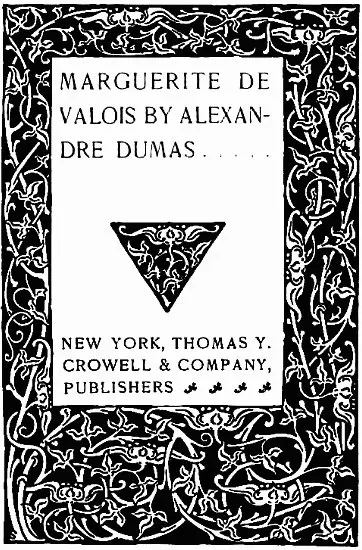
THE CLASSIC COLLECTION · 1900
"Marguerite de Valois" by Alexandre Dumas and Auguste Maquet is a historical novel written in 1845. Set during the French Wars of Religion in 1572 Paris, it follows Marguerite de Valois, daughter of Henry II, whose marriage to Protestant Prince Henri de Bourbon is meant to bring peace. But her mother, Catherine de Medici, schemes to orchestrate the St. Bartholomew's Day Massacre. As court intrigues multiply and poisonings follow, Margot begins a dangerous affair with the soldier La Môle while Catherine plots to secure power for her own son.
Introduction adapted from the source catalogue; source summaries may be automatically generated.
Free to read · English · 203,835 words · No account needed
MAKE TIME FOR A GOOD BOOK
On by default. Untick to stop anonymous reading totals. Each page counts after 10 seconds in view. How this works.
Anonymous counting is on unless you have switched it off.
"But," continued Henry, "the Huguenots are divided among themselves, and De Mouy, brave and loyal as he is, represents only one-half of the party. Now this other half, which is not to be scorned, has not given up the hope of having Henry of Navarre on the throne, who having hesitated at first may have reflected since."
"You think this?"
"Oh, every day I receive proofs of it. The troops which joined us at the hunt, did you notice of what men it was composed?"
"Yes, of converted gentlemen."
"Did you recognize the leader of the troop who signed to me?"
"Yes, it was the Vicomte de Turenne."
"Did you know what they wanted of me?"
"Yes, they proposed to you to escape."
"Then," said Henry to François, who was growing restless, "there is evidently a second party which wants something else besides what Monsieur de Mouy wants."
"A second party?"
"Yes, and a very powerful one, I tell you, so that in order to succeed it is necessary to unite the two--Turenne and De Mouy. The conspiracy progresses, the troops are ready, the signal alone is waited for. Now in this supreme situation, which demands prompt solution on my part, I have come to two decisions between which I am wavering. I have come to submit these decisions to you as to a friend."
"Say rather as to a brother."
"Yes, as to a brother," went on Henry.
"Speak, then, I am listening."
"In the first place I ought to explain to you the condition of my mind, my dear François. No desire, no ambition, no ability. I am an honest country gentleman, poor, sensual, and timid. The career of conspirator offers me indignities poorly compensated for even by the certain prospect of a crown."
"Ah, brother," said François, "you do wrong. Sad indeed is the position of a prince whose fortune is limited by the boundary of the paternal estate or by a man in a career for honors! I do not believe, therefore, in what you tell me."
"And yet what I tell you is so true, brother, that if I thought I had a true friend, I would resign in his favor the power which this party wishes to give me; but," he added with a sigh, "I have none."
"Perhaps you have. You probably are mistaken."
Your reading position is saved on this browser. Take it to another device with a library code. Reading pages adapt to text, rather than matching a printed edition.
Alexandre Dumas
Alexandre Dumas & Auguste Maquet
Alexandre Dumas
Alexandre Dumas
BEHIND THE BOOK
This eBook is for the use of anyone anywhere in the United States and most other parts of the world at no cost and with almost no restrictions whatsoever. You may copy it, give it away or re-use it under the terms of the Project Gutenberg License included with this eBook or online at www.gutenberg.org. If you are not located in the United States, you will have to check the laws of the country where you are located before using this eBook. Read the source licence.
The original source file, including credits and licence, is retained by this library. Request an original-format copy at no charge. Please include the book title and Project Gutenberg identifier #33609.
KEEP YOUR CURIOSITY GOING
Cécile Tormay

Moritz Busch
Coulson Kernahan
John L. Ransom

Maurice Baring
Frances Wright