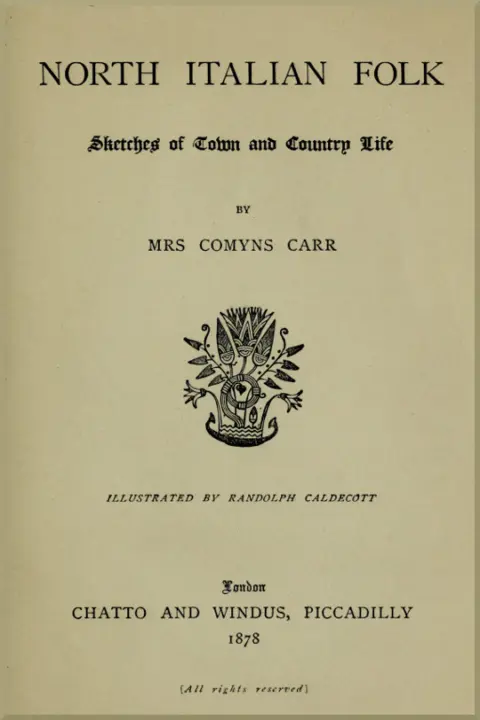
North Italian Folk: Sketches of Town and Country Life
Alice Vansittart Strettel Carr
THE CLASSIC COLLECTION · 1889
"Margaret Maliphant" by Mrs. Comyn Carr is a novel written in the late 19th century. The story centers on Margaret, a young woman navigating the complexities of her family's legacy and her sister Joyce's beauty in rural Sussex. The novel explores themes of family dynamics, social status, and the aspiration for upward mobility while focusing on the relationships between its characters, particularly the sisters and the gentleman interested in Joyce. The opening of "Margaret Maliphant" sets a vivid scene of the marshy landscape, introducing readers to the quieter life of the Maliphant family, who have lived at Knellestone Grange for generations. The narration unfolds through Margaret's perspective, shedding light on her strong connection to the land and her sister Joyce's delicate beauty, which captures the eye of Captain Forrester, a friend of Squire Broderick. As Margaret observes the interactions between her family, the squire, and their aspirations for marital happiness, the stage is set for tensions between tradition and ambition, as well as the roles expected of women in their society.
Introduction adapted from the source catalogue; source summaries may be automatically generated.
Free to read · English · 157,308 words · No account needed
MAKE TIME FOR A GOOD BOOK
On by default. Untick to stop anonymous reading totals. Each page counts after 10 seconds in view. How this works.
Anonymous counting is on unless you have switched it off.
There was something so much more romantic about a captain than about a plain mister. And such a captain! I had met captains before at the Volunteer ball, but not like this one. It did not occur to me for a moment that if the gentleman was a friend of the squire's he must needs belong to the class which I thought I abhorred, and therefore should not be a suitable lover for my sister. I was too much fascinated by the individual to remember the class. Joyce looked at me for help.
"I don't know what to say, I'm sure," murmured she.
The horse began to fidget again at being kept so long standing. There could be no possible objection to a friend of the squire's driving us over.
"Thank you," said I, trying to be cool and dignified and not at all eager. "If you would be so kind as to drive us, I shall be very much obliged to you." And turning to the shop-boy I added, "Put the parcel into the carriage."
I do not know what the captain must have thought of my sudden change of manner; I did not stop to consider. I jumped to the ground before he had time to help me, and began to let down the back seat of the cart.
"No, no; don't leave the horse," cried I, as he came round to the back to help me. "I know how to do this perfectly well. Do get up. Joyce is so very nervous."
"As you like," said he, still smiling; and he got up beside Joyce.
In a moment I had fixed the seat and jumped into it, and we started off at a smart trot down the village street. Joyce was not entirely reassured, although vanity prevented her from openly expressing her alarm, as she would have done if I had been at her side. She sat holding on to the cart, with lips parted and eyes fixed on the horse's ears. I had turned round a little on the seat so that I could see her, and I thought that she looked very lovely. I thought Captain Forrester must be of the same mind; but I think he had not much time to look at her just then--the mare kept his hands full. We rattled down the hill over the cobble-stones and out of the town. Soon its red roofs, crowned by the square tower of the ancient church at its summit, were only a feature in the landscape, which I watched gradually mellowing into the white background as I sat with my back to the others. Before long I was lost in one of what father would have called my brown studies, and quite forgot to notice whether the two in front of me were getting on well together or not. The vague dream that I had always had about my sister's future was beginning to take shape--it unrolled itself slowly before me in a sweet and delightful picture, to which the fair scene before me imparted life and brilliancy as the sense of it mingled imperceptibly with my thoughts. I had never known what it really was that I desired for my sister's lot. To be the wife of a country bumpkin she was far too beautiful; and yet I thought that nothing should have induced me to help towards mating her with one of the gentry who crushed the people's honest rights. Sir Walter Scott's "Fair Maid of Perth," which I had just finished reading, had lent wings to my youthful imagination; but there were no burghers in these days who held the honorable positions of those smiths and glovers, although no doubt at that time there had been many such living in the very town where we had just been to market, and which was in days of old one of the strongholds of his Majesty's realm. If there had been any such suitors, I think I would have given our "Fair Maid" to one of them; but there was all the difference between the man who owned the linen-draper's shop--even if he did not measure off yards of stuff behind the counter--and the man who fashioned the goods with his own hand and took a pride in making them beautiful. And nowadays there were no men who made armor--there were no men who needed it. War had become a very brutal thing compared to what it was then, when it really was a trial of individual strength; nevertheless, of the professions of which I knew anything, it was still to my mind the finest, and it seemed to me that a fine profession was the only thing between a countryman and a landed proprietor such as Squire Broderick. I wonder if I should have thought all this out so neatly if the fine, handsome, and gentlemanly young man who had come across our path had not borne the title of "Captain?" Anyway, it had struck my fancy, as he had struck my fancy--for Joyce.
Your reading position is saved on this browser. Take it to another device with a library code. Reading pages adapt to text, rather than matching a printed edition.
Alice Vansittart Strettel Carr
BEHIND THE BOOK
This eBook is for the use of anyone anywhere in the United States and most other parts of the world at no cost and with almost no restrictions whatsoever. You may copy it, give it away or re-use it under the terms of the Project Gutenberg License included with this eBook or online at www.gutenberg.org. If you are not located in the United States, you will have to check the laws of the country where you are located before using this eBook. Read the source licence.
The original source file, including credits and licence, is retained by this library. Request an original-format copy at no charge. Please include the book title and Project Gutenberg identifier #63202.
KEEP YOUR CURIOSITY GOING
Coulson Kernahan

Maurice Baring
Frances Wright
Cécile Tormay

Frederic Jesup Stimson

W. H. P. (William Henry Pope) Jarvis