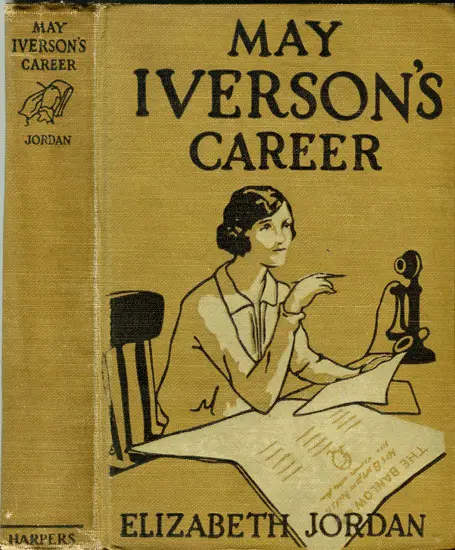
May Iverson’s Career
Elizabeth Garver Jordan
THE CLASSIC COLLECTION · 1908
"Many Kingdoms" by Elizabeth Garver Jordan is a novel likely written in the early 20th century. The story seems to revolve around the character Lawrence Varick, who experiences peculiar dreams that blur the line between reality and illusion, particularly with a mysterious woman he encounters in these dreams. The themes of love, dreams, and the search for connection appear to be central to the narrative. The opening of "Many Kingdoms" introduces Varick, a practical young man who is suddenly drawn into a vivid dream where he walks through a foreign village and meets a captivating woman. Their interactions are marked by confusion and intrigue as they navigate this surreal experience, with Varick grappling with the strange sensations and emotions that arise from their connection. Eventually, he awakens, left pondering the nature of his dream and the feeling of longing for the woman he encountered. This blend of fantasy and emotional depth sets the stage for a deeper exploration of Varick's inner world and the mysteries of love and dreams throughout the novel.
Introduction adapted from the source catalogue; source summaries may be automatically generated.
Free to read · English · 60,709 words · No account needed
MAKE TIME FOR A GOOD BOOK
On by default. Untick to stop anonymous reading totals. Each page counts after 10 seconds in view. How this works.
Anonymous counting is on unless you have switched it off.
"She--why, she's the girl I play with! Everybody knows Lily Bell!"
"Oh!"
Some of the brightness was gone from the eager face.
"Will she like me?" she asked, at last.
"I don't know--I guess--p'r'aps so."
"Will I like her?"
"I don't know. You can't see her, you know."
"Can't see her? Why can't I see her? Doesn't she come here, ever?"
"Oh yes, she's here all the time, but--" The boy squirmed. For the first time in his short life he was--was he--ashamed of Lily Bell? No; not that. Never that! He held his small head high, and his lips set; but he was a boy, after all, and his voice, to cover the embarrassment, took on a tone of lofty superiority.
"Nobody ever does see her but me," he asserted. "They'd like to, but
they don't."
"Why don't they?"
Verily, this was a persistent child. The boy was in for complete
surrender, and he made it.
"She ain't a little girl like you," he explained, briefly. "She doesn't have any home, and I don't know where she comes from--heaven, maybe," he hazarded, desperately, as a sort of "When in doubt, play trumps." "But she comes, an' no one but me sees her, an' we play."
"Huh!" This without enthusiasm from Margaret Hamilton Perry. She eyed him remotely for a moment. Then, with an effort at understanding, she spoke again.
"I shouldn't think that would be very much fun," she said, candidly. "Just pretendin' there's a little girl when there ain't! I should think it would be lots nicer--" She hesitated, a sense of delicacy restraining her from making the point she so obviously had in mind.
"Anyhow," she added, handsomely, "I'll like her an' play with her if
you do."
Raymond Mortimer was relieved but doubtful. Memories of the extreme contrariness of Lily Bell on occasion overcame him.
"If she'll let you," he repeated, doggedly.
Margaret Hamilton stared at him and her eyes grew big.
"Won't you let me, if she doesn't?" she gasped. "Why--why--" The situation overcame her. The big, brown eyes filled suddenly. A small gingham back rippling with fat sobs was presented to Raymond Mortimer. In him was born immediately man's antipathy to woman's tears.
"Oh, say," he begged, "don't cry; please don't." He approached the gingham back and touched it tentatively. "She will let you play with us," he urged. And then, moved to entire recklessness as the sobs continued, "I'll make her!" he promised. The gingham back stopped heaving; a wet face was turned toward him, and a rainbow arched their little heaven as Margaret Hamilton smiled. Her first triumph was complete.
Your reading position is saved on this browser. Take it to another device with a library code. Reading pages adapt to text, rather than matching a printed edition.
Elizabeth Garver Jordan
Anna Howard Shaw & Elizabeth Garver Jordan
BEHIND THE BOOK
This eBook is for the use of anyone anywhere in the United States and most other parts of the world at no cost and with almost no restrictions whatsoever. You may copy it, give it away or re-use it under the terms of the Project Gutenberg License included with this eBook or online at www.gutenberg.org. If you are not located in the United States, you will have to check the laws of the country where you are located before using this eBook. Read the source licence.
The original source file, including credits and licence, is retained by this library. Request an original-format copy at no charge. Please include the book title and Project Gutenberg identifier #5953.
KEEP YOUR CURIOSITY GOING
Coulson Kernahan

Maurice Baring
Frances Wright
Cécile Tormay

Frederic Jesup Stimson

W. H. P. (William Henry Pope) Jarvis