THE CLASSIC COLLECTION✦An outlaw’s diary: the CommuneCLASSIC FREE BOOKS
An outlaw’s diary: the Commune
Cécile Tormay
THE CLASSIC COLLECTION · 1889
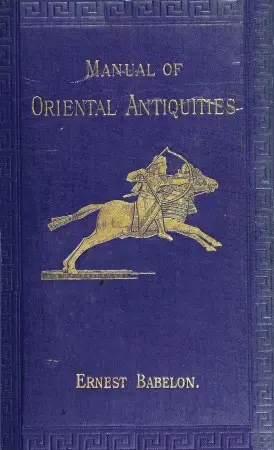
"Manual of Oriental Antiquities" by Ernest Babelon is a scholarly work focusing on historical and artistic analyses of ancient Eastern civilizations, drafted in the early 20th century. It comprehensively covers the architecture, sculpture, and various arts of cultures such as Chaldæa, Assyria, Persia, and others until reaching the influence of Greek civilization. The book aims to unravel the connections and unique characteristics of these rich cultures while highlighting recent archaeological discoveries. The opening of this manual introduces readers to the rich tapestry of ancient civilizations in the Near East, excluding Egypt, that once thrived long before the influence of Greece and Rome. Babelon emphasizes the artistic genius of these civilizations, declaring that what we call “Persian art” or “Jewish art” fundamentally draws from Chaldæo-Assyrian and Egyptian roots. The text reveals exciting archaeological findings from sites such as Tello, which have contributed significantly to our understanding of ancient architecture and sculpture, laying the groundwork for a broader discussion of art forms, materials, and techniques used by these remarkable societies.
Introduction adapted from the source catalogue; source summaries may be automatically generated.
Free to read · English · 81,642 words · No account needed
MAKE TIME FOR A GOOD BOOK
On by default. Untick to stop anonymous reading totals. Each page counts after 10 seconds in view. How this works.
Anonymous counting is on unless you have switched it off.
Two horns made of alabaster, bearing inscriptions in the name of this prince, must have belonged to an enormous bull’s head.[113] There are numbers of objects of a votive character, which appear to have been thrown in quantities into the foundations of the temple of Shushinak. Griffins’ heads in gold, animals’ heads in pottery, lions carved in agate in the round, bulls’ heads in lapis, pendants in carnelian mounted in gold, sheets of gold with Anzanite inscriptions. There is ample space in this new field of archæology for studying these objects, for classifying and comparing them, and drawing from them all the information that can be afforded by their examination.
Want of space forbids our dwelling longer on this subject, and for the same reason we will say nothing about the numerous monuments of the period of the Persian Achæmenids, nor with yet stronger reason, of the time of the Parthians, Arsacids, and Sassanians, which does not enter into the scheme of our present volume. And yet, in bringing this rapid sketch to a conclusion, we will remark that, of all the discoveries made by M. de Morgan, that which is perhaps most admired by the public is the gold jewellery, set with precious stones, which came from the tomb of a woman of the period of the Persian Achæmenids. It is advisable to compare it from a technical point of view with the more ancient jewellery of the Elamite period.
These bracelets, pendants, and gold beads, these multiple rows of the richest necklaces, bear witness to the extraordinary luxury of the courts of Darius and Xerxes, and may well dazzle us. Noticeable among these treasures are pendants formed of minute gold curls, in imitation of the curled and wavy manes of lions. Here I believe we find an artistic innovation of striking originality in a form of art bound by conventions and traditions.
The setting of the gems in gold mounts of marvellous delicacy has not in any civilisation attained a higher level than in Achæmenian Susa. It is necessary to use a magnifying glass to examine this minute and delicate work. Here is the perfection of the goldsmith’s art, and these Persian jewels of the fifth century B.C. now form a preponderant and essential factor in the question round which so much controversy rages, of the origin of cloisonné jewellery.
Absalom, Tomb of, 234.
Abu Habbah, 2, 12, 42.
Abu Shahrein, 2, 3, 10, 18, 73, 76.
Achæmenid dynasty,
Palaces of, 56, 118, 147 ff.
jewellery, 337.
Addume, 294.
“Æginetan smile,” 273.
Afaj, 36.
Agade, 47, 308, 319, 320.
Ahasuerus, 139.
Ahura-mazda, 165, 166, 172, 179.
Ain el-Hayât, 240.
Alabaster,--
thresholds of, 17.
statuette of, 42.
uses of, in Assyrian architecture, 85.
Phœnician mortuary vases of, 259.
vases, 307, 335.
beads, 336.
horns, 336.
Ala-Safat, 230.
Alexander the Great, 312.
Your reading position is saved on this browser. Take it to another device with a library code. Reading pages adapt to text, rather than matching a printed edition.
BEHIND THE BOOK
This eBook is for the use of anyone anywhere in the United States and most other parts of the world at no cost and with almost no restrictions whatsoever. You may copy it, give it away or re-use it under the terms of the Project Gutenberg License included with this eBook or online at www.gutenberg.org. If you are not located in the United States, you will have to check the laws of the country where you are located before using this eBook. Read the source licence.
The original source file, including credits and licence, is retained by this library. Request an original-format copy at no charge. Please include the book title and Project Gutenberg identifier #50626.
KEEP YOUR CURIOSITY GOING
Cécile Tormay

Moritz Busch
John L. Ransom
Frances Wright
Cécile Tormay

Mabel Potter Daggett