THE CLASSIC COLLECTION✦An outlaw’s diary: the CommuneCLASSIC FREE BOOKS
An outlaw’s diary: the Commune
Cécile Tormay
THE CLASSIC COLLECTION · 1889
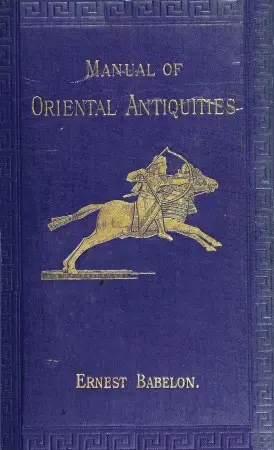
"Manual of Oriental Antiquities" by Ernest Babelon is a scholarly work focusing on historical and artistic analyses of ancient Eastern civilizations, drafted in the early 20th century. It comprehensively covers the architecture, sculpture, and various arts of cultures such as Chaldæa, Assyria, Persia, and others until reaching the influence of Greek civilization. The book aims to unravel the connections and unique characteristics of these rich cultures while highlighting recent archaeological discoveries. The opening of this manual introduces readers to the rich tapestry of ancient civilizations in the Near East, excluding Egypt, that once thrived long before the influence of Greece and Rome. Babelon emphasizes the artistic genius of these civilizations, declaring that what we call “Persian art” or “Jewish art” fundamentally draws from Chaldæo-Assyrian and Egyptian roots. The text reveals exciting archaeological findings from sites such as Tello, which have contributed significantly to our understanding of ancient architecture and sculpture, laying the groundwork for a broader discussion of art forms, materials, and techniques used by these remarkable societies.
Introduction adapted from the source catalogue; source summaries may be automatically generated.
Free to read · English · 81,642 words · No account needed
MAKE TIME FOR A GOOD BOOK
On by default. Untick to stop anonymous reading totals. Each page counts after 10 seconds in view. How this works.
Anonymous counting is on unless you have switched it off.
This gigantic basin was fixed and immovable; for the purpose of drawing water, wheeled basins had been constructed, ten in number, also of bronze, into which the water intended for ceremonial purposes was poured. Each had four wheels, like a chariot; the wheels supported a square box, above which was placed the cylindrical basin, large enough to contain from 150 to 170 gallons. The walls of the receptacle and of the box which supported it were decorated with palms, colocynths, oxen and winged lions in relief.
Such were the principal features of the temple furniture; smaller utensils, knives, pincers, tongs, dishes, are scarcely known to us. An exact idea of them can, however, be formed by an examination of the products of Egyptian and Assyrian industry, especially of the dishes, vases, and utensils found among the substructures of the Phœnician temples in the island of Cyprus.
Various passages in the Bible enumerate the ornaments of the priests, such as the ephod, which, in certain cases, signifies the liturgical vestment; in others a sort of sacred casket, containing two talismanic cubes, called urim and thummim. The priestly costume of Aaron is an embroidered garment in which gems are set, according to the Book of Exodus. As early as the period of Genesis, we see the children of Israel making use of seals of precious stone, precisely as their neighbours the Egyptians and Chaldæans did. A certain number of gems carved in intaglio have come down to us which bear names apparently Jewish: Shebaniah, Nathanyahu, Hananyahu, Obadyahu. These seals for the most part only bear the name of their possessor; they have neither ornament nor symbol.
The temple of Jerusalem, in which the national life of the Jews was concentrated, was also, as we have said, the summary of their art and industry. In vain have many archæologists, during the last sixty years, made efforts to discover in Palestine, or in the other regions of southern Syria, and even in the heart of Arabia, traces of an art which might have flourished in these regions before the arrival of the Greeks and Romans. Travellers have indeed observed at Ala-Safat, at Jebel-Musa, in the land of Moab, on the Bahr-el-Huleh in Galilee, near Hesban, and in many other places, dolmens and upright stones, analogous to those in Africa, in Brittany, and on Salisbury Plain, and remains of walls of Cyclopean masonry, no doubt built by those giants, the Rephaim and the Anakim, who, as the Bible tells us, were the first inhabitants of these regions. Certain circles of great blocks, like those of Minyeh and Deir Ghuzaleh in the land of Moab, may have marked the bounds of sacred enclosures, temples in the open air, that is to say, of those bâmoth, or “high places” of which the Scriptures so often speak. But these barbaric remains, like the borders of certain wells at which, perhaps, the flocks of the patriarchs slaked their thirst, have little interest for the history of art. No idea can be formed of civil architecture except by imaginary restorations. Solomon’s palace, which communicated with the temple and was situated to the south, upon Ophel, was demolished and rebuilt twenty times with incessant modifications, until its final ruin. The principal building, standing in the middle of a spacious court, enclosed by supporting walls which bounded the hill like the temple-enclosure, was called the House of Lebanon, after the place whence the timber was brought of which it was partly constructed. It was 100 cubits long, 50 broad and 30 high; its walls were built of large blocks; forty-five cedar columns were counted in it, divided into three rows, and supporting architraves of the same sweet-smelling wood.[89] This edifice was used as an arsenal: like the monarchs of Nineveh, the kings of Judah had a magazine of weapons in their palace.
Your reading position is saved on this browser. Take it to another device with a library code. Reading pages adapt to text, rather than matching a printed edition.
BEHIND THE BOOK
This eBook is for the use of anyone anywhere in the United States and most other parts of the world at no cost and with almost no restrictions whatsoever. You may copy it, give it away or re-use it under the terms of the Project Gutenberg License included with this eBook or online at www.gutenberg.org. If you are not located in the United States, you will have to check the laws of the country where you are located before using this eBook. Read the source licence.
The original source file, including credits and licence, is retained by this library. Request an original-format copy at no charge. Please include the book title and Project Gutenberg identifier #50626.
KEEP YOUR CURIOSITY GOING
Cécile Tormay

Moritz Busch
John L. Ransom
Frances Wright
Cécile Tormay

Mabel Potter Daggett