THE CLASSIC COLLECTION✦The sprightly romance of MarsacCLASSIC FREE BOOKS
The sprightly romance of Marsac
Molly Elliot Seawell
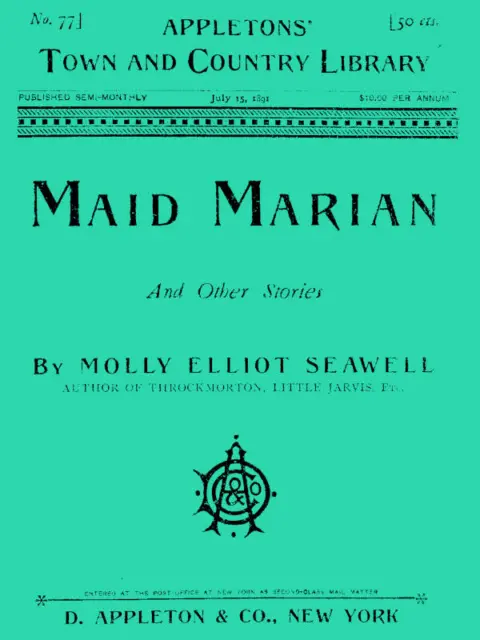
THE CLASSIC COLLECTION · 1891
"Maid Marian and Other Stories" by Molly Elliot Seawell is a collection of short stories written in the late 19th century. The narrative focuses on various characters and their adventures, with the titular character, Maid Marian, being a central figure whose charm and grace captivate those around her. This work presents a blend of romanticism and humor, illustrating the social dynamics of the time and the interplay between nobility and commoners. The opening of the first story introduces a character named Macfarren, a New York lawyer, who becomes enchanted by a portrait of Lady Marian, which he has displayed in his modest hotel room. The portrait seems to bring her to life, leading to a fantastical encounter where Lady Marian appears before him, seemingly unaware of her transition from a painted figure to a living person. The ensuing dialogue between Macfarren and Marian reveals both her enchanting nature and his humorous attempts to navigate the unexpected situation. This charming start sets the tone for the whimsical and romantic stories to follow, inviting readers into a world of imagination and social commentary.
Introduction adapted from the source catalogue; source summaries may be automatically generated.
Free to read · English · 60,913 words · No account needed
MAKE TIME FOR A GOOD BOOK
On by default. Untick to stop anonymous reading totals. Each page counts after 10 seconds in view. How this works.
Anonymous counting is on unless you have switched it off.
"What! dost thou lay fine cloths upon the floor instead of rushes? I would like to have a gown of this rich stuff when I go to court. Canst thou not buy me enough for a train, or even a petticoat?"
"Certainly, with pleasure," said Macfarren.
"But will it not cost a prince's ransom?" cried Marian, anxiously, stooping down and picking up a small rug that lay before the door. "Think how my lady Stukely would fume if she saw me with a petticoat of this queenly stuff."
She held the rug up before her in admiration, but, as if suddenly ashamed of her childishness, dropped it and walked rapidly down the corridor, Macfarren keeping at her side. Macfarren knew but little of the dress of women, and, having seen many startling costumes in New York society of late years, flattered himself that his companion's guise was not much out of the ordinary run. But his illusion vanished when Mrs. Dietrick Van Tromp swept out, gorgeous in dinner-dress, from a door opening on the corridor. He saw at once that she was stricken with surprise, and, as she bowed to him, her eyes asked, expressively:
"Who is she?"
Nor was Marian one whit less impressed with the descendant of the Knickerbockers. She gave one comprehensive glance of admiration, and whispered hurriedly to Macfarren:
"What noble dame is that?"
Macfarren felt a certain malicious pleasure as he answered, sotto
voce:
"That is Mrs. Dietrick Van Tromp, the lady who I suggested should
attend you to the table."
Marian's countenance changed to one of angry and amazed disgust.
"If mercers' wives dress thus, how can they be told from queens and princesses?" she inquired, haughtily.
"They can't," responded Macfarren, "except that queens and princesses are usually much less toploftical."
"But," demanded Marian, "are there not sumptuary laws that forbid the daughters of tradesmen and merchants from wearing stuffs reserved for the nobility and gentry?"
"There has been a very strong effort to pass sumptuary laws in Ohio and Georgia and Maine and Kansas, but they have generally proved inoperative," answered Macfarren. Seeing, however, his companion's puzzled look, he hastened forward and said, "Ah! there is the elevator."
Mrs. Van Tromp had preceded them, and stood by the door. As Marian and Macfarren approached, the former gave her a look of unmistakable disdain, which, to Macfarren's horror, was supplemented by a command given in a clear and self-possessed voice:
"Give place, madam."
Mrs. Van Tromp made no reply, but glanced, stupefied for a moment, at Macfarren, who turned pale and then red. A flush rose to her face, and, without replying, she turned half around from Marian and rang the bell again.
Your reading position is saved on this browser. Take it to another device with a library code. Reading pages adapt to text, rather than matching a printed edition.
Molly Elliot Seawell
Molly Elliot Seawell
Molly Elliot Seawell
Molly Elliot Seawell
BEHIND THE BOOK
This eBook is for the use of anyone anywhere in the United States and most other parts of the world at no cost and with almost no restrictions whatsoever. You may copy it, give it away or re-use it under the terms of the Project Gutenberg License included with this eBook or online at www.gutenberg.org. If you are not located in the United States, you will have to check the laws of the country where you are located before using this eBook. Read the source licence.
The original source file, including credits and licence, is retained by this library. Request an original-format copy at no charge. Please include the book title and Project Gutenberg identifier #61194.
KEEP YOUR CURIOSITY GOING
Coulson Kernahan

Maurice Baring
Frances Wright
Cécile Tormay

Frederic Jesup Stimson

W. H. P. (William Henry Pope) Jarvis