
Last letters from the living dead man
David Patterson (Spirit) Hatch
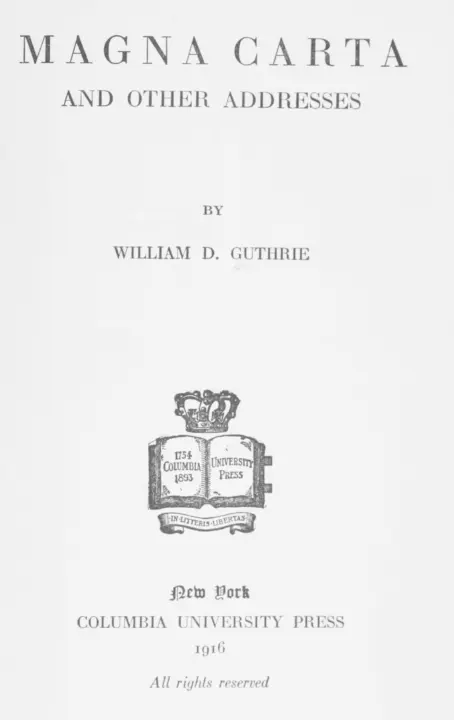
THE CLASSIC COLLECTION · 1916
"Magna Carta and Other Addresses" by William D. Guthrie is a collection of historical and legal addresses written in the early 20th century. The work primarily focuses on foundational documents of American democracy, such as the Magna Carta and the Mayflower Compact, examining their influences on civil liberties and constitutional principles in the United States. The addresses reflect on the significance of these historic milestones in the context of contemporary governance and law. The opening of the book begins with an address commemorating the 700th anniversary of the Magna Carta, delivered at a New York Constitutional Convention. Guthrie highlights the Great Charter's profound legacy in safeguarding individual liberties and establishing the rule of law against tyranny. He discusses how the Magna Carta provided essential principles regarding governance and justice which resonate through subsequent American constitutional developments. The address emphasizes the importance of these historical documents in nurturing a commitment to civil rights, alongside a cautionary note on the need for vigilance in preserving these hard-won freedoms in the face of contemporary legal challenges.
Introduction adapted from the source catalogue; source summaries may be automatically generated.
Free to read · English · 71,269 words · No account needed
MAKE TIME FOR A GOOD BOOK
On by default. Untick to stop anonymous reading totals. Each page counts after 10 seconds in view. How this works.
Anonymous counting is on unless you have switched it off.
Assaults upon our judiciary and unwarranted and unjust criticism of our judges undermine the people's trust in the courts and threaten the whole structure of our civilization. The United States judges are justly sensitive to public opinion and distressed by unjust and ignorant criticism. They know how important it is that they should retain public confidence. They realize, as their opinions constantly show, that "next to doing right, the great object in the administration of public justice should be to give public satisfaction." But they cannot sacrifice truth to popularity, the Constitution to present expediency. Those who assail the federal judges should bear in mind that the founders in their wisdom constituted the judicial power our bulwark against unadvised, hasty and tyrannical action on the part of those in power and our shield against "those sudden and strong passions to which we are exposed," and which, if unchecked and unrestrained, may lead to ruin. However unpopular and disagreeable the task may be of setting aside an act of Congress or of a state legislature, however painful it must be to any just man to become the subject of calumny, a federal judge has no choice, no discretion, no will of his own, but must hear and decide according to his conscience every case submitted to him within the jurisdiction of his court as conferred and imposed by the Constitution and laws of the United States. Let us always bear in mind the lofty words of the great Chief Justice in the case of Aaron Burr, in the decision which excited so much public prejudice and clamor one hundred years ago, when, speaking of the duty of a judge, he said: "If he has no choice in the case; if there is no alternative presented to him but a dereliction of duty, or the opprobrium of those who are denominated the world, he merits the contempt as well as the indignation of his country who can hesitate which to embrace."[49]
[Footnote 23: Address before the New York State Bar Association at its thirty-first annual meeting held in New York, January 25, 1908.]
[Footnote 24: 2 Dallas' Reports, p. 419.]
[Footnote 25: 6 Wheaton's Reports, pp. 406-407.]
[Footnote 26: 134 United States Reports, pp. 1, 22.]
[Footnote 27: 108 United States Reports, p. 447.]
[Footnote 28: 200 United States Reports, pp. 283, 284.]
[Footnote 29: 1 Cranch's Reports, p. 163.]
[Footnote 30: 11 Wallace's Reports, p. 183.]
[Footnote 31: 16 Wallace's Reports, p. 156.]
[Footnote 32: 106 United States Reports, p. 205.]
[Footnote 33: 101 United States Reports, p. 343.]
[Footnote 34: The Law of the Constitution, 8th ed., p. 189.]
[Footnote 35: Reported by Hargrave, 19 Howell's State Trials, pp. 1030,
1073.]
[Footnote 36: 6 Best and Smith's Queen's Bench Reports (1865), p. 297.]
[Footnote 37: Reported in 14 Howell's State Trials, pp. 1-114.]
[Footnote 38: 188 United States Reports, p. 543.]
[Footnote 39: 114 United States Reports, p. 270.]
[Footnote 40: 9 Wheaton's Reports, p. 738.]
[Footnote 41: 16 Wallace's Reports, p. 220.]
Your reading position is saved on this browser. Take it to another device with a library code. Reading pages adapt to text, rather than matching a printed edition.
BEHIND THE BOOK
This eBook is for the use of anyone anywhere in the United States and most other parts of the world at no cost and with almost no restrictions whatsoever. You may copy it, give it away or re-use it under the terms of the Project Gutenberg License included with this eBook or online at www.gutenberg.org. If you are not located in the United States, you will have to check the laws of the country where you are located before using this eBook. Read the source licence.
The original source file, including credits and licence, is retained by this library. Request an original-format copy at no charge. Please include the book title and Project Gutenberg identifier #64197.
KEEP YOUR CURIOSITY GOING
David Patterson (Spirit) Hatch

David Patterson (Spirit) Hatch

David Patterson (Spirit) Hatch
Cécile Tormay

Moritz Busch
John L. Ransom