
Last letters from the living dead man
David Patterson (Spirit) Hatch
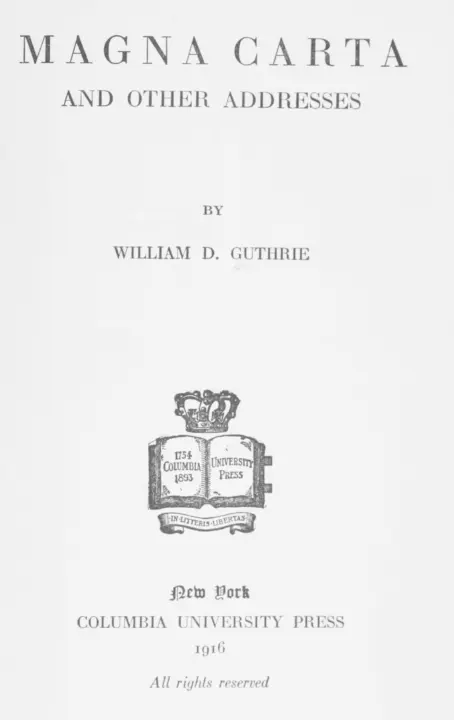
THE CLASSIC COLLECTION · 1916
"Magna Carta and Other Addresses" by William D. Guthrie is a collection of historical and legal addresses written in the early 20th century. The work primarily focuses on foundational documents of American democracy, such as the Magna Carta and the Mayflower Compact, examining their influences on civil liberties and constitutional principles in the United States. The addresses reflect on the significance of these historic milestones in the context of contemporary governance and law. The opening of the book begins with an address commemorating the 700th anniversary of the Magna Carta, delivered at a New York Constitutional Convention. Guthrie highlights the Great Charter's profound legacy in safeguarding individual liberties and establishing the rule of law against tyranny. He discusses how the Magna Carta provided essential principles regarding governance and justice which resonate through subsequent American constitutional developments. The address emphasizes the importance of these historical documents in nurturing a commitment to civil rights, alongside a cautionary note on the need for vigilance in preserving these hard-won freedoms in the face of contemporary legal challenges.
Introduction adapted from the source catalogue; source summaries may be automatically generated.
Free to read · English · 71,269 words · No account needed
MAKE TIME FOR A GOOD BOOK
On by default. Untick to stop anonymous reading totals. Each page counts after 10 seconds in view. How this works.
Anonymous counting is on unless you have switched it off.
The case in the New York courts which probably is being more criticized and misrepresented than any other is known as the Tenement House Tobacco case (Matter of Jacobs),[12] decided in January, 1885. The courts then held unconstitutional an act which forbade the manufacture of tobacco products in certain tenement houses in New York and Brooklyn, because the statute unwarrantably and unreasonably interfered with the liberty of the individual. The enactment was an attempt on the part of the owners of large tobacco factories to destroy the competition of cigar manufacturers who worked at home. It was not an honest health measure at all; it was not in fact designed to protect the health of tobacco workers, and it did not contain a single provision tending in any degree to secure sanitary conditions of work or living. Not one word in the opinions of the courts in the Jacobs case prevented the legislature from adopting regulations to secure wholesome conditions in the manufacture of any article. Since that decision, the New York constitution has been carefully revised by a constitutional convention in 1894, and in addition has been repeatedly amended, no less than nineteen separate amendments having been adopted by the people, whilst a large number of additional proposed amendments have been rejected. But in neither the revision nor in any of the amendments, whether adopted or rejected, was any change suggested in the rule of constitutional law declared in the Tenement House case, although the subject was directly called to the attention of the convention. For more than a quarter of a century, the people of the state of New York have acquiesced in the decision of the Court of Appeals as fair, just and satisfactory.
Jacobs with his wife and two children lived in a tenement house in the city of New York and occupied an apartment of seven rooms in a building where there were only three other apartments, all of equal size. In this apartment he carried on the trade of manufacturing cigars, and the rooms in which he did so were separated from the sleeping and cooking-rooms. The testimony showed that there was no odor of tobacco in these sleeping and cooking-rooms. The conditions under which he was carrying on his trade in his own home for the support of himself and his family were much more healthful than if he and his assistants had been compelled to work in a crowded factory, particularly in 1884, when there were no such sanitary conditions in factories as now prevail under the beneficent operation of our present public health and labor laws. It was shown that, when this legislation was enacted, 840,000,000 cigars were being manufactured annually in the city of New York, of which about 370,000,000, or 44 per cent., were made in the homes of dwellers in tenement or apartment houses, and that about two thousand artisans were supporting themselves and their families by thus working at home. The board of health of the city of New York had officially declared, after careful investigation, as set forth in the brief of Mr. Evarts, then the leader of the American bar, "that the health of the tenement-house population is not jeopardized by the manufacture of cigars in those houses; that this bill is not a sanitary measure, and that it has not been approved by this board." It also appeared from this brief that while the death-rate in the city of New York generally was 31 in each 1,000, it was only 9 in each 1,000 in the tenement houses where cigars were being manufactured. The act, if valid and enforceable, would have crushed the competition of home workers with the tobacco factories; it would have deprived the tenement-house dweller of the liberty to exercise his trade of cigar-making at home even under the most sanitary conditions, and it would have driven every such workman and the working members of his family into crowded and generally unhealthful factories, to be harassed and oppressed by strikes and lockouts and the other troubles which attend modern labor conditions, to say nothing of being exposed to all the mischiefs, physical and moral, that are inseparable from crowded workshops. The court held that the statute was not a legitimate health regulation and released Jacobs from imprisonment. The principle of constitutional law recognized and applied was that an individual cannot be made a criminal for working at a lawful trade in his own home under sanitary conditions, and cannot be compelled by discriminatory legislation to labor in a crowded factory. If the provisions of the act had not been declared to be in conflict with the constitutional guaranty of personal liberty, similar statutes could have been passed with respect to all kinds of home work, and all artisans, whether men or women, could have been driven into factories at the dictation of factory owners or trade-unions having sufficient political influence to secure the necessary legislation.
Your reading position is saved on this browser. Take it to another device with a library code. Reading pages adapt to text, rather than matching a printed edition.
BEHIND THE BOOK
This eBook is for the use of anyone anywhere in the United States and most other parts of the world at no cost and with almost no restrictions whatsoever. You may copy it, give it away or re-use it under the terms of the Project Gutenberg License included with this eBook or online at www.gutenberg.org. If you are not located in the United States, you will have to check the laws of the country where you are located before using this eBook. Read the source licence.
The original source file, including credits and licence, is retained by this library. Request an original-format copy at no charge. Please include the book title and Project Gutenberg identifier #64197.
KEEP YOUR CURIOSITY GOING
David Patterson (Spirit) Hatch

David Patterson (Spirit) Hatch

David Patterson (Spirit) Hatch
Cécile Tormay

Moritz Busch
John L. Ransom