
Last letters from the living dead man
David Patterson (Spirit) Hatch
THE CLASSIC COLLECTION · 1916
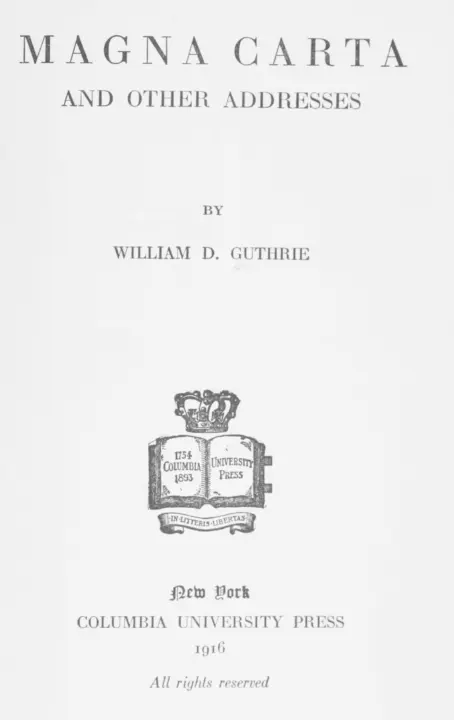
"Magna Carta and Other Addresses" by William D. Guthrie is a collection of historical and legal addresses written in the early 20th century. The work primarily focuses on foundational documents of American democracy, such as the Magna Carta and the Mayflower Compact, examining their influences on civil liberties and constitutional principles in the United States. The addresses reflect on the significance of these historic milestones in the context of contemporary governance and law. The opening of the book begins with an address commemorating the 700th anniversary of the Magna Carta, delivered at a New York Constitutional Convention. Guthrie highlights the Great Charter's profound legacy in safeguarding individual liberties and establishing the rule of law against tyranny. He discusses how the Magna Carta provided essential principles regarding governance and justice which resonate through subsequent American constitutional developments. The address emphasizes the importance of these historical documents in nurturing a commitment to civil rights, alongside a cautionary note on the need for vigilance in preserving these hard-won freedoms in the face of contemporary legal challenges.
Introduction adapted from the source catalogue; source summaries may be automatically generated.
Free to read · English · 71,269 words · No account needed
MAKE TIME FOR A GOOD BOOK
On by default. Untick to stop anonymous reading totals. Each page counts after 10 seconds in view. How this works.
Anonymous counting is on unless you have switched it off.
In this crisis, the greatest in our national affairs since 1861, I hope we shall profit by the example of the founders of Plymouth, who, as Palfrey wrote, "gave diligent heed to arrangements for the military defence of the colony." It may be also that Providence will give us, in the descendant of a Pilgrim, the captain who shall be both our shield and our weapon as Myles Standish was the shield and the weapon of your ancestors.
[Footnote 5: Remarks responding to the toast, "The Mayflower Compact," at the twenty-first annual banquet of the Society of Mayflower Descendants in the State of New York, held at the Hotel St. Regis, New York, November 23, 1915.]
[Footnote 6: Lafcadio Hearn, Kokoro, pp. 289-290.]
[Footnote 7: The original manuscript of the Mayflower Compact has been lost or destroyed. The text, as preserved by Governor Bradford in his annals entitled "Of Plimoth Plantation," is as follows:
"In ye name of God, Amen. We whose names are under-writen, the loyall subjects of our dread soveraigne Lord, King James, by ye grace of God, of Great Britaine, Franc, & Ireland king, defender of ye faith, &c., haveing undertaken, for ye glorie of God, and advancemente of ye Christian faith, and honour of our king & countrie, a voyage to plant ye first colonie in ye Northerne parts of Virginia, doe by those presents solemnly & mutualy in ye presence of God, and one of another, covenant & combine our selves togeather into a civill body politick, for our better ordering & preservation & furtherance of ye ends aforesaid; and by vertue hearof to enacte, constitute, and frame such just & equall lawes, ordinances, acts, constitutions, & offices, from time to time, as shall be thought most meete & convenient for ye generall good of ye Colonie, unto which we promise all due submission and obedience. In witnes wherof we have hereunder subscribed our names at Cap-Codd ye 11. of November, in ye year of ye raigne of our soveraigne lord, King James, of England, France, & Ireland ye eighteenth, and of Scotland ye fiftie fourth. Ano: Dom. 1620." Printed in the Collections of the Massachusetts Historical Society, 4th series, vol. III, pp. 89-90. See also the text in Bradford's History of Plymouth Plantation, ed. W.T. Davis (1908), p. 107.]
[Footnote 8: The legislation against the Quakers as enforced in the Plymouth colony seems to have been essentially political. The records, so far as we have them, indicate that the Quakers were proceeded against because of their attempts to disturb the peace and overthrow established law and order, and not because of their religious beliefs.]
[Footnote 9: Collections of the Massachusetts Historical Society, 4th series, vol. III, pp. 134-136.]
Your reading position is saved on this browser. Take it to another device with a library code. Reading pages adapt to text, rather than matching a printed edition.
BEHIND THE BOOK
This eBook is for the use of anyone anywhere in the United States and most other parts of the world at no cost and with almost no restrictions whatsoever. You may copy it, give it away or re-use it under the terms of the Project Gutenberg License included with this eBook or online at www.gutenberg.org. If you are not located in the United States, you will have to check the laws of the country where you are located before using this eBook. Read the source licence.
The original source file, including credits and licence, is retained by this library. Request an original-format copy at no charge. Please include the book title and Project Gutenberg identifier #64197.
KEEP YOUR CURIOSITY GOING
David Patterson (Spirit) Hatch

David Patterson (Spirit) Hatch

David Patterson (Spirit) Hatch
Cécile Tormay

Moritz Busch
John L. Ransom