THE CLASSIC COLLECTION✦An outlaw’s diary: the CommuneCLASSIC FREE BOOKS
An outlaw’s diary: the Commune
Cécile Tormay
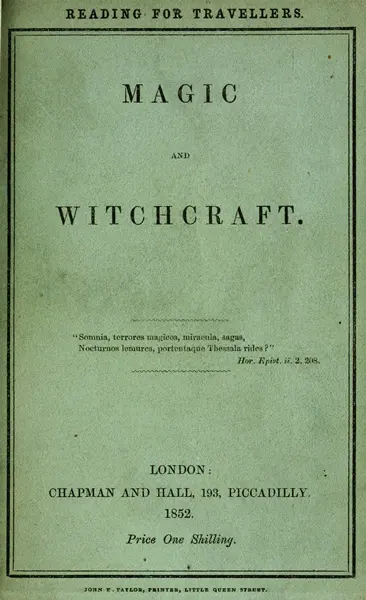
THE CLASSIC COLLECTION · 1852
"Magic and Witchcraft" by George Moir is a historical account written in the mid-19th century. The work delves into the history of magic and witchcraft, exploring their evolution and impact on human thought and society. Through a blend of scholarly insight and historical narratives, the text aims to uncover the origins and consequences of these beliefs, tracing their evolution across various cultures and epochs. The opening of the book presents a preface outlining the author's intention to compile a thorough investigation into the subjects of magic and witchcraft. It expresses the need for a comprehensive history that reflects human belief systems, particularly focusing on the darker aspects of superstition and the societal delusions it spurred. Moir argues that magic often emerges from profound truths twisted into falsehoods and gets interwoven with humanity’s enduring quest for power over nature and the divine. The tone is reflective and analytical, setting the stage for a discussion on the universality of these beliefs and their consequences throughout history, laying the groundwork for specific examples and cases that would be explored later in the text.
Introduction adapted from the source catalogue; source summaries may be automatically generated.
Free to read · English · 26,919 words · No account needed
MAKE TIME FOR A GOOD BOOK
On by default. Untick to stop anonymous reading totals. Each page counts after 10 seconds in view. How this works.
Anonymous counting is on unless you have switched it off.
The lingering belief in the old religion, and in the magical and thaumaturgical practices which had, like ivy around an oak, gradually accrued to it, was productive in the decline of Paganism of many poetical forms of superstition. It is curious and instructive to remark the increasing earnestness with which the decaying creed of Heathendom sought to array itself against the encroachments of Christianity. The light persiflage with which the philosophy of the Augustan age treated the state-religion nearly disappears. The indifference of the magistrate gives place to an intolerant and indignant tone of reclamation. The Pagan Cæsars attack the new religion as a formidable antagonist; the Christian emperors, in their turn, assail directly or ferret out perseveringly the superstitions which lingered among the rural towns and districts. The ancient gods are no longer regarded by either their worshipers or their opponents as simply deified heroes or men, but as powerful and mysterious beings, informed with demoniac energies and capable of conferring temporal good or evil,--beauty, power, and wealth, on the one hand; deformity, ignominy, and disease, on the other,--upon those who honoured or abjured them. Such conceptions of blessing or of bale were embodied in strange narratives of weeping or jubilant processions of majestic forms when the moon was hid in her vacant interlunar cave, of demons assuming the shape of fair enchantresses who beguiled men to their undoing, of palaces reared in a night and dislimning in the day, of banquets, like that visionary banquet in the wilderness, which Milton has adorned with all the graces of imagination in his 'Paradise Lost.'
We can afford room for only two of the narratives of demoniac influence in which the later Pagans expressed their belief in the influence of the early gods.
1. The superstition of the Lamia. One result of the consolidation of Western Asia with Europe, under the Roman Empire, was to spread widely over the latter continent the germs of the serpent-worship of the East. The subtlest beast of the field, retaining in full vigour his powers of assuming tempting forms and uttering beguiling words, was wont, it seems, to disport himself among the sons and daughters of men under the shape in which he deceived our general mother, the over-curious Eve. Especially did he delight to entrap some hopeful youth who was studying philosophy in the schools of Athens or Berytus, or some neophyte in the Christian Church. A fair young gentleman at Corinth had been abroad on a pleasure excursion, and might perchance be returning home a little the worse for wine. However this may have been, at the gates of Corinth he encountered a damsel richly attired, "beautiful exceedingly," but with hair dishevelled, and drowned in tears. He began by inquiring the cause of her distress. Faithless servants had carried off her litter and left her lone. He offered her consolation, which she accepted, and his arm also, which she did not decline. She led him to a lordly palace in a bye street of the city, where he had never yet been. At its marble portico waited a crowd of slaves with torches awaiting their absent mistress, and the pair, now become fond, were ushered into a sumptuous banqueting hall, where a board was spread covered with all the delicacies of the season, and garnished with effulgent plate. In this palace of delight the young man abode many days, taking no account of time. But at length, cloyed with sweets, he proposed inviting a party of his college friends, much to the dismay of his fair hostess, who, with many tears and embraces, besought him to forego his wish. In an evil hour however he persevered, and his rooms were filled with gownsmen, marvelling much, not without envy, at the good fortune that had befallen their chum, Lucius, no one knew how or why. But among the undergraduates came a grave and grey college tutor, deeply read in conjurors' books, who could detect by his skill the devil under any shape. Pale and silent the old man sat at the festive board, and was ill-bred enough to stare the lady not only out of countenance, but out of her beauty also. She grew pale, livid, an indiscriminate form: she melted away; the palace melted also; the plate, the viands, and the wines vanished also; and in place of columns and ceiled roofs was a void square in Corinth, and in place of the damsel was a loathsome serpent, writhing in the agonies of dissolution. The white-bearded fellow had scanned and scotched and slain the snake--the Lamia--but he destroyed his patient also, for Lucius became a maniac; had the charm lasted awhile longer, his soul would have become the fiend's property.
Your reading position is saved on this browser. Take it to another device with a library code. Reading pages adapt to text, rather than matching a printed edition.
BEHIND THE BOOK
This eBook is for the use of anyone anywhere in the United States and most other parts of the world at no cost and with almost no restrictions whatsoever. You may copy it, give it away or re-use it under the terms of the Project Gutenberg License included with this eBook or online at www.gutenberg.org. If you are not located in the United States, you will have to check the laws of the country where you are located before using this eBook. Read the source licence.
The original source file, including credits and licence, is retained by this library. Request an original-format copy at no charge. Please include the book title and Project Gutenberg identifier #42550.
KEEP YOUR CURIOSITY GOING
Cécile Tormay

Moritz Busch
John L. Ransom
Frances Wright
Cécile Tormay

Mabel Potter Daggett