THE CLASSIC COLLECTION✦Nigeria and its tin fieldsCLASSIC FREE BOOKS
Nigeria and its tin fields
Albert Frederick Calvert
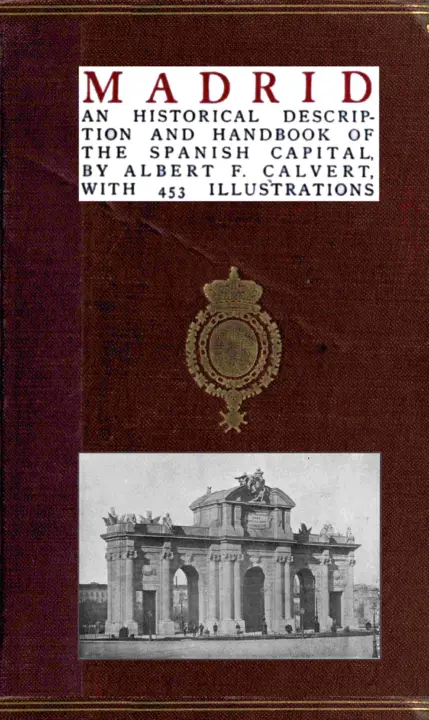
THE CLASSIC COLLECTION · 1909
"Madrid: An Historical Description and Handbook of the Spanish Capital" by Albert F. Calvert is a historical account written in the early 20th century. The book explores the rich history, culture, and modern developments of Madrid, positioning it within the broader context of Spain's past and present. It likely serves as both a guide for visitors and a celebration of the city's character, as the author expresses admiration for its people and beauty. The opening of the book introduces Madrid as a relatively young city compared to other historic Spanish cities, with its importance growing significantly over the centuries, particularly from the 16th century onwards. Calvert describes the unique geographical features of Madrid, including its elevation and climate, as well as the remarkable transformation from a city perceived negatively in terms of hygiene and accessibility to one that is vibrant and modern. He articulates the city's contrast between historical significance and contemporary life, emphasizing its modern architecture, social life, and cultural vibrancy while acknowledging its historical roots and struggles. The narrative sets an engaging tone for what seems to be a comprehensive exploration of Madrid's identity and evolution.
Introduction adapted from the source catalogue; source summaries may be automatically generated.
Free to read · English · 45,396 words · No account needed
MAKE TIME FOR A GOOD BOOK
On by default. Untick to stop anonymous reading totals. Each page counts after 10 seconds in view. How this works.
Anonymous counting is on unless you have switched it off.
Lope de Vega wrote about eighteen hundred plays. Much of his work is hasty, extravagant and bombastic. Calderon wrote with more directness and simplicity of style, and spent far more pains upon his compositions. Augustin Moreto produced thirty-six plays, which rank high from the literary point of view. De Castro, de Roscas, and de Solis are three of the more esteemed comedy authors of a later period, whose pieces were played in Madrid.
Galdos, who is the author of several novels and plays, resides in Madrid, in the Paseo de Areneros. Doña Emilia Pardo de Bazan, the most powerful of the women writers of Spain, says: “The life of the playwright in Madrid is more active, agitated, and arduous than other branches of the literary career, which languish and sleep for want of stimulus.” Most of the dramatists of the nation live in Madrid, or spend part of the year there. Among them are José Echegaray, now the leading playwright, Guimerá, Eugenio Sellés, Dicenta, Vital Aza, Abati Ricardo de la Vega, Garcia, and Paso.
Poets living in Madrid are Emilio Ferrari, Grilo, Manuel del Palacio, the Marquis de Cerralbo, the Duke de Rivas, Eduardo Benot, and Melchor de Palau. There are also several writers of humorous verse, such as López Silva, Pérez de Zúñiga, and Luis de Tapia.
The great novelist, Armando Palacio Valdés--who, in his novel, “Froth,” gives a true picture of Madrid manners--lives in the city occasionally. Here, too, reside Father Luis Coloma, Blasco Ibañez, Baroja, José Ortega Munilla, Antonio de Hoyos, and several other writers of fiction. Doña Emilia Pardo de Bazan lives in Madrid.
Among the celebrated journalists are Cavia, Kasabal, Azorin, Claudio Frollo, Luis Morote, Troyano, and “Zeda” (Sr. Fernandez Villegas).
The Madrileños appreciate the drama--in small doses--and support fourteen theatres, of which the most frequented are the Teatro Real, belonging to the State, the Español, belonging to the Municipality, the Princesa, Comedia, Lara, Apolo, and Zarzuela. As elsewhere in Spain, each performance consists of three or more short pieces or sketches--zarzuelas and saynetes--almost always dealing with aspects of popular life. To foreigners this persistent harping on the amours of the policeman and flower-girl and the vicissitudes of a chairmender’s career is a little surprising. The legitimate drama has been almost driven from the boards in Spain, despite the efforts of Señora Guerrero--the Spanish Bernhardt--to revive it, some years ago. This lady’s husband is the Marquis de Mendoza, who follows the same profession, to do which he required the special authorisation of the Council of State. Spain does not want for good actors and actresses, despite the loss of Vico, Calvo, and the ever-popular Emilio Mario. Maria Tubau is an able interpreter of Ibsen and Sudermann (when the opportunity presents itself), and the names of Thuillier, Pinelo, and Carmen Cobeña deserve mention. Naturalism has by no means asserted its sway over the Spanish theatre, and the entertainments, as the old play-bills used to say, are still largely frequented by ladies and children. Every one smokes during the performances, and talks frantically during the entr’actes. The theatres are comfortable and well upholstered. English visitors will be struck by the absence of programmes, the place of which is often taken by some such sheet as Blanco y Negro.
Your reading position is saved on this browser. Take it to another device with a library code. Reading pages adapt to text, rather than matching a printed edition.
Albert Frederick Calvert
Albert Frederick Calvert
Albert Frederick Calvert
Albert Frederick Calvert
BEHIND THE BOOK
This eBook is for the use of anyone anywhere in the United States and most other parts of the world at no cost and with almost no restrictions whatsoever. You may copy it, give it away or re-use it under the terms of the Project Gutenberg License included with this eBook or online at www.gutenberg.org. If you are not located in the United States, you will have to check the laws of the country where you are located before using this eBook. Read the source licence.
The original source file, including credits and licence, is retained by this library. Request an original-format copy at no charge. Please include the book title and Project Gutenberg identifier #63020.
KEEP YOUR CURIOSITY GOING
Wilfrid Scawen Blunt
Wilfrid Scawen Blunt

E. W. (Edgar Watson) Howe
Cécile Tormay

Moritz Busch
John L. Ransom