The Yellow Dove
George Gibbs
THE CLASSIC COLLECTION · 1913
"Madcap" by George Gibbs is a novel likely written in the early 20th century. The story revolves around Hermia Challoner, a spirited heiress with a penchant for adventure who frequently clashes with the expectations of high society. As she navigates her way through various social interactions—including encounters with the enigmatic artist John Markham—Hermia’s character unfolds against a backdrop of wealth, individuality, and the tension between societal norms and personal desires. The opening of the novel introduces us to Hermia and her maid, Titine, as Hermia energetically prepares for her day after a late-night escapade and an exhilarating ride on a "violent horse." Hermia's carefree and slightly reckless attitude showcases her spirited nature, while her dialogue with Titine presents a comedic yet revealing take on her character. When she later meets her friends, including the Countess Olga Tcherny, their conversation delves into themes of beauty, independence, and the social expectations placed on wealthy women. The narrative highlights Hermia's struggle between embracing her desires and conforming to societal pressures, making it clear that her dynamic with Markham will play a significant role in her journey of self-discovery and challenge the conventions of her world.
Introduction adapted from the source catalogue; source summaries may be automatically generated.
Free to read · English · 89,595 words · No account needed
MAKE TIME FOR A GOOD BOOK
On by default. Untick to stop anonymous reading totals. Each page counts after 10 seconds in view. How this works.
Anonymous counting is on unless you have switched it off.
He had already seen the towers of Verneuil from the hilltops behind
them and indicated.
"I'm sorry, Hermia," he said softly. "Will you forgive me?"
She shrugged. "Oh, it's of no consequence. I've been kissed before,"
she said.
His gaze was lowered, his jaw set.
"You provoked it--"
"Did I? I know now how you consider me. I did not believe you to be
that kind of a man."
"What kind of a man?"
"The man of promiscuous gallantries."
"I'm not--"
She shrugged and turned away.
"Your record is against you."
He found no reply and she laughed at him.
"When I wish to be kissed," she said brazenly, "I usually find a way of
letting men know it."
"You are speaking heresies," he said slowly. "That is not true."
"It is the truth, John Markham. But I did not choose your
companionship for that purpose."
"No, no, don't!" he pleaded contritely. "I've never thought that of you. We've had a code of our own, Hermia--all our own. Last night you made me happy. I dreamed of you, child, that you cared for me and I--"
She halted suddenly, her slight figure barring the way, her eyes
flashing furiously.
"We'll have no more of that nonsense," she cried. "Do you hear? When I ask for love--uncomplaining--unselfish, I know where to seek it." She reached up suddenly, snatched Père Guégou's faded blossom from his button-hole and throwing it in the road, ground it under her heel. "The Order of the Golden Rose is not for you, Monsieur Philidor," she finished. And before he was really awake to the full extent of his disaster was again on her way.
They entered Verneuil in a procession, Hermia in the lead, the donkey following, and Philidor, now thoroughly disillusioned, bringing up the rear. He was thinking deeply, his gaze on the graceful lines of her intolerant back, aware that she had paid him in full for his temerity, and wondering in an aimless way how soon she would be taking the train for Paris. He had done what he could to atone but some instinct warned him against further contrition.
His judgment was excellent. As they entered the street of the town she stopped and waited for him to join her.
"You'll unpack my orchestra if you please," she said acidly. "I'm going through the town alone."
He laid his hand on the strap at which she was already fingering, his
manner coolly assertive.
"No," he said quietly. "You'll not go alone. You're in my charge. Where you go, I go--unless of course"--and he pointed toward the railroad which passed nearby, "I put you on the train for Paris."
Your reading position is saved on this browser. Take it to another device with a library code. Reading pages adapt to text, rather than matching a printed edition.
George Gibbs
George Gibbs
George Gibbs
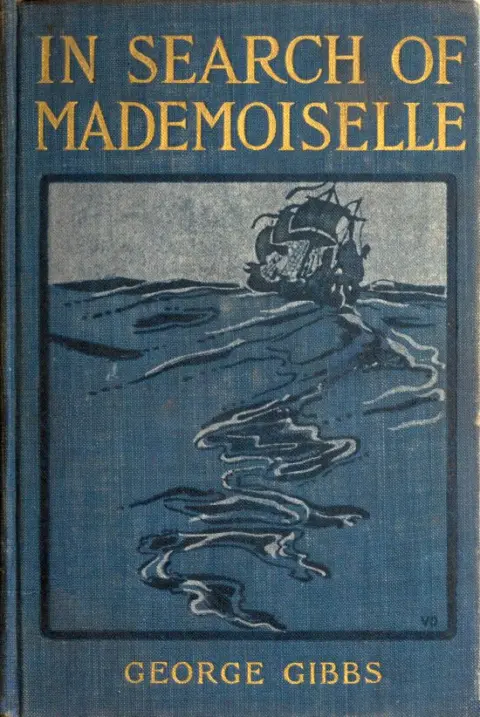
George Gibbs
BEHIND THE BOOK
This eBook is for the use of anyone anywhere in the United States and most other parts of the world at no cost and with almost no restrictions whatsoever. You may copy it, give it away or re-use it under the terms of the Project Gutenberg License included with this eBook or online at www.gutenberg.org. If you are not located in the United States, you will have to check the laws of the country where you are located before using this eBook. Read the source licence.
The original source file, including credits and licence, is retained by this library. Request an original-format copy at no charge. Please include the book title and Project Gutenberg identifier #11584.
KEEP YOUR CURIOSITY GOING
Coulson Kernahan

Maurice Baring
Frances Wright
Cécile Tormay

Frederic Jesup Stimson

W. H. P. (William Henry Pope) Jarvis