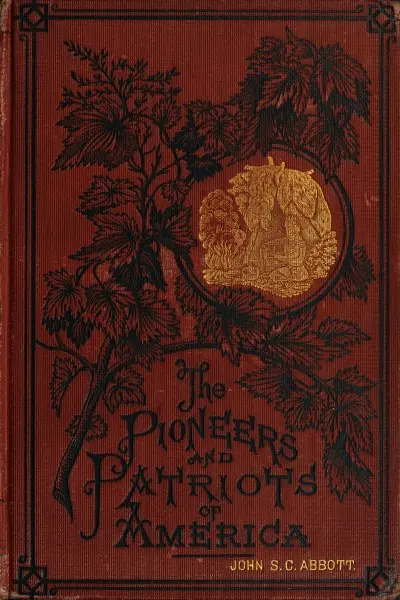
George Washington; or, Life in America One Hundred Years Ago.
John S. C. (John Stevens Cabot) Abbott
THE CLASSIC COLLECTION · 1878
"Madame Roland, Makers of History" by John S. C. Abbott is a historical account written in the late 19th century. The book delves into the life of Madame Roland, a significant figure during the French Revolution, exploring her formative years, intellectual development, and her role amidst the tumultuous events of her time. It reflects on her ambitions, the challenges she faced, and the profound influence she had as a woman engaged in political and social reform. The opening of the narrative introduces us to Jane Maria Phlippon, later known as Madame Roland, by tracing her childhood and the contrasting influences of her parents. Her father, Gratien Phlippon, embodies the restless spirit of the working class dissatisfied with societal inequalities, while her mother epitomizes a more submissive, pious nature. As Jane grows up, her thirst for knowledge and intellectual pursuits burgeons, leading her to a convent. The chapter outlines her formative experiences, including her early love for literature and her profound reflections on the disparities present in society. This early life foreshadows her later achievements and her pivotal role in one of history's most significant revolutions.
Introduction adapted from the source catalogue; source summaries may be automatically generated.
Free to read · English · 57,563 words · No account needed
MAKE TIME FOR A GOOD BOOK
On by default. Untick to stop anonymous reading totals. Each page counts after 10 seconds in view. How this works.
Anonymous counting is on unless you have switched it off.
In this rising conflict between plebeian and patrician, between democrat and aristocrat, the position in which M. Roland and wife were placed, as most conspicuous and influential members of the revolutionary party, arrayed against them, with daily increasing animosity, all the aristocratic community of Lyons. Each day their names were pronounced by the advocates of reform with more enthusiasm, and by their opponents with deepening hostility. The applause and the censure alike invigorated Madame Roland, and her whole soul became absorbed in the one idea of popular liberty. This object became her passion, and she devoted herself to it with the concentration of every energy of mind and heart.
On the 20th of February, 1791, Madame Roland accompanied her husband to Paris, as he took his seat, with a name already prominent, in the National Assembly. Five years before, she had left the metropolis in obscurity and depression. She now returned with wealth, with elevated rank, with brilliant reputation, and exulting in conscious power. Her persuasive influence was dictating those measures which were driving the ancient nobility of France from their chateaux, and her vigorous mind was guiding those blows before which the throne of the Bourbons trembled. The unblemished and incorruptible integrity of M. Roland, his simplicity of manners and acknowledged ability, invested him immediately with much authority among his associates. The brilliance of his wife, and her most fascinating colloquial powers, also reflected much luster upon his name. Madame Roland, with her glowing zeal, had just written a pamphlet upon the new order of things, in language so powerful and impressive that more than sixty thousand copies had been sold--an enormous number, considering the comparative fewness of readers at that time. She, of course, was received with the most flattering attention, and great deference was paid to her opinions. She attended daily the sittings of the Assembly, and listened with the deepest interest to the debates. The king and queen had already been torn from their palaces at Versailles, and were virtually prisoners in the Tuileries. Many of the nobles had fled from the perils which seemed to be gathering around them, and had joined the army of emigrants at Coblentz. A few, however, of the nobility, and many of the higher clergy, remained heroically at their posts, and, as members of the Assembly, made valiant but unavailing efforts to defend the ancient prerogatives of the crown and of the Church. Madame Roland witnessed with mortification, which she could neither repress nor conceal, the decided superiority of the court party in dignity, and polish of manners, and in general intellectual culture, over those of plebeian origin, who were struggling, with the energy of an infant Hercules, for the overthrow of despotic power. All her tastes were with the ancient nobility and their defenders. All her principles were with the people. And as she contrasted the unrefined exterior and clumsy speech of the democratic leaders with the courtly bearing and elegant diction of those who rallied around the throne, she was aroused to a more vehement desire for the social and intellectual elevation of those with whom she had cast in her lot. The conflict with the nobles was of short continuance. The energy of rising democracy soon vanquished them. Violence took the place of law. And now the conflict for power arose between those of the Republicans who were more and those who were less radical in their plans of reform. The most moderate party, consisting of those who would sustain the throne, but limit its powers by a free constitution, retaining many of the institutions and customs which antiquity had rendered venerable, was called the Girondist party. It was so called because their most prominent leaders were from the department of the Gironde. They would deprive the king of many of his prerogatives, but not of his crown. They would take from him his despotic power, but not his life. They would raise the mass of the people to the enjoyment of liberty, but to liberty controlled by vigorous law. Opposed to them were the Jacobins--far more radical in their views of reform. They would overthrow both throne and altar, break down all privileged orders, confiscate the property of the nobles, and place prince and beggar on the footing of equality. These were the two great parties into which revolutionary France was divided and the conflict between them was the most fierce and implacable earth has ever witnessed.
Your reading position is saved on this browser. Take it to another device with a library code. Reading pages adapt to text, rather than matching a printed edition.
John S. C. (John Stevens Cabot) Abbott
John S. C. (John Stevens Cabot) Abbott
John S. C. (John Stevens Cabot) Abbott
John S. C. (John Stevens Cabot) Abbott
BEHIND THE BOOK
This eBook is for the use of anyone anywhere in the United States and most other parts of the world at no cost and with almost no restrictions whatsoever. You may copy it, give it away or re-use it under the terms of the Project Gutenberg License included with this eBook or online at www.gutenberg.org. If you are not located in the United States, you will have to check the laws of the country where you are located before using this eBook. Read the source licence.
The original source file, including credits and licence, is retained by this library. Request an original-format copy at no charge. Please include the book title and Project Gutenberg identifier #28445.
KEEP YOUR CURIOSITY GOING
Cécile Tormay

Moritz Busch
John L. Ransom
Frances Wright
Cécile Tormay

Mabel Potter Daggett