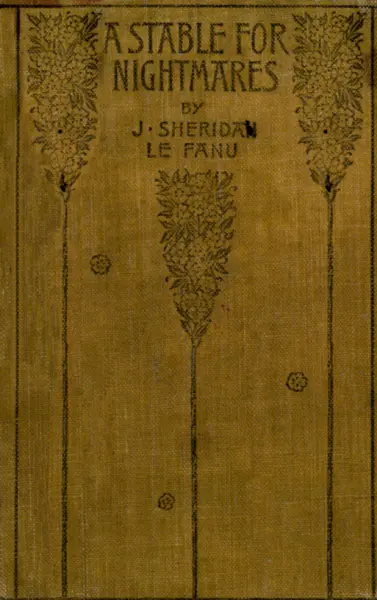
A Stable for Nightmares; or, Weird Tales
Joseph Sheridan Le Fanu & Charles L. (Charles Lawrence), Sir Young
THE CLASSIC COLLECTION · 1871
"Madam Crowl's Ghost and The Dead Sexton" by Joseph Sheridan Le Fanu is a collection of supernatural tales that first appeared in the early 1870s, during a time when Gothic fiction was gaining popularity in the literary scene. These stories delve into themes of the macabre and the unknown, exploring the interactions of the living with unsettling spectral figures. The collection is indicative of the Victorian era's fascination with ghost stories and the supernatural. In "Madam Crowl's Ghost," the narrative follows a young girl, who recounts her experiences with the enigmatic and reportedly malevolent Dame Crowl, an elderly woman rumored to be connected to the disappearance of her stepson. As the young nursemaid witnesses strange occurrences and encounters the ghostly figure of Dame Crowl, the lines between reality and the supernatural begin to blur. In "The Dead Sexton," the tale revolves around the mysterious death of Toby Crooke, the town's sexton, who dies under suspicious circumstances that hint at a dark history. The twist culminates with the revelation of his nefarious intentions to rob the church, ultimately leading to tragic consequences. Both stories weave together elements of suspense, moral lessons, and the inevitability of fate, making this collection a captivating exploration of ghostly folklore.
Introduction adapted from the source catalogue; source summaries may be automatically generated.
Free to read · English · 13,890 words · No account needed
MAKE TIME FOR A GOOD BOOK
On by default. Untick to stop anonymous reading totals. Each page counts after 10 seconds in view. How this works.
Anonymous counting is on unless you have switched it off.
The old woman who was in charge of it slept in a settle-bed, among broken stools, old sacks, rotten chests and other rattle-traps, in the small room at the rear of the house, floored with tiles.
At what time of the night she could not tell, she awoke, and saw a man, with his hat on, in her room. He had a candle in his hand, which he shaded with his coat from her eye; his back was towards her, and he was rummaging in the drawer in which she usually kept her money.
Having got her quarter's pension of two pounds that day, however, she had placed it, folded in a rag, in the corner of her tea caddy, and locked it up in the "eat-malison" or cupboard.
She was frightened when she saw the figure in her room, and she could not tell whether her visitor might not have made his entrance from the contiguous churchyard. So, sitting bolt upright in her bed, her grey hair almost lifting her kerchief off her head, and all over in "a fit o' t' creepins," as she expressed it, she demanded:
"In God's name, what want ye thar?"
"Whar's the peppermint ye used to hev by ye, woman? I'm bad wi' an
inward pain."
"It's all gane a month sin'," she answered; and offered to make him a "het" drink if he'd get to his room.
But he said:
"Never mind, I'll try a mouthful o' gin."
And, turning on his heel, he left her.
In the morning the sexton was gone. Not only in his lodging was there no account of him, but, when inquiry began to be extended, nowhere in the village of Golden Friars could he be found.
Still he might have gone off, on business of his own, to some distant village, before the town was stirring; and the sexton had no near kindred to trouble their heads about him. People, therefore, were willing to wait, and take his return ultimately for granted.
At three o'clock the good Vicar, standing at his hall door, looking across the lake towards the noble fells that rise, steep and furrowed, from that beautiful mere, saw two men approaching across the green, in a straight line, from a boat that was moored at the water's edge. They were carrying between them something which, though not very large, seemed ponderous.
"Ye'll ken this, sir," said one of the boatmen as they set down, almost at his feet, a small church bell, such as in old-fashioned chimes yields the treble notes.
"This won't be less nor five stean. I ween it's fra' the church
steeple yon."
Your reading position is saved on this browser. Take it to another device with a library code. Reading pages adapt to text, rather than matching a printed edition.
Joseph Sheridan Le Fanu & Charles L. (Charles Lawrence), Sir Young
Joseph Sheridan Le Fanu
Joseph Sheridan Le Fanu
Joseph Sheridan Le Fanu
BEHIND THE BOOK
This eBook is for the use of anyone anywhere in the United States and most other parts of the world at no cost and with almost no restrictions whatsoever. You may copy it, give it away or re-use it under the terms of the Project Gutenberg License included with this eBook or online at www.gutenberg.org. If you are not located in the United States, you will have to check the laws of the country where you are located before using this eBook. Read the source licence.
The original source file, including credits and licence, is retained by this library. Request an original-format copy at no charge. Please include the book title and Project Gutenberg identifier #11610.
KEEP YOUR CURIOSITY GOING

Maurice Baring
Francis Greenleaf Allinson & Anne C. E. (Anne Crosby Emery) Allinson
Charles Dickens
Stuart Dodgson Collingwood
Percy Keese Fitzhugh
Mary Macleod & Edmund Spenser