
The prophetic marriage
Warwick Deeping
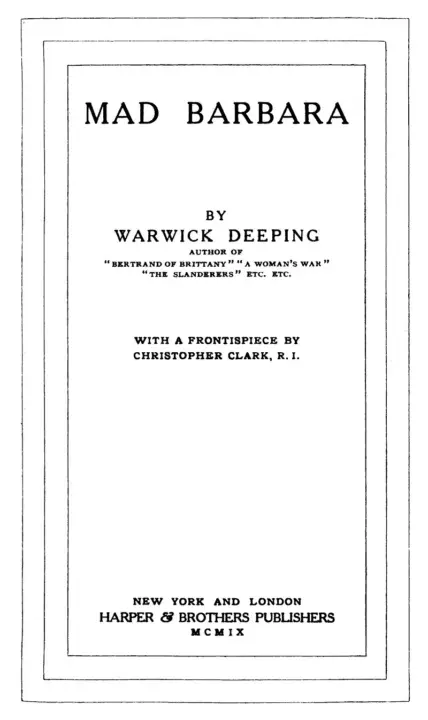
THE CLASSIC COLLECTION · 1908
"Mad Barbara" by Warwick Deeping is a historical novel written in the early 20th century. The story is set against a rich backdrop of aristocracy and intrigue, focusing on the titular character, Barbara Purcell, who grapples with the traumatic aftermath of her father's mysterious murder. As she navigates the complex dynamics of her family and societal expectations, her emotional turmoil drives her quest for truth and revenge. The opening of the novel intrigues the reader by presenting a poignant scene: Barbara discovers her father dead in their music-room, which sets the stage for her deep obsession with the past and her silent mourning for a man she both loved and feared. As she contemplates her father's untimely demise, the narrative introduces her challenging relationships with her mother, Anne, and the larger social environment of the time, where joy and frivolity clash starkly against her grief. The story hints at Barbara's internal struggle and foreshadows her future encounters with the world around her, including her interactions with figures such as Lord Gore and his son, John, who enters the narrative as a figure of intrigue and potential alliance against the backdrop of her tragic reality.
Introduction adapted from the source catalogue; source summaries may be automatically generated.
Free to read · English · 110,959 words · No account needed
MAKE TIME FOR A GOOD BOOK
On by default. Untick to stop anonymous reading totals. Each page counts after 10 seconds in view. How this works.
Anonymous counting is on unless you have switched it off.
“No; we are the larks this morning.”
She was silent a moment, looking away toward the distant hills. Her voice had a tremor when she spoke again.
“John!”
“Yes!”
“Come to me; I want you.”
And he went up, to find her weeping.
Man, being a creature of tougher fibre, cannot always comprehend a woman’s moods. They may seem inexplicable to him, because her sensitiveness can be as fine as gossamer, and hardly visible against the coarser background of reality. Even as a man cannot always gauge the strange, shrinking prides of a shy child, so he may blunder against the delicate and sacred things of a woman’s soul, unless love, spiritual love, gives him that intuition that sees beyond the carnal clay.
“Why, Barbe—weeping!”
He looked at her, not a little troubled, searching his own heart guiltily, yet having no consciousness of having wounded her in any way. The tears of a woman whom he loves have always a personal issue for a man. They may pique him if he is vain, challenge him if he be honest.
“Oh, it is nothing, John!”
He did the only thing a man could do, and that was to take her face between his two hands and kiss her.
“Little wife, no secrets from me. Let us begin life so; we shall never
regret it.”
She closed her eyes, and, putting her hands upon his shoulders, hung her
head a little.
“It was foolish of me, dear. I have been so happy, and sometimes when one has been very happy—”
“The tears come, little wife.”
“I have never been very happy till now, John. And just now it came into my heart so suddenly—”
She faltered, and he stood looking down at her as he held her in his
arms.
“Barbara—wife, you felt lonely.”
She darted up a look at him as though surprised that he should know.
“How do I know, child? Because I had something of the same feeling myself. What a pair of fond fools, eh! No, it is something deeper and more sacred than that.”
“Yes, John, I know. But do you think—”
“I think a great many things, Barbe.”
“Yes; but that I shall make you happy, that I can fill your life for
you?”
He took her unloosed hair, and put it back from off her forehead. Perhaps he was learning the familiar truth that no being can be more fiercely conscientious and self-critical than a good woman newly married. Fevers of doubt and of introspection rise in her. The surrender is so final, so utter, and the future seems so precious.
Your reading position is saved on this browser. Take it to another device with a library code. Reading pages adapt to text, rather than matching a printed edition.
Warwick Deeping

Warwick Deeping

Warwick Deeping

Warwick Deeping
BEHIND THE BOOK
This eBook is for the use of anyone anywhere in the United States and most other parts of the world at no cost and with almost no restrictions whatsoever. You may copy it, give it away or re-use it under the terms of the Project Gutenberg License included with this eBook or online at www.gutenberg.org. If you are not located in the United States, you will have to check the laws of the country where you are located before using this eBook. Read the source licence.
The original source file, including credits and licence, is retained by this library. Request an original-format copy at no charge. Please include the book title and Project Gutenberg identifier #50995.
KEEP YOUR CURIOSITY GOING
Cécile Tormay

Moritz Busch
Coulson Kernahan
John L. Ransom

Maurice Baring
Frances Wright