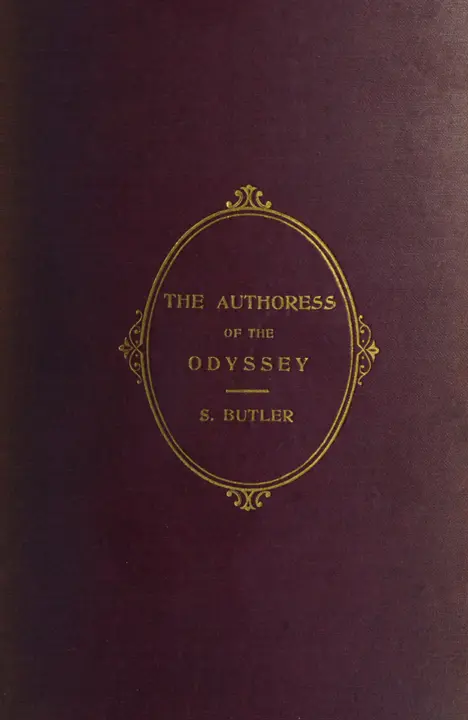
The Authoress of the Odyssey Where and when she wrote, who she was, the use she made of the Iliad, and how the poem grew under her hands
Samuel Butler
THE CLASSIC COLLECTION · 1887
"Luck, or Cunning, as the Main Means of Organic Modification" by Samuel Butler is a scientific publication written in the late 19th century. The book explores the complex relationship between heredity and memory while seeking to reintegrate the concept of design into the evolutionary narrative, challenging the dominant Darwinian view of natural selection. The beginning of the text establishes Butler's intent to delve into the nuances of organic development, arguing for the significant overlap between heredity and memory. Following an introduction that highlights his shift from an initial focus on the division of life forms to a deeper examination of Darwin's theories, Butler reflects on his interactions with influential contemporaries such as Alfred Tylor and Herbert Spencer. He articulates that understanding the intricacies of descent requires acknowledging design's role in evolution while arguing that instinct should be perceived as inherited memory—a concept he aims to substantiate throughout the work.
Introduction adapted from the source catalogue; source summaries may be automatically generated.
Free to read · English · 84,207 words · No account needed
MAKE TIME FOR A GOOD BOOK
On by default. Untick to stop anonymous reading totals. Each page counts after 10 seconds in view. How this works.
Anonymous counting is on unless you have switched it off.
How is progress ever to be made if races keep reversing, Penelope-like, in one generation all that they have been achieving in the preceding? And how, on Mr. Darwin’s system, of which the accumulation of strokes of luck is the greatly preponderating feature, is a hoard ever to be got together and conserved, no matter how often luck may have thrown good things in an organism’s way? Luck, or absence of design, may be sometimes almost said to throw good things in our way, or at any rate we may occasionally get more through having made no design than any design we should have been likely to have formed would have given us; but luck does not hoard these good things for our use and make our wills for us, nor does it keep providing us with the same good gifts again and again, and no matter how often we reject them.
I had better, perhaps, give Mr. Spencer’s own words as quoted by himself in his article in the Nineteenth Century for April, 1886. He there wrote as follows, quoting from § 166 of his “Principles of Biology,” which appeared in 1864:—
“Where the life is comparatively simple, or where surrounding circumstances render some one function supremely important, the survival of the fittest” (which means here the survival of the luckiest) “may readily bring about the appropriate structural change, without any aid from the transmission of functionally-acquired modifications” (into which effort and design have entered). “But in proportion as the life grows complex—in proportion as a healthy existence cannot be secured by a large endowment of some one power, but demands many powers; in the same proportion do there arise obstacles to the increase of any particular power, by ‘the preservation of favoured races in the struggle for life’” (that is to say, through mere survival of the luckiest). “As fast as the faculties are multiplied, so fast does it become possible for the several members of a species to have various kinds of superiority over one another. While one saves its life by higher speed, another does the like by clearer vision, another by keener scent, another by quicker hearing, another by greater strength, another by unusual power of enduring cold or hunger, another by special sagacity, another by special timidity, another by special courage; and others by other bodily and mental attributes. Now it is unquestionably true that, other things equal, each of these attributes, giving its possessor an equal extra chance of life, is likely to be transmitted to posterity. But there seems no reason to believe it will be increased in subsequent generations by natural selection. That it may be thus increased, the animals not possessing more than average endowments of it must be more frequently killed off than individuals highly endowed with it; and this can only happen when the attribute is one of greater importance, for the time being, than most of the other attributes. If those members of the species which have but ordinary shares of it, nevertheless survive by virtue of other superiorities which they severally possess, then it is not easy to see how this particular attribute can be developed by natural selection in subsequent generations.” (For if some other superiority is a greater source of luck, then natural selection, or survival of the luckiest, will ensure that this other superiority be preserved at the expense of the one acquired in the earlier generation.) “The probability seems rather to be, that by gamogenesis, this extra endowment will, on the average, be diminished in posterity—just serving in the long run to compensate the deficient endowments of other individuals, whose special powers lie in other directions; and so to keep up the normal structure of the species. The working out of the process is here somewhat difficult to follow” (there is no difficulty as soon as it is perceived that Mr. Darwin’s natural selection invariably means, or ought to mean, the survival of the luckiest, and that seasons and what they bring with them, though fairly constant on an average, yet individually vary so greatly that what is luck in one season is disaster in another); “but it appears to me that as fast as the number of bodily and mental faculties increases, and as fast as the maintenance of life comes to depend less on the amount of any one, and more on the combined action of all, so fast does the production of specialities of character by natural selection alone become difficult. Particularly does this seem to be so with a species so multitudinous in powers as mankind; and above all does it seem to be so with such of the human powers as have but minor shares in aiding the struggle for life—the æsthetic faculties, for example.
Your reading position is saved on this browser. Take it to another device with a library code. Reading pages adapt to text, rather than matching a printed edition.
Samuel Butler
Samuel Butler
Samuel Butler
Samuel Butler
BEHIND THE BOOK
This eBook is for the use of anyone anywhere in the United States and most other parts of the world at no cost and with almost no restrictions whatsoever. You may copy it, give it away or re-use it under the terms of the Project Gutenberg License included with this eBook or online at www.gutenberg.org. If you are not located in the United States, you will have to check the laws of the country where you are located before using this eBook. Read the source licence.
The original source file, including credits and licence, is retained by this library. Request an original-format copy at no charge. Please include the book title and Project Gutenberg identifier #4967.
KEEP YOUR CURIOSITY GOING

David Patterson (Spirit) Hatch
Coulson Kernahan

Ralph Waldo Emerson
Frances Wright

Edwin Abbott Abbott

Joseph Droz