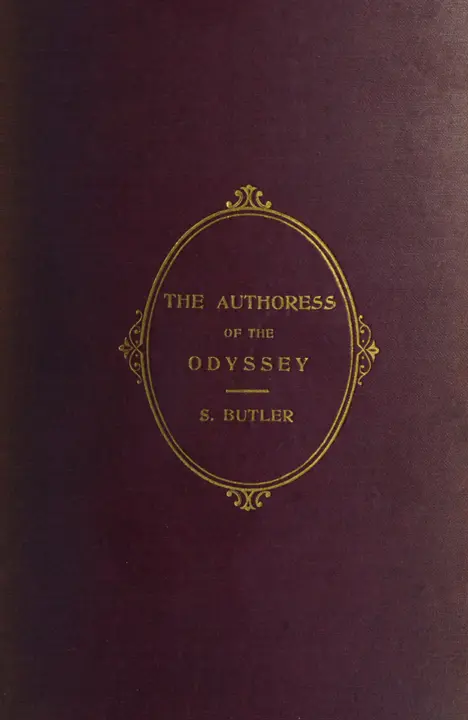
The Authoress of the Odyssey Where and when she wrote, who she was, the use she made of the Iliad, and how the poem grew under her hands
Samuel Butler
THE CLASSIC COLLECTION · 1887
"Luck, or Cunning, as the Main Means of Organic Modification" by Samuel Butler is a scientific publication written in the late 19th century. The book explores the complex relationship between heredity and memory while seeking to reintegrate the concept of design into the evolutionary narrative, challenging the dominant Darwinian view of natural selection. The beginning of the text establishes Butler's intent to delve into the nuances of organic development, arguing for the significant overlap between heredity and memory. Following an introduction that highlights his shift from an initial focus on the division of life forms to a deeper examination of Darwin's theories, Butler reflects on his interactions with influential contemporaries such as Alfred Tylor and Herbert Spencer. He articulates that understanding the intricacies of descent requires acknowledging design's role in evolution while arguing that instinct should be perceived as inherited memory—a concept he aims to substantiate throughout the work.
Introduction adapted from the source catalogue; source summaries may be automatically generated.
Free to read · English · 84,207 words · No account needed
MAKE TIME FOR A GOOD BOOK
On by default. Untick to stop anonymous reading totals. Each page counts after 10 seconds in view. How this works.
Anonymous counting is on unless you have switched it off.
“Geological research has done scarcely anything in breaking down the distinction between species, by connecting them together by numerous, fine, intermediate varieties; and this not having been effected, is probably the gravest and most obvious of all the many objections which may be urged against my views” (p. 299).
We naturally took “my views” to mean descent with modification. The “my” has been allowed to stand.
Again:—
“If, then, there be some degree of truth in these remarks, we have no right to expect to find in our geological formations an infinite number of those transitional forms which on my theory assuredly have connected all the past and present species of the same group in one long and branching chain of life . . . But I do not pretend that I should ever have suspected how poor was the record in the best preserved geological sections, had not the absence of innumerable transitional links between the species which lived at the commencement and at the close of each formation pressed so hardly on my theory” (pp. 301, 302).
Substitute “descent with modification” for “my theory” and the meaning does not suffer. The first of the two “my theories” in the passage last quoted was altered in 1869 into “our theory;” the second has been allowed to stand.
Again:—
“The abrupt manner in which whole groups of species suddenly appear in some formations, has been urged by several palæontologists . . . as a fatal objection to the belief in the transmutation of species. If numerous species, belonging to the same genera or families, have really started into life all at once, the fact would be fatal to the theory of descent with slow modification through natural selection” (p. 302).
Here “the belief in the transmutation of species,” or descent with modification, is treated as synonymous with “the theory of descent with slow modification through natural selection;” but it has nowhere been explained that there are two widely different “theories of descent with slow modification through natural selection,” the one of which may be true enough for all practical purposes, while the other is seen to be absurd as soon as it is examined closely. The theory of descent with modification is not properly convertible with either of these two views, for descent with modification deals with the question whether species are transmutable or no, and dispute as to the respective merits of the two natural selections deals with the question how it comes to be transmuted; nevertheless, the words “the theory of descent with slow modification through the ordinary course of things” (which is what “descent with modification through natural selection” comes to) may be considered as expressing the facts with practical accuracy, if the ordinary course of nature is supposed to be that modification is mainly consequent on the discharge of some correlated function, and that modification, if favourable, will tend to accumulate so long as the given function continues important to the wellbeing of the organism; the words, however, have no correspondence with reality if they are supposed to imply that variations which are mainly matters of pure chance and unconnected in any way with function will accumulate and result in specific difference, no matter how much each one of them may be preserved in the generation in which it appears. In the one case, therefore, the expression natural selection may be loosely used as a synonym for descent with modification, and in the other it may not. Unfortunately with Mr. Charles Darwin the variations are mainly accidental. The words “through natural selection,” therefore, in the passage last quoted carry no weight, for it is the wrong natural selection that is, or ought to be, intended; practically, however, they derived a weight from Mr. Darwin’s name to which they had no title of their own, and we understood that “the theory of descent with slow modification” through the kind of natural selection ostensibly intended by Mr. Darwin was a quasi-synonymous expression for the transmutation of species. We understood—so far as we understood anything beyond that we were to believe in descent with modification—that natural selection was Mr. Darwin’s theory; we therefore concluded, since Mr. Darwin seemed to say so, that the theory of the transmutation of species generally was so also. At any rate we felt as regards the passage last quoted that the theory of descent with modification was the point of attack and defence, and we supposed it to be the theory so often referred to by Mr. Darwin as “my.”
Your reading position is saved on this browser. Take it to another device with a library code. Reading pages adapt to text, rather than matching a printed edition.
Samuel Butler
Samuel Butler
Samuel Butler
Samuel Butler
BEHIND THE BOOK
This eBook is for the use of anyone anywhere in the United States and most other parts of the world at no cost and with almost no restrictions whatsoever. You may copy it, give it away or re-use it under the terms of the Project Gutenberg License included with this eBook or online at www.gutenberg.org. If you are not located in the United States, you will have to check the laws of the country where you are located before using this eBook. Read the source licence.
The original source file, including credits and licence, is retained by this library. Request an original-format copy at no charge. Please include the book title and Project Gutenberg identifier #4967.
KEEP YOUR CURIOSITY GOING

David Patterson (Spirit) Hatch
Coulson Kernahan

Ralph Waldo Emerson
Frances Wright

Edwin Abbott Abbott

Joseph Droz