
The manliness of Christ
Thomas Hughes
THE CLASSIC COLLECTION · 1892
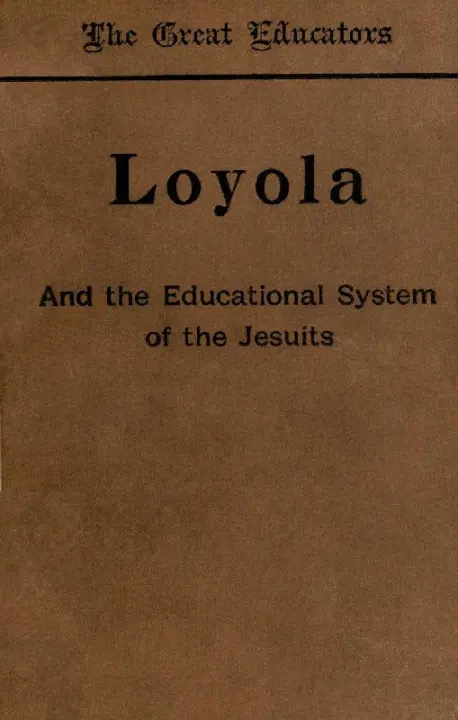
"Loyola and the Educational System of the Jesuits" by Thomas Hughes is a historical account written in the late 19th century. The book explores the educational principles and methods developed by the Society of Jesus, primarily focusing on the life of its founder, St. Ignatius of Loyola. Through a critical analysis of the Jesuit educational system called the "Ratio Studiorum", Hughes assesses its historical development and lasting influence on pedagogical approaches." The opening of the text establishes the author's intent to provide a detailed examination of the Jesuit educational system by combining biographical elements with historical context. It discusses the evolution of Christian education from ancient times leading up to the Reformation and reflects on the societal conditions that prompted the need for a revised educational framework represented by the Society of Jesus. Hughes highlights significant moments in the life of Ignatius of Loyola, illustrating how his experiences and insights shaped the Jesuit approach, emphasizing the importance of integrating moral and intellectual development in education.
Introduction adapted from the source catalogue; source summaries may be automatically generated.
Free to read · English · 76,962 words · No account needed
MAKE TIME FOR A GOOD BOOK
On by default. Untick to stop anonymous reading totals. Each page counts after 10 seconds in view. How this works.
Anonymous counting is on unless you have switched it off.
Passing on to universities of the Order, he defines for their scope, first, in behalf of those who are to be Ecclesiastics, Scholastic Theology, Holy Scripture, and Positive Theology; secondly, for all students, Humane Letters, Latin, Greek, Hebrew, and other such languages as Chaldaic, Arabic, and Indian, subject to the demands of necessity or utility; moreover, Logic, Physics, Metaphysics, Moral Philosophy, and Mathematics. All these departments are to be provided for by Professors of the Order. If the departments of Civil Law and Medicine are added, they will be conducted by Professors not of the Society.[68]
As to the Scholastic members of the Society, their mental culture in the Order begins, of course, where their collegiate curriculum had closed, that is, at the end of their classical course. Their studies henceforth are defined by two objects; one, that of professing, as formed Jesuits in the future, what they are studying now; the other, that of being differentiated, according to talent and circumstance, into preachers, writers, directors of consciences, or managers of affairs.
In view of this two-fold object, all the examinations, arranged for members of the Order in the advanced courses, are regulated by one standard, that the Jesuit Scholastics must be found competent, at each stage, to teach the course in which they are being tested. Accordingly, they review their previous literary acquirements, in all the lines which the Society regularly professes; then, during three years, they apply exclusively to Philosophy and Natural Sciences; and, four years more, to Divinity and allied Sciences.[69]
This protracted course, therefore, as given more in detail by the subsequent Ratio, consists of Poetry, Rhetoric, and Literature; Mathematics, Physics, and Chemistry; Logic, Ontology, Cosmology, Psychology, and Natural Theology; Ethics, Natural, Social and Public Right, Moral Theology, Canon Law, Ecclesiastical History, Scholastic Theology, Hebrew, Sacred Scripture. The courses are to be pursued either in the same classes which external students attend, or, in their own university classes, when a general house of studies is formed as a "Scholasticate." In both cases, they have Seminary exercises of their own, beyond what is required in the most condensed university courses.
Those whom health and excellence have approved at every step are ordinarily to be withdrawn from studies, "when the course of Arts has been finished, and when four years have been spent on Theology."[70] Specialties are to be cultivated.[71] Subsequent legislation places these specialties in the interval between the Arts and Theology; and, again, after the latter.
Your reading position is saved on this browser. Take it to another device with a library code. Reading pages adapt to text, rather than matching a printed edition.
Thomas Hughes

Thomas Hughes

Thomas Hughes

Thomas Hughes
BEHIND THE BOOK
This eBook is for the use of anyone anywhere in the United States and most other parts of the world at no cost and with almost no restrictions whatsoever. You may copy it, give it away or re-use it under the terms of the Project Gutenberg License included with this eBook or online at www.gutenberg.org. If you are not located in the United States, you will have to check the laws of the country where you are located before using this eBook. Read the source licence.
The original source file, including credits and licence, is retained by this library. Request an original-format copy at no charge. Please include the book title and Project Gutenberg identifier #46018.
KEEP YOUR CURIOSITY GOING
Cécile Tormay

Moritz Busch
John L. Ransom
Frances Wright
Cécile Tormay

Mabel Potter Daggett