
The manliness of Christ
Thomas Hughes
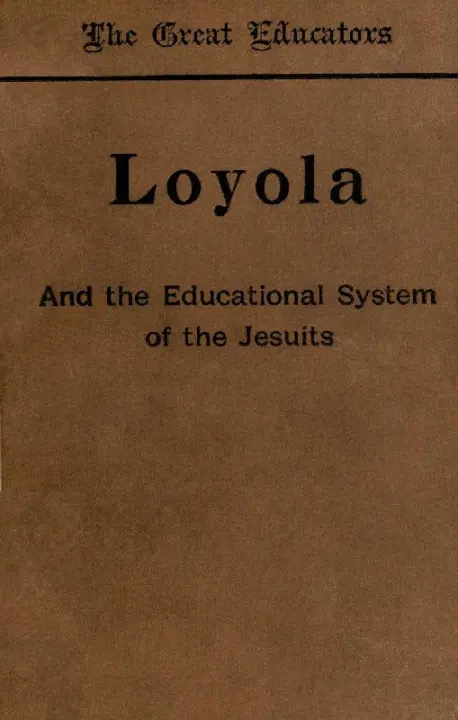
THE CLASSIC COLLECTION · 1892
"Loyola and the Educational System of the Jesuits" by Thomas Hughes is a historical account written in the late 19th century. The book explores the educational principles and methods developed by the Society of Jesus, primarily focusing on the life of its founder, St. Ignatius of Loyola. Through a critical analysis of the Jesuit educational system called the "Ratio Studiorum", Hughes assesses its historical development and lasting influence on pedagogical approaches." The opening of the text establishes the author's intent to provide a detailed examination of the Jesuit educational system by combining biographical elements with historical context. It discusses the evolution of Christian education from ancient times leading up to the Reformation and reflects on the societal conditions that prompted the need for a revised educational framework represented by the Society of Jesus. Hughes highlights significant moments in the life of Ignatius of Loyola, illustrating how his experiences and insights shaped the Jesuit approach, emphasizing the importance of integrating moral and intellectual development in education.
Introduction adapted from the source catalogue; source summaries may be automatically generated.
Free to read · English · 76,962 words · No account needed
MAKE TIME FOR A GOOD BOOK
On by default. Untick to stop anonymous reading totals. Each page counts after 10 seconds in view. How this works.
Anonymous counting is on unless you have switched it off.
[93] Histoire d'un Collège Municipal aux XVI^e, XVII^e, et XVIII^e siècles ... à Bayonne avant 1789. Thèse presentée à la Faculté des Lettres de Toulouse, par J. M. Drevon, censeur des Études au Lycée d'Agen, 1890. About 500 pages.
[94] Pp. 160-234.
[96] Dante, Parad. viii.
[97] De La Haute Éducation Intellectuelle, liv. iv, ch 4. Compare
Vasco, vol. i, n. 24.
[98] Essais sur l'Instruction Publique, par Charles Lenormant, membre de l'Institut; quoted by Rochemonteix, Le Collège Henri IV, tom. ii, ch. 1, p. 49, in his very instructive discussion on the Jesuit internat, or pensionnat.
[99] Monumenta Germaniæ Pædagogica, vol. ii, Pachtler, p. 78.
[100] Const., part iv, ch. 3, decl. B.
[101] Turpissimis signis.
[102] Bibliotheca Selecta, lib. i, ch. 44; Quasnam tetenderit insidias humani generis hostis, etc.
[103] Ribadeneira, Bollandists, nn. 373 seq.
[104] Bibliotheca Selecta, lib. i, ch. 40.
[105] Ratio Studiorum of 1599 and 1832, Reg. Prov. 37. The higher courses are allowed a midsummer vacation of between one and two months; in the lower or literary course, Rhetoric is allowed one month, the others classes less. Besides certain feast-days during the year, every week must have one day free, which, in the higher courses, is the whole day, but, in the lower, is only the latter part of it.
[106] 1602; Monumenta Germaniæ Pædagogica, vol. ii, Pachtler, p. 467.
[107] Monumenta Germaniæ Pædagogica, vol. ii, Pachtler, p. 411.
[108] Bollandists, n. 374.
[109] Lettre 7 février, 1746; OEuvres, tom. viii, p. 1128; edit. 1817.
[110] Crétineau-Joly, Histoire de la Compagnie de Jésus, tom. iv, ch. 3, p. 209; edit. 1851. This chapter and the following one, ch. 4, in Crétineau-Joly, pp. 158-297, contain the most varied information on our subject, regarding professors, writers, scholars, etc.
[111] Epistola de Institutione Juventutis, et Studiis Litterarum Promovendis, 1639; Mon. Germ. Pæd., vol. ix, Pachtler, p. 62.
[112] Paradise Lost, book iv.
[113] Notice sur le Pensionnat, etc. à Fribourg en Suisse, 1839, pp. 56
seq.
[114] 1585; Monumenta Germaniæ Pædagogica, vol. ii, Pachtler, p. 411.
[115] Monumenta Germaniæ Pædagogica, vol. ix, Pachtler, p. 59.
[116] Manare, Commentarius.
[117] Crétineau-Joly, tom. i, ch. 3, p. 150.
[118] Compare Cretineau-Joly, tom. i, ch. 6; tom. iv, chs. 3, 4.
[119] The more heavily the strain of war bore upon Germany, the more assiduously were the succors sent in; no part of the field was more under Loyola's eye.
[120] History of the Papacy, vol. i, book v, § 3; The First Jesuit Schools in Germany; Foster's translation, p. 417.
[121] Compare Monumenta Germaniæ Pædagogica, vol. ix, Pachtler, Nr. 72;
Nr. 91; Nr. 92, etc.
[122] This very instructive correspondence may be seen sketched in Genelli's Life of St. Ignatius of Loyola, part ii, ch. 8, pp. 342 seq. 1889.
[123] Ch. 6, above, p. 84.
[124] Const., pars iv, c. 7, decl. E.
Your reading position is saved on this browser. Take it to another device with a library code. Reading pages adapt to text, rather than matching a printed edition.
Thomas Hughes

Thomas Hughes

Thomas Hughes

Thomas Hughes
BEHIND THE BOOK
This eBook is for the use of anyone anywhere in the United States and most other parts of the world at no cost and with almost no restrictions whatsoever. You may copy it, give it away or re-use it under the terms of the Project Gutenberg License included with this eBook or online at www.gutenberg.org. If you are not located in the United States, you will have to check the laws of the country where you are located before using this eBook. Read the source licence.
The original source file, including credits and licence, is retained by this library. Request an original-format copy at no charge. Please include the book title and Project Gutenberg identifier #46018.
KEEP YOUR CURIOSITY GOING
Cécile Tormay

Moritz Busch
John L. Ransom
Frances Wright
Cécile Tormay

Mabel Potter Daggett