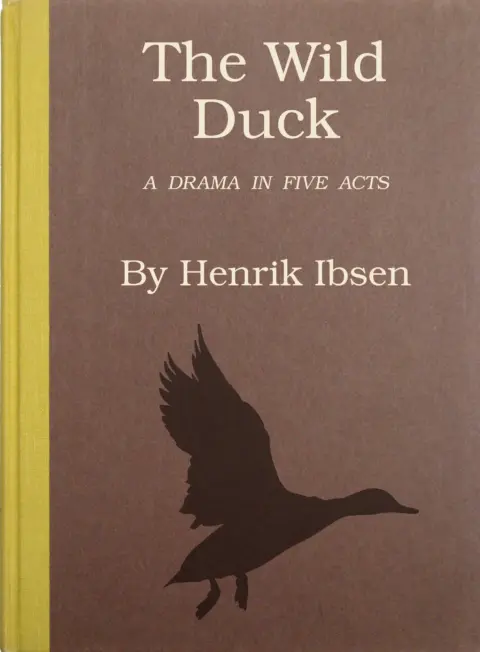
The wild duck
Henrik Ibsen
THE CLASSIC COLLECTION · 1907
"Love's Comedy" by Henrik Ibsen is a verse comedy first published in 1862. When idealistic poet Falk denounces bourgeois marriage as the death of true love, society brands him immoral and ostracizes him. But Svanhild admires his courage, and together they plan to escape convention and live their ideal. Can passionate love survive beyond its first flush, or must it be preserved untainted by refusing to let it fade into comfortable domesticity? Their surprising answer challenges everything they believe about romance and sacrifice.
Introduction adapted from the source catalogue; source summaries may be automatically generated.
Free to read · English · 26,705 words · No account needed
MAKE TIME FOR A GOOD BOOK
On by default. Untick to stop anonymous reading totals. Each page counts after 10 seconds in view. How this works.
Anonymous counting is on unless you have switched it off.
GULDSTAD.
Do you doubt it now?
MRS. HALM.
This is most singular.
GULDSTAD.
O, I've noted how
His work of late absorb'd his interest.
MRS. HALM [to herself].
Who would have fancied Svanhild so sly?
[Vivaciously to GULDSTAD.
But no--I can't think.
GULDSTAD.
Put it to the test.
MRS. HALM.
Now, on the spot?
GULDSTAD.
Yes, and decisively!
MRS. HALM [giving him her hand].
God's blessing with you!
GULDSTAD [gravely].
Thanks, it may bestead.
[Comes to the front.
MRS. HALM [looking back as she goes towards the house].
Whichever way it goes, my child is sped.
[Goes in.
GULDSTAD [approaching FALK].
It's late, I think?
FALK.
Ten minutes and I go.
GULDSTAD.
Sufficient for my purpose.
SVANHILD [going].
Farewell.
GULDSTAD.
No,
Remain.
SVANHILD.
Shall I?
GULDSTAD.
Until you've answered me.
It's time we squared accounts. It's time we three
Talked out for once together from the heart.
FALK [taken aback].
We three?
GULDSTAD.
Yes,--all disguises flung apart.
FALK [suppressing a smile].
O, at your service.
GULDSTAD.
Very good, then hear.
We've been acquainted now for half a year;
We've wrangled--
FALK.
Yes.
GULDSTAD.
We've been in constant feud;
We've changed hard blows enough. You fought--alone--
For a sublime ideal; I as one
Among the money-grubbing multitude.
And yet it seemed as if a chord united
Us two, as if a thousand thoughts that lay
Deep in my own youth's memory benighted
Had started at your bidding into day.
Yes, I amaze you. But this hair grey-sprinkled
Once fluttered brown in spring-time, and this brow,
Which daily occupation moistens now
With sweat of labour, was not always wrinkled.
Enough; I am a man of business, hence--
FALK [with gentle sarcasm].
You are the type of practical good sense.
GULDSTAD.
And you are hope's own singer young and fain.
[Stepping between them.
Just therefore, Falk and Svanhild, I am here.
Now let us talk, then; for the hour is near
Which brings good hap or sorrow in its train.
FALK [in suspense].
Speak, then!
GULDSTAD [smiling].
My ground is, as I said last night,
A kind of poetry--
FALK.
In practice.
GULDSTAD.
Right!
FALK.
And if one asked the source from which you drew--?
GULDSTAD
[Glancing a moment at SVANHILD, and then turning
again to FALK.
A common source discovered by us two.
SVANHILD.
Now I must go.
Your reading position is saved on this browser. Take it to another device with a library code. Reading pages adapt to text, rather than matching a printed edition.
BEHIND THE BOOK
This eBook is for the use of anyone anywhere in the United States and most other parts of the world at no cost and with almost no restrictions whatsoever. You may copy it, give it away or re-use it under the terms of the Project Gutenberg License included with this eBook or online at www.gutenberg.org. If you are not located in the United States, you will have to check the laws of the country where you are located before using this eBook. Read the source licence.
The original source file, including credits and licence, is retained by this library. Request an original-format copy at no charge. Please include the book title and Project Gutenberg identifier #18657.
KEEP YOUR CURIOSITY GOING
Maurice Baring
W. B. (William Butler) Yeats
Edward Martyn

John Brougham & Charlotte Brontë
Marguerite Merington
Leonid Andreyev