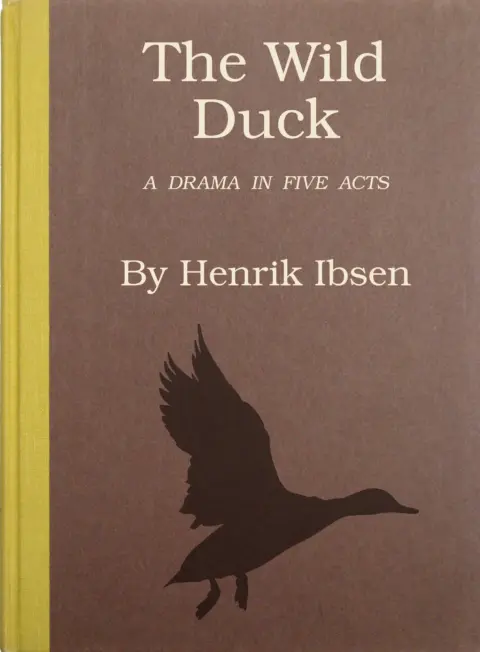
The wild duck
Henrik Ibsen
THE CLASSIC COLLECTION · 1907
"Love's Comedy" by Henrik Ibsen is a verse comedy first published in 1862. When idealistic poet Falk denounces bourgeois marriage as the death of true love, society brands him immoral and ostracizes him. But Svanhild admires his courage, and together they plan to escape convention and live their ideal. Can passionate love survive beyond its first flush, or must it be preserved untainted by refusing to let it fade into comfortable domesticity? Their surprising answer challenges everything they believe about romance and sacrifice.
Introduction adapted from the source catalogue; source summaries may be automatically generated.
Free to read · English · 26,705 words · No account needed
MAKE TIME FOR A GOOD BOOK
On by default. Untick to stop anonymous reading totals. Each page counts after 10 seconds in view. How this works.
Anonymous counting is on unless you have switched it off.
LIND.
Well; I go,--disclose to none
The secret that we share alone with one.
'Twas good of you to listen; now enfold it
Deep in your heart,--warm, glowing, as I told it.
[He goes out in the background to the others. FALK
looks after him a moment, and paces up and down
in the garden, visibly striving to master his
agitation. Presently SVANHILD comes out with a
shawl on her arm, and is going towards the back.
FALK approaches and gazes at her fixedly.
SVANHILD stops.
SVANHILD [after a short pause].
You gaze at me so!
FALK [half to himself].
Yes, 'tis there--the same;
The shadow in her eyes' deep mirror sleeping,
The roguish elf about her lips a-peeping,
It is there.
SVANHILD.
What? You frighten me.
FALK.
Your name
Is Svanhild?
SVANHILD.
Yes, you know it very well.
FALK.
But do you know the name is laughable?
I beg you to discard it from to-night!
SVANHILD.
That would be far beyond a daughter's right--
FALK [laughing].
Hm. "Svanhild! Svanhild!"
[With sudden gravity.
With your earliest breath
How came you by this prophecy of death?
SVANHILD.
Is it so grim?
FALK.
No, lovely as a song,
But for our age too great and stern and strong,
How can a modern demoiselle fill out
The ideal that heroic name expresses?
No, no, discard it with your outworn dresses.
SVANHILD.
You mean the mythical princess, no doubt--
FALK.
Who, guiltless, died beneath the horse's feet.
SVANHILD.
But now such acts are clearly obsolete.
No, no, I'll mount his saddle! There's my place!
How often have I dreamt, in pensive ease,
He bore me, buoyant, through the world apace,
His mane a flag of freedom in the breeze!
FALK.
Yes, the old tale. In "pensive ease" no mortal
Is stopped by thwarting bar or cullis'd portal;
Fearless we cleave the ether without bound;
In practice, tho', we shrewdly hug the ground;
For all love life and, having choice, will choose it;
And no man dares to leap where he may lose it.
SVANHILD.
Yes! show me but the end, I'll spurn the shore;
But let the end be worth the leaping for!
A Ballarat beyond the desert sands--
Else each will stay exactly where he stands.
FALK [sarcastically].
I grasp the case;--the due conditions fail.
SVANHILD [eagerly].
Exactly: what's the use of spreading sail
When there is not a breath of wind astir?
Your reading position is saved on this browser. Take it to another device with a library code. Reading pages adapt to text, rather than matching a printed edition.
BEHIND THE BOOK
This eBook is for the use of anyone anywhere in the United States and most other parts of the world at no cost and with almost no restrictions whatsoever. You may copy it, give it away or re-use it under the terms of the Project Gutenberg License included with this eBook or online at www.gutenberg.org. If you are not located in the United States, you will have to check the laws of the country where you are located before using this eBook. Read the source licence.
The original source file, including credits and licence, is retained by this library. Request an original-format copy at no charge. Please include the book title and Project Gutenberg identifier #18657.
KEEP YOUR CURIOSITY GOING
Maurice Baring
W. B. (William Butler) Yeats
Edward Martyn

John Brougham & Charlotte Brontë
Marguerite Merington
Leonid Andreyev