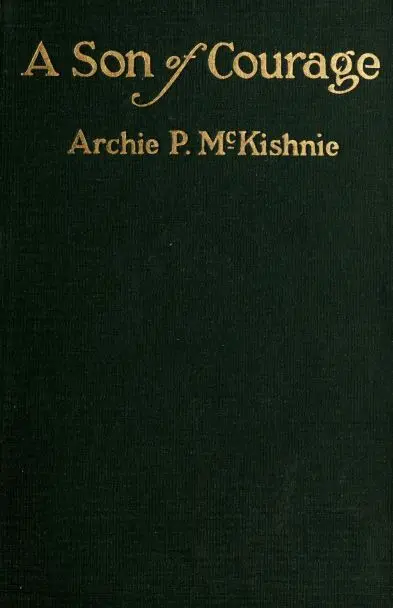
A Son of Courage
Archie P. McKishnie

THE CLASSIC COLLECTION · 1910
"Love of the Wild" by Archie P. McKishnie is a novel written in the early 20th century. The story primarily revolves around Boy McTavish, a young man deeply connected to nature and the untamed wilderness around him. As his world is threatened by the encroachment of civilization and a new schoolteacher, Boy grapples with his love for the wild and the complexities of his life as he navigates his relationships and his place in a changing environment. At the start of the story, we are introduced to Boy McTavish, who observes the interactions of local wildlife—a black squirrel being chased by red squirrels—while he contemplates the intrusion of civilization symbolized by a nearby schoolhouse. He displays a deep understanding of the forest and its creatures, highlighting his connection to the natural world. When he captures a squirrel, he is faced with the reality of life and death in nature, leading to reflections on the sacrifices inherent in the cycle of life. The narrative shifts to Boy’s home, where family dynamics and his affection for a girl named Gloss begin to unfold against the backdrop of nature. As conflicts with an encroaching authority figure, Mr. Watson, and the looming threat of colonization arise, Boy's internal struggles and his passion for the wild are central to the unfolding drama.
Introduction adapted from the source catalogue; source summaries may be automatically generated.
Free to read · English · 81,219 words · No account needed
MAKE TIME FOR A GOOD BOOK
On by default. Untick to stop anonymous reading totals. Each page counts after 10 seconds in view. How this works.
Anonymous counting is on unless you have switched it off.
“When the little ma is well, which please God ’ll soon be,” said McTavish, “we’ll have a real old-fashioned dance here, with all the old boys and girls and all the young boys and girls right here together. And then, ladies, ma and me’ll show you how the minuet should be danced. We’ll have French Joe over to play. He’s a good fiddler, is Joe, almost as good as anybody I know.”
He hung the instrument up on its nail and, passing on to the couch, sank
on his knee before it.
“Ma,” he said softly, stroking the heavy brown hair away from the little woman’s forehead, “there’s only one real shadder in all this big bright bush-world of ours, and God ain’t goin’ to let that rest there long. I’ve watched shadders long enough to know that they don’t last. When this one passes there’ll be happy times. You maybe can guess how much I miss you up and around, ma, so won’t you try and get better for my sake, and all our sakes?”
She caught the rough, strong hand in hers and held it against her face.
“Mac,” she whispered, “I’ll try even harder than I have been doing.”
He patted her cheek and made to rise, but she held him.
“And Mac,” she said, a catch in her voice, “you mus’n’t worry about me, or about anything, and you must show Boy that it is useless to worry about losing this bushland. Nobody can steal it, Mac, believe me; I know.”
“O’ course you know, ma.” He arose and hastily left the house.
Widow Ross, in white apron and bare arms, was dissecting one of the golden pumpkins on a block of wood outside.
“Ander’ll likely have a fine day for his loggin’ to-morrow,” she remarked as McTavish passed.
“There’ll be quite a crowd there, I bet,” returned the man. “I’ve sort of led ’em all to expect a good feed of custard, widder.”
“Oh, you go along, you blarney,” cried Mrs. Ross. But she cut into the pumpkin with renewed vigor and started to sing:
“Oh, we’ll cross the river of Jordan,
Happy, happy, happy, happy,
Cross the river of Jordan,
Happy in the Lord.”
McTavish listened in wonderment, then with a chuckle made to pass on. The woman bade him stay a moment.
“I’m not just sure I done right in dancin’ in that Scotch four,” she faltered. “Mr. Smythe seems to think dancin’ wrong, same’s smokin’ and such.”
Your reading position is saved on this browser. Take it to another device with a library code. Reading pages adapt to text, rather than matching a printed edition.
Archie P. McKishnie
BEHIND THE BOOK
This eBook is for the use of anyone anywhere in the United States and most other parts of the world at no cost and with almost no restrictions whatsoever. You may copy it, give it away or re-use it under the terms of the Project Gutenberg License included with this eBook or online at www.gutenberg.org. If you are not located in the United States, you will have to check the laws of the country where you are located before using this eBook. Read the source licence.
The original source file, including credits and licence, is retained by this library. Request an original-format copy at no charge. Please include the book title and Project Gutenberg identifier #49553.
KEEP YOUR CURIOSITY GOING
Coulson Kernahan

Maurice Baring
Frances Wright
Cécile Tormay

Frederic Jesup Stimson

W. H. P. (William Henry Pope) Jarvis