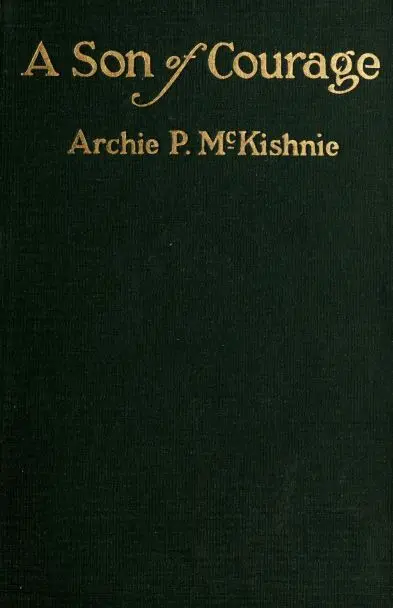
A Son of Courage
Archie P. McKishnie

THE CLASSIC COLLECTION · 1910
"Love of the Wild" by Archie P. McKishnie is a novel written in the early 20th century. The story primarily revolves around Boy McTavish, a young man deeply connected to nature and the untamed wilderness around him. As his world is threatened by the encroachment of civilization and a new schoolteacher, Boy grapples with his love for the wild and the complexities of his life as he navigates his relationships and his place in a changing environment. At the start of the story, we are introduced to Boy McTavish, who observes the interactions of local wildlife—a black squirrel being chased by red squirrels—while he contemplates the intrusion of civilization symbolized by a nearby schoolhouse. He displays a deep understanding of the forest and its creatures, highlighting his connection to the natural world. When he captures a squirrel, he is faced with the reality of life and death in nature, leading to reflections on the sacrifices inherent in the cycle of life. The narrative shifts to Boy’s home, where family dynamics and his affection for a girl named Gloss begin to unfold against the backdrop of nature. As conflicts with an encroaching authority figure, Mr. Watson, and the looming threat of colonization arise, Boy's internal struggles and his passion for the wild are central to the unfolding drama.
Introduction adapted from the source catalogue; source summaries may be automatically generated.
Free to read · English · 81,219 words · No account needed
MAKE TIME FOR A GOOD BOOK
On by default. Untick to stop anonymous reading totals. Each page counts after 10 seconds in view. How this works.
Anonymous counting is on unless you have switched it off.
“Finest pack in Ontario; finest pack in the whole Dominion, I say—those fellows,” laughed Hallibut, jolting, in the semi-darkness, against a pile of furs and toppling it over on the floor.
Immediately three of the tired dogs stretched themselves out on the soft bed, as though it had been arranged for them, and went to sleep. Hallibut threw himself into a chair by the fireplace and laughed at the other’s dismay.
“Better not try to disturb ’em, Smythe,” he cautioned. “They’re ugly, I tell you. Get them something to eat, will you? And say, Smythe, just have that nigger of yours get me up a snack, too, like a good fellow; I’ve been riding since morning.”
“St. Thomas?” asked Mr. Smythe, shifting his light eyes to the Colonel’s face and patting his thin hair with his long fingers.
“It doesn’t matter,” returned the other. “Where is Watson?”
“I’m sorry to say,” commenced Smythe; but the Colonel turned upon him, his black brows knit in a frown.
“You needn’t finish. I know.”
He arose stiffly and walked around behind the counter.
“Give me the key, Smythe,” he demanded, holding out his hand.
The Colonel took the key and unlocked a small oak cupboard, extracting from it a bottle of red liquor.
“I’m afraid if Watson persists in drinking I’ll have to find a new agent,” he said, walking to the door and throwing the bottle across the street.
“Seems he can’t resist the drink, Colonel,” stammered the groceryman.
His long face had turned to a yellow-white, though, it was hid by the advancing night-shadows from the black orbs of the ponderous man before him.
“I’ll go and have you a meal prepared. Make yourself comfortable,
Colonel Hallibut.”
Not until the door of the inner room closed upon him did the soul of Smythe vent itself in whispered imprecations. He clenched his claw-like fists and shook them fiercely. He let forth a tirade of murmured oaths that would have made a Newfoundland fisherman gasp in wonder. Finally, he turned and, prying through the gloom, sought out the recumbent figure of his colored man-of-all-work, who was peacefully sleeping on a cot of willow-boughs. Smythe crept forward and bent above the sleeper. A prolonged snore met him. He reached forward and, feeling down the wide bridge of the negro’s nose until he got the desired hold, he deliberately gave that member such a violent twist that Sam came out of Magnolialand to this trying sphere with a suppressed snort.
“Yes, massar,” he cried, struggling up.
“Light the candles and put some bacon to fry,” commanded Smythe. “Colonel Hallibut is here.”
Your reading position is saved on this browser. Take it to another device with a library code. Reading pages adapt to text, rather than matching a printed edition.
Archie P. McKishnie
BEHIND THE BOOK
This eBook is for the use of anyone anywhere in the United States and most other parts of the world at no cost and with almost no restrictions whatsoever. You may copy it, give it away or re-use it under the terms of the Project Gutenberg License included with this eBook or online at www.gutenberg.org. If you are not located in the United States, you will have to check the laws of the country where you are located before using this eBook. Read the source licence.
The original source file, including credits and licence, is retained by this library. Request an original-format copy at no charge. Please include the book title and Project Gutenberg identifier #49553.
KEEP YOUR CURIOSITY GOING
Coulson Kernahan

Maurice Baring
Frances Wright
Cécile Tormay

Frederic Jesup Stimson

W. H. P. (William Henry Pope) Jarvis