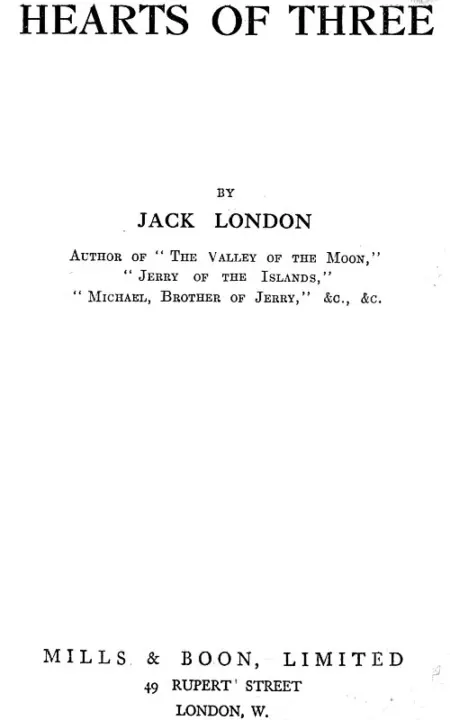
Hearts of three
Jack London
THE CLASSIC COLLECTION · 1906
"Love of Life, and Other Stories" by Jack London is a collection of short stories written during the early 20th century. The opening story, titled "Love of Life," introduces readers to the harsh realities of survival against the odds, as it follows two men, Bill and another unnamed man, who are struggling in the unforgiving wilderness of the Canadian Barrens. The themes of despair, endurance, and the innate will to survive are prominently explored as the characters contend with their physical and emotional hardships. The beginning of "Love of Life" immerses us in the daunting landscape, where the two men are heavily burdened and clearly exhausted. One man, whose sprained ankle hampers him, desperately calls out to his companion Bill, who continues on without looking back. This sets up a poignant tension as he comes to realize his isolation and the overwhelming challenge of survival in an empty and desolate wilderness. We witness his internal battles against fear and despair as he fights to overcome physical pain and the gnawing hunger that threatens his existence, ultimately embodying the predominant theme of survival against both nature and human instinct in Jack London's writing.
Introduction adapted from the source catalogue; source summaries may be automatically generated.
Free to read · English · 48,706 words · No account needed
MAKE TIME FOR A GOOD BOOK
On by default. Untick to stop anonymous reading totals. Each page counts after 10 seconds in view. How this works.
Anonymous counting is on unless you have switched it off.
"The graves must be dug sometime," he said.
"But you do not know how many," she objected desperately. She noted his indecision, and added, "Besides, I'll go with you and help."
Hans stepped back to the table and mechanically snuffed the candle. Then between them they made the examination. Both Harkey and Dutchy were dead--frightfully dead, because of the close range of the shot-gun. Hans refused to go near Dennin, and Edith was forced to conduct this portion of the investigation by herself.
"He isn't dead," she called to Hans.
He walked over and looked down at the murderer.
"What did you say?" Edith demanded, having caught the rumble of inarticulate speech in her husband's throat.
"I said it was a damn shame that he isn't dead," came the reply.
Edith was bending over the body.
"Leave him alone," Hans commanded harshly, in a strange voice.
She looked at him in sudden alarm. He had picked up the shot-gun dropped by Dennin and was thrusting in the shells.
"What are you going to do?" she cried, rising swiftly from her bending
position.
Hans did not answer, but she saw the shot-gun going to his shoulder. She grasped the muzzle with her hand and threw it up.
"Leave me alone!" he cried hoarsely.
He tried to jerk the weapon away from her, but she came in closer and
clung to him.
"Hans! Hans! Wake up!" she cried. "Don't be crazy!"
"He killed Dutchy and Harkey!" was her husband's reply; "and I am going
to kill him."
"But that is wrong," she objected. "There is the law."
He sneered his incredulity of the law's potency in such a region, but he merely iterated, dispassionately, doggedly, "He killed Dutchy and Harkey."
Long she argued it with him, but the argument was one-sided, for he contented himself with repeating again and again, "He killed Dutchy and Harkey." But she could not escape from her childhood training nor from the blood that was in her. The heritage of law was hers, and right conduct, to her, was the fulfilment of the law. She could see no other righteous course to pursue. Hans's taking the law in his own hands was no more justifiable than Dennin's deed. Two wrongs did not make a right, she contended, and there was only one way to punish Dennin, and that was the legal way arranged by society. At last Hans gave in to her.
"All right," he said. "Have it your own way. And to-morrow or next day look to see him kill you and me."
She shook her head and held out her hand for the shot-gun. He started to hand it to her, then hesitated.
Your reading position is saved on this browser. Take it to another device with a library code. Reading pages adapt to text, rather than matching a printed edition.
Jack London
Jack London
Jack London
Jack London
BEHIND THE BOOK
This eBook is for the use of anyone anywhere in the United States and most other parts of the world at no cost and with almost no restrictions whatsoever. You may copy it, give it away or re-use it under the terms of the Project Gutenberg License included with this eBook or online at www.gutenberg.org. If you are not located in the United States, you will have to check the laws of the country where you are located before using this eBook. Read the source licence.
The original source file, including credits and licence, is retained by this library. Request an original-format copy at no charge. Please include the book title and Project Gutenberg identifier #710.
KEEP YOUR CURIOSITY GOING
Coulson Kernahan

Maurice Baring
Frances Wright
Cécile Tormay

Frederic Jesup Stimson

W. H. P. (William Henry Pope) Jarvis