
The Diary of a Saint
Arlo Bates
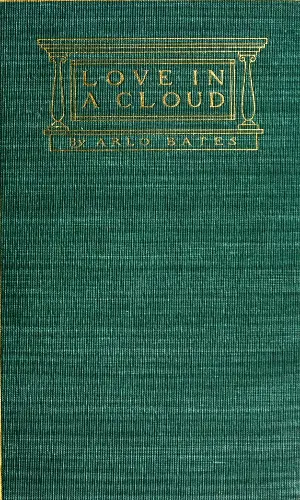
THE CLASSIC COLLECTION · 1900
"Love in a Cloud: A Comedy in Filigree" by Arlo Bates is a novel written in the late 19th century. The story revolves around the complexities of love and social interactions among a group of characters in high society, particularly focusing on young May Calthorpe and her secret correspondence with the mysterious author Christopher Calumus, who is linked to the popular book "Love in a Cloud." Other characters, like Mrs. Harbinger and Tom Harbinger, also navigate their romantic entanglements, revealing a comedic yet poignant exploration of relationships. At the start of the novel, we find May Calthorpe enthusiastically defending the merits of the book "Love in a Cloud" to her friend Mrs. Harbinger, who is tired of its incessant mention in their social circle. As the conversation unfolds, it is revealed that May has taken a bold step by writing to the author using a pseudonym, Christopher Calumus, expressing her admiration for his work. May eagerly anticipates meeting the author that afternoon at tea, setting the stage for an exciting blend of romance, misunderstandings, and intriguing social dynamics to come. The opening serves as an engaging introduction to the themes of love, secrecy, and societal norms that will play a significant role throughout the story.
Introduction adapted from the source catalogue; source summaries may be automatically generated.
Free to read · English · 66,579 words · No account needed
MAKE TIME FOR A GOOD BOOK
On by default. Untick to stop anonymous reading totals. Each page counts after 10 seconds in view. How this works.
Anonymous counting is on unless you have switched it off.
"I am afraid," he said, "that even the author of 'Love in a Cloud'
wouldn't expect so much of you as that you should call his story the
best."
"I do call it the best," she returned, a little defiantly. "Don't you?"
"No," he said slowly, "I couldn't go so far as that."
"But you spoke yesterday as if you admired it."
"But that isn't the same thing as saying that there is nothing better."
Miss Calthorpe began to tap her small foot impatiently.
"That is always the way with men who write," she declared. "They always have all sorts of fault to find with everything."
"Have you known a great many literary men?" he asked.
There are few things more offensive in conversation, especially in conversation with a lady, than an insistence upon logic. To ask of a woman that she shall make only exact statements is as bad as to require her to be always consistent, and there is small reason for wonder if at this inquiry Miss Calthorpe should show signs of offense.
"I do not see what that has to do with the matter," she returned stiffly. "Of course everybody knows about literary men."
The sun of the April afternoon smiled over the landscape, and the young man smiled under his mustache, which was too large to be entirely becoming. He glanced up at his companion, who did not smile in return, but only sat there looking extremely pretty, with her flushed cheeks, her dark hair in pretty willful tendrils about her temples, and her dark eyes alight.
"Perhaps you have some personal feeling about the book," he said. "You know that it is claimed that a woman's opinion of literature is always half personal feeling."
She flushed more deeply yet, and drew herself up as if he were intruding upon unwarrantable matters.
"I don't even know who wrote the book," she replied.
"Then it is only the book itself that you admire, and not the author?"
"Of course it is the book. Haven't I said that I don't even know who the author is? I can't see," she went on somewhat irrelevantly, "why it is that as soon as there is anything that is worth praising you men begin to run it down."
He looked as if he were a trifle surprised at her warmth.
"Run it down?" he repeated. "Why, I am not running it down. I said that I admired the novel, didn't I?"
"But you said that you didn't think it was one of the best," she
insisted.
"But you might allow a little for individual taste, Miss Calthorpe."
Your reading position is saved on this browser. Take it to another device with a library code. Reading pages adapt to text, rather than matching a printed edition.
Arlo Bates

Arlo Bates

Arlo Bates

Arlo Bates
BEHIND THE BOOK
This eBook is for the use of anyone anywhere in the United States and most other parts of the world at no cost and with almost no restrictions whatsoever. You may copy it, give it away or re-use it under the terms of the Project Gutenberg License included with this eBook or online at www.gutenberg.org. If you are not located in the United States, you will have to check the laws of the country where you are located before using this eBook. Read the source licence.
The original source file, including credits and licence, is retained by this library. Request an original-format copy at no charge. Please include the book title and Project Gutenberg identifier #42831.
KEEP YOUR CURIOSITY GOING
Coulson Kernahan

Maurice Baring
Frances Wright
Cécile Tormay

Frederic Jesup Stimson

W. H. P. (William Henry Pope) Jarvis