THE CLASSIC COLLECTION✦Helen and Arthur; or, Miss Thusa’s Spinning WheelCLASSIC FREE BOOKS
Helen and Arthur; or, Miss Thusa’s Spinning Wheel
Caroline Lee Hentz
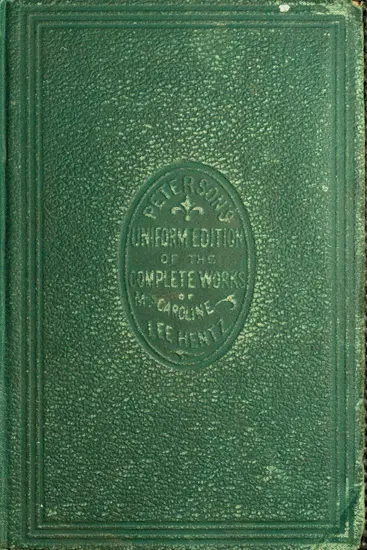
THE CLASSIC COLLECTION · 1857
"Love After Marriage; and Other Stories of the Heart" by Caroline Lee Hentz is a collection of short stories written in the late 19th century. The anthology appears to delve into themes related to love, relationships, and societal expectations, particularly focusing on the emotional intricacies surrounding marriage. The opening story introduces us to key characters whose fates become intertwined, setting the stage for the exploration of affection and social perceptions. At the start of the opening portion, readers are introduced to Augusta Temple, who is anxiously awaiting the arrival of her betrothed, Sydney Allison. However, their first encounter unfolds humorously, as Augusta reacts with dismay to Sydney's changed appearance, a result of illness, leading to feelings of disappointment and disdain. As Sydney, unaware of her reaction, contemplates his own acceptance of their union, both characters grapple with the emotional nuance of their situation. The narrative foreshadows a complex dynamic as they navigate their obligations, expectations, and personal feelings, ultimately hinting at deeper themes of love and emotional growth amidst societal pressures and personal struggles.
Introduction adapted from the source catalogue; source summaries may be automatically generated.
Free to read · English · 100,134 words · No account needed
MAKE TIME FOR A GOOD BOOK
On by default. Untick to stop anonymous reading totals. Each page counts after 10 seconds in view. How this works.
Anonymous counting is on unless you have switched it off.
The leaves of autumn soon fell, and then everything was changed in the destiny of Grace. Mr. Worthington claimed his child, and when Susan resigned her, her last words bid her pray for strength to keep her virtuous resolution.
It would be difficult to describe the passions that struggled for mastery in Lucy's breast, when she learned from her brother the part he had acted. Incapable of concealing them at first, and believing she had lost the affection of Roland, she no longer disguised the bitterness of her heart. She hated Grace still more, since she was conscious she had injured her, and when she, appealing in behalf of Roland's happiness as well as her own, entreated her to free her from her promise, she turned a deaf ear to the prayer, and claimed the fulfilment of her word, renewing the same fearful penalty--"Unless," she added, with a scornful smile, "you can prove your family equal to ours, and that your alliance will bring no disgrace."
Strange paradox of the human heart! Had Lucy taken scorpions into her bosom, she could not have suffered keener pangs than the consciousness of Roland's alienated affection caused her; yet she refused to bend her stubborn pride, and wrapped herself up in the sulliness of self-will, feeling a kind of stern joy that she had made others as wretched as herself.
Grace was standing in a lighted saloon, leaning on the arm of Mr. Worthington, and an unwilling partaker of the gay scene. A tall and majestic-looking man passed the spot where she stood, whose appearance excited her interest and curiosity, for he was evidently a stranger in the throng of fashion and wealth, then gathered together. The suns of warmer climes had darkened his face, and added gloom to features of a fine and noble expression. As Grace lifted her mild gray eyes his somewhat stern countenance relaxed, and turning round he gazed earnestly in her face. Abashed by his scrutiny, she moved into another part of the room; still the tall stranger followed, with his melancholy eyes, pursuing her figure. Roland, never far from the object of his apparently hopeless devotion, now jealous and irritated, drew to her side. "Oh, Roland," said she, suddenly agitated by a new emotion, "there is something in that stranger's face, resembling this!"--and she drew from her bosom the miniature suspended from the golden chain. There was indeed a resemblance, only the face of the picture was younger, and the sable locks unbleached. The stranger observed the motions of Grace, and pressed forward, while the miniature was still open in her hand. "Pardon me, madam," said he, earnestly, "I must be pardoned--but allow me to look at that picture." Grace with trembling fingers unloosed the chain, and gave it into the stranger's hand. "It was once my mother's," said she, in a faltering voice, "and her name was Grace Goldman." "Was"--said the stranger--"and yet how could it be otherwise?--she was my sister--my only sister--and you"--he became too much agitated to finish the sentence, and entirely forgetting the throng that surrounded them, he clasped Grace to his bosom, as the living representative of his lost and lamented sister. Yes! in Mr. Maitland, the rich merchant, just returned from the East Indies, Grace had found an uncle, which proved her lineage to be such, that even the proud Lucy must acknowledge to be equal to her own. His sister, the mother of Grace, had eloped, when very young, with a handsome but profligate man, and being cast off by her parents, she was soon doomed to eat the bread of poverty, in consequence of her husband's excesses. Her brother, as soon as he learned her situation, offered to support her through life, declaring his intention never to marry, if she would leave her unprincipled husband. But she, in the strength of that passion which hopes all, believes all, and endures all, refused to leave the man she still loved, and whom she still trusted she might reclaim. Her brother, finding her wedded to her fate, left her with a purse of gold and his own miniature as a parting pledge of love, and departed for a foreign land. Forced to fly from the clamours of his creditors, Goldman removed his wife from place to place, till she was far out of the reach of former friends, when, plunging deeper and deeper in the gulf of inebriation, he left her to die, as we have described, of a broken heart. For himself, he died a drunkard's death by the wayside, and was buried by the same humane society that protected his orphan child. This circumstance had been concealed from Grace, nor did she learn it, till her subsequent visit to the Shaker village. Mr. Maitland, who had dwelt long in other lands, accumulating wealth, which his generous heart longed to share with the friends of his early youth, returned to mourn over the graves of his parents, and to seek in vain intelligence of his lost sister, till he saw in the crowd the lovely form of Grace, such as her ill-fated mother was in the days of her beauty and youth. Lucy could with sincerity offer her congratulations and welcome as a sister the niece of Mr. Maitland, though she had scorned the alliance of the humble Shaker girl. But she felt she was degraded in her eyes, and this was a punishment to her proud spirit, keener than the task-master's lash. Mr. Maitland's gratitude to Mr. Worthington was boundless as it was warm; but he longed to see the kind Samaritans, who had soothed his sister's dying hours and guarded her orphan child.
Your reading position is saved on this browser. Take it to another device with a library code. Reading pages adapt to text, rather than matching a printed edition.
Caroline Lee Hentz
Caroline Lee Hentz
BEHIND THE BOOK
This eBook is for the use of anyone anywhere in the United States and most other parts of the world at no cost and with almost no restrictions whatsoever. You may copy it, give it away or re-use it under the terms of the Project Gutenberg License included with this eBook or online at www.gutenberg.org. If you are not located in the United States, you will have to check the laws of the country where you are located before using this eBook. Read the source licence.
The original source file, including credits and licence, is retained by this library. Request an original-format copy at no charge. Please include the book title and Project Gutenberg identifier #43019.
KEEP YOUR CURIOSITY GOING
Coulson Kernahan

Maurice Baring
Frances Wright
Cécile Tormay

Frederic Jesup Stimson

W. H. P. (William Henry Pope) Jarvis