THE CLASSIC COLLECTION✦Helen and Arthur; or, Miss Thusa’s Spinning WheelCLASSIC FREE BOOKS
Helen and Arthur; or, Miss Thusa’s Spinning Wheel
Caroline Lee Hentz
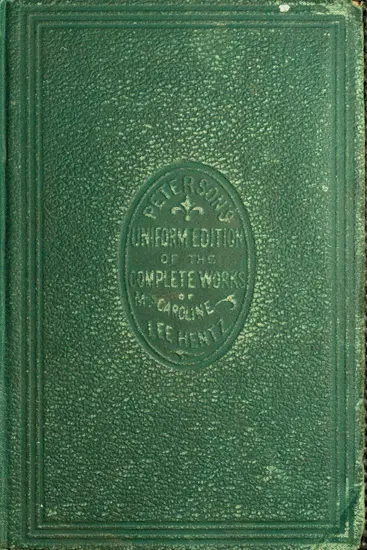
THE CLASSIC COLLECTION · 1857
"Love After Marriage; and Other Stories of the Heart" by Caroline Lee Hentz is a collection of short stories written in the late 19th century. The anthology appears to delve into themes related to love, relationships, and societal expectations, particularly focusing on the emotional intricacies surrounding marriage. The opening story introduces us to key characters whose fates become intertwined, setting the stage for the exploration of affection and social perceptions. At the start of the opening portion, readers are introduced to Augusta Temple, who is anxiously awaiting the arrival of her betrothed, Sydney Allison. However, their first encounter unfolds humorously, as Augusta reacts with dismay to Sydney's changed appearance, a result of illness, leading to feelings of disappointment and disdain. As Sydney, unaware of her reaction, contemplates his own acceptance of their union, both characters grapple with the emotional nuance of their situation. The narrative foreshadows a complex dynamic as they navigate their obligations, expectations, and personal feelings, ultimately hinting at deeper themes of love and emotional growth amidst societal pressures and personal struggles.
Introduction adapted from the source catalogue; source summaries may be automatically generated.
Free to read · English · 100,134 words · No account needed
MAKE TIME FOR A GOOD BOOK
On by default. Untick to stop anonymous reading totals. Each page counts after 10 seconds in view. How this works.
Anonymous counting is on unless you have switched it off.
Had Mr. Worthington conceived the project that Lucy had suggested, and been aware at the same time of Roland's family pride, it is not probable he would have induced her to reveal to him the sad events of her childhood; and had Grace been the artful being described, she would never have told with such straightforward simplicity and deep sensibility of her father's brutality and vices, nor expressed the startling fear, that he might still assert the forfeited rights of nature, and tear her from the arms of her benefactor. Such thoughts as these filled the breast of Roland, as Grace continued her affecting recital, where truth was attested by her blushes and her tears. She unclasped from her neck a golden chain, from which a miniature was suspended, the sole relic of her mother. The chain was beautifully wrought, and indicated that however abject was the condition to which the owner had been reduced, she had once been accustomed to the decorations of wealth. The miniature was that of a gentleman in the prime of life, with a dark, but interesting countenance, and dignified bearing. Grace knew not whether it was her father's picture, for she had but a faint recollection of his features, and the Shaker who discovered it around her mother's neck, after she was speechless in death, could give her no information.
Here was mystery and romance, innocence, beauty, and youth; and Roland felt as if he would gladly twine them together, and bind them around his heart, as all "he guessed of heaven." But while his imagination was weaving the garland and revelling in its fragrance, the vision of
"A sister's jealous care,
A cruel sister she,"
rose before him, and the wreath faded and the blossoms fell. With a stinging sensation of shame, he admitted the conviction, that he feared his sister. He had long worn her fetters unconsciously, but now, when for the first time they galled and restrained him, his pride and his heart rebelled against the hand that bound him in thraldom. Grace retired that night, with a thousand bright hopes hovering round her pillow. Roland then was her first benefactor. It was he, who had awakened the interest of Mr. Worthington, and directed him to her retreat. He, the handsome and noble-looking youth, whose dark piercing eyes had kindled in her such yearnings after the world from which she was excluded, and who for four years had been the morning and evening star on the horizon of her memory. She knew something of this before, but she had never realized it so fully as now; for he had himself confirmed it, by words, which, though simple in themselves, were unutterably eloquent, accompanied by such looks--she blushed even in the darkness, as she caught herself involuntarily repeating, "and have I found my pretty Shakeress at last?" For two or three days, Roland avoided being alone with Lucy, but to his surprise, she did not seem to desire an opportunity to renew her warnings. On the contrary, she was more kind and affectionate towards Grace than she had ever been before, who, in the confidingness of innocence, relied on her unwonted testimonies of favour, as the harbingers of her dearest wishes. "Grace," said Lucy--they were alone and secure of interruption, for Mr. Worthington and Roland were both absent on business--"Grace, are you willing to tell me of what you are now thinking?" Grace started--she had fallen into an unconscious revery, and her work lay idly in her lap; her cheeks glowed painfully, but with that habitual reverence for truth which always distinguished her, she answered, "I was thinking of Roland." Unprepared for such perfect ingenuousness, Lucy hesitated a moment, and conscience upbraided her for the part she was about to act, but again fixing her keen eye on a countenance as transparent as crystal, she continued: "Has Roland ever told you that he loved you?" Grace crimsoned still more deeply from wounded modesty and shame, while she answered in a low voice, "Never!" "Then," said the inquisitor, drawing a relieving breath, "Grace, your task is easy, and I rejoice that he has made it so; you must not think of Roland, you must not love him, for he never can be to you anything more than he now is." Grace turned deadly pale, but she did not speak, and Lucy went on--"My brother was my father's only son, and is sole heir of a name long conspicuous for its honours. Our parents died when we were both young; but I, as the elder, became the guardian and guide. To me, on his death-bed, my father committed my young brother, charging me with the solemnity of that awful hour, to guard his honour from stain, and his name from degradation. My father was a proud and haughty man, and he has transmitted to his children a portion of his own spirit. Grace, you have told me all the circumstances of your life; you know there is mystery, but you may not know in your extreme simplicity, that there may be disgrace in your birth. The golden chain that wreathes your neck, shows that your mother was not born to poverty. Why then did she flee from her friends, to bury herself in solitude with the dark and cruel man you called father; and why are you an alien from your kindred? You ought to know these truths, which the mistaken kindness of your friends conceals from you, and I reveal them to you, that you may not encourage hopes that never can be realized; to convince you, you can never be the wife of Roland. For myself, hear me, Grace, to the end--if Roland could forget himself so far as to think of such an union, I would forever disown him as a brother, and load with maledictions the being who had brought such misery on us both." All the strong passions at work in Lucy's bosom, sent their baleful lustre to her eyes, and poor Grace shrunk from their beams as if they were withering her very heart. Brought up in the midst of that gentle and subdued sisterhood, in whose uniform existence the passions seemed cradled into unbroken slumber, she had almost forgotten their existence. The terrible dreams of her childhood were brought back to her. The curses of her father again rung in her ears--the helpless cries of her mother. She clasped her hands despairingly over her eyes--she knew she had been poor and wretched; but benevolence and charity had administered to her wants, and the very remembrance of poverty had faded from her mind; but disgrace--that there was a disgrace attached to her that made it sinful in her to love Roland Gray, that debarred her from an union with the honourable and good--that was the thought that crushed her, that chilled her blood, and turned her cheeks to marble and her lips to ashes. Lucy paused, and attempted to soothe the agony she had excited. Cold herself to the softer emotions, she had no faith in the eternity of love. Grace, like a child robbed of its plaything, now wept and refused to be comforted, but she would soon smile animated by some new-born hope. Thus Lucy tried to reason, while she held her chill grasp on the heart of Grace, and bound her still more closely to her will. "Promise me," said she, "that you will not reveal to any one the conversation of this morning--Mr. Worthington has deceived you, and you would not meanly appeal to the compassion of Roland--promise this, and you shall find in me a friend who will never forsake you in weal or woe. Deny it, and you will create an enemy whose power can make you tremble." Grace, with all her woman's pride rising to her relief, at the idea of appealing to the compassion of Roland, gave the desired promise, and still more--she voluntarily declared she would rather die than think of Roland, after what Lucy had just uttered. Lucy, satisfied with her promise, for she knew her truth, embraced her with commendations which fell heedlessly on poor Grace's paralyzed ears--she withdrew to her chamber, "for her whole head was pained and her whole heart sick;" and when Mr. Worthington and Roland returned, Grace was said to be unable, from indisposition, to join the circle, where she was wont to preside an angel of light and joy. The sympathy and sorrow excited by so common an event, reconciled Lucy more than anything else, to her selfishness and cruelty. But was she happy in the success of her operations! She had planted thorns in the bosom of another--but were there none rankling in her own! Could she, a daughter of this land of republicanism, shelter herself under the cold shadow of family pride, from the reproaches of her own conscience? Ah! no! the heart is its own avenger, and for every drop of sorrow wilfully wrung from the eyes of another, shall be doomed to give only tears of blood.
Your reading position is saved on this browser. Take it to another device with a library code. Reading pages adapt to text, rather than matching a printed edition.
Caroline Lee Hentz
Caroline Lee Hentz
BEHIND THE BOOK
This eBook is for the use of anyone anywhere in the United States and most other parts of the world at no cost and with almost no restrictions whatsoever. You may copy it, give it away or re-use it under the terms of the Project Gutenberg License included with this eBook or online at www.gutenberg.org. If you are not located in the United States, you will have to check the laws of the country where you are located before using this eBook. Read the source licence.
The original source file, including credits and licence, is retained by this library. Request an original-format copy at no charge. Please include the book title and Project Gutenberg identifier #43019.
KEEP YOUR CURIOSITY GOING
Coulson Kernahan

Maurice Baring
Frances Wright
Cécile Tormay

Frederic Jesup Stimson

W. H. P. (William Henry Pope) Jarvis