THE CLASSIC COLLECTION✦Helen and Arthur; or, Miss Thusa’s Spinning WheelCLASSIC FREE BOOKS
Helen and Arthur; or, Miss Thusa’s Spinning Wheel
Caroline Lee Hentz
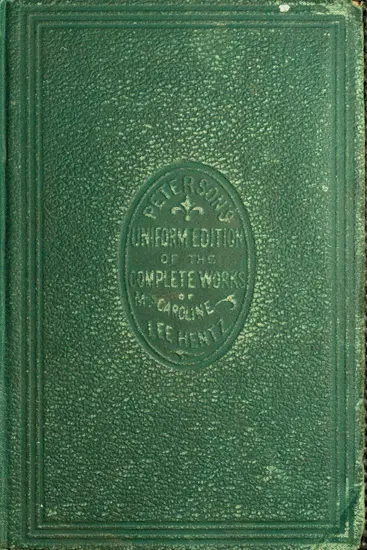
THE CLASSIC COLLECTION · 1857
"Love After Marriage; and Other Stories of the Heart" by Caroline Lee Hentz is a collection of short stories written in the late 19th century. The anthology appears to delve into themes related to love, relationships, and societal expectations, particularly focusing on the emotional intricacies surrounding marriage. The opening story introduces us to key characters whose fates become intertwined, setting the stage for the exploration of affection and social perceptions. At the start of the opening portion, readers are introduced to Augusta Temple, who is anxiously awaiting the arrival of her betrothed, Sydney Allison. However, their first encounter unfolds humorously, as Augusta reacts with dismay to Sydney's changed appearance, a result of illness, leading to feelings of disappointment and disdain. As Sydney, unaware of her reaction, contemplates his own acceptance of their union, both characters grapple with the emotional nuance of their situation. The narrative foreshadows a complex dynamic as they navigate their obligations, expectations, and personal feelings, ultimately hinting at deeper themes of love and emotional growth amidst societal pressures and personal struggles.
Introduction adapted from the source catalogue; source summaries may be automatically generated.
Free to read · English · 100,134 words · No account needed
MAKE TIME FOR A GOOD BOOK
On by default. Untick to stop anonymous reading totals. Each page counts after 10 seconds in view. How this works.
Anonymous counting is on unless you have switched it off.
"What a change there is in Mrs. Wentworth!" observed Miss Bentley to Miss Hart, as they met one morning at the house of a mutual friend. "I never saw any one so transformed in my life. She looks and dresses like the most complete flirt I ever saw; I suspect Captain Wentworth has very good reason to watch her as he does."
Miss Hart shrugged her shoulders and smiled significantly, but did not
say anything.
"It must be a very pleasant alteration to you," continued Miss Bentley, "the house seems to be frequented by gentlemen from morning till night. I suppose you have the grace to appropriate their visits to yourself."
"I have nothing to say about myself," answered Miss Hart, "and I do not wish to speak of Mrs. Wentworth otherwise than kindly. You know she is excessively kind to me, and it would be ungrateful in me to condemn her conduct. To be sure I must have my own thoughts on the subject. She is certainly very imprudent, and too fond of admiration. But I would not have you repeat what I have said, for the world, for being in the family it would have such weight. Be very careful what you say, and above all, don't mention my name."
Miss Bentley was very careful to repeat the remarks to every one she saw, with as many additions of her own as she pleased, and the unutterable language of the smile and the shrug was added too, to give force to the comments. Mrs. Wentworth, in the mean while, unconscious of the serpent she was nursing in her bosom, suffered herself to be borne along on the current on which she had thoughtlessly embarked, without the power to arrest her progress, or turn back into the quiet channel she had quitted. The arrival of her brother, a gay and handsome young man, gave additional animation to her household, and company flowed in still more continuously. Henry More, the brother of Mrs. Wentworth, was the favourite of every circle in which he moved. With an uncommon flow of spirits, a ready and graceful wit, a fluent and flattering tongue, he mingled in society unaffected by its contrasts, unwounded by its asperities, and unruffled by its contentions. He seemed to revel in the happy consciousness of being able to impart pleasure to all, and was equally willing to receive it. He was delighted to find a fine-looking, amiable girl, an inmate of his sister's dwelling, and immediately addressing her in his accustomed strain of sportive gallantry, found that she not only lent a willing ear, but was well skilled in the same language. Though Miss Hart was still young, she had outlived the romance and credulity of youth. She had a precocious experience and wisdom in the ways of this world. She had seen the affections of many a young man, with a disposition open and ingenuous as Henry's, won through the medium of their vanity, by women, too, who could not boast of attractions equal to her own. She believed that juxtaposition could work miracles, and as long as they were the inmates of the same house, participating in the same pleasures, engaged in the same pursuits, and often perusing the same book, she feared no rival. She rejoiced, too, in the close-drawing socialities of the winter fireside, and delighted when a friendly storm compelled them to find all their enjoyment within their own little circle. Mrs. Wentworth, who had once been cheerful and serene in clouds as well as sunshine, was now subject to fits of despondency and silence. It was only when excited by company, that her eyes were lighted up with animation, and her lips with smiles. She dreaded the reproaches of her husband on his return, for acting so contrary to his wishes, and when she heard the night-gust sweep by her windows, and thought of him exposed to the warring elements, perhaps even then clinging to the drifting wreck, or floating in a watery grave, and recollected the scenes of levity and folly in which she was now constantly acting a part, merely to avoid the censures of the very people she detested and despised, she sighed and wept, and wished she had followed her bosom counsellor, rather than the suggestions of the friend in whom she still confided, and on whose affection she relied with unwavering trust. It was strange, she could hear Miss Hart ridicule others, and join in the laugh; she could sit quietly and see her breathe the subtle venom of slander over the fairest characters, till they blackened and became polluted under her touch, and yet she felt herself as secure as if she were placed on the summit of Mont Blanc, in a region of inaccessible purity and splendour. So blinding is the influence of self-love, pampered by flattery, strengthened by indulgence, and unrestrained by religious principle.
Your reading position is saved on this browser. Take it to another device with a library code. Reading pages adapt to text, rather than matching a printed edition.
Caroline Lee Hentz
Caroline Lee Hentz
BEHIND THE BOOK
This eBook is for the use of anyone anywhere in the United States and most other parts of the world at no cost and with almost no restrictions whatsoever. You may copy it, give it away or re-use it under the terms of the Project Gutenberg License included with this eBook or online at www.gutenberg.org. If you are not located in the United States, you will have to check the laws of the country where you are located before using this eBook. Read the source licence.
The original source file, including credits and licence, is retained by this library. Request an original-format copy at no charge. Please include the book title and Project Gutenberg identifier #43019.
KEEP YOUR CURIOSITY GOING
Coulson Kernahan

Maurice Baring
Frances Wright
Cécile Tormay

Frederic Jesup Stimson

W. H. P. (William Henry Pope) Jarvis