THE CLASSIC COLLECTION✦Helen and Arthur; or, Miss Thusa’s Spinning WheelCLASSIC FREE BOOKS
Helen and Arthur; or, Miss Thusa’s Spinning Wheel
Caroline Lee Hentz
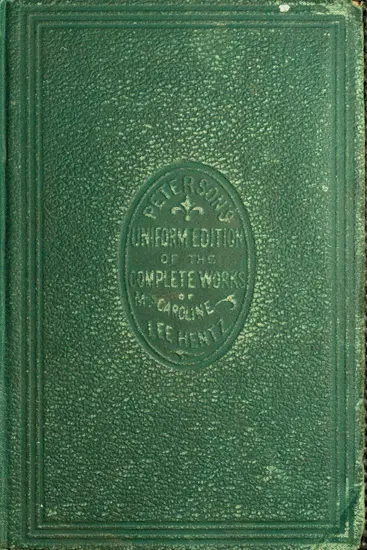
THE CLASSIC COLLECTION · 1857
"Love After Marriage; and Other Stories of the Heart" by Caroline Lee Hentz is a collection of short stories written in the late 19th century. The anthology appears to delve into themes related to love, relationships, and societal expectations, particularly focusing on the emotional intricacies surrounding marriage. The opening story introduces us to key characters whose fates become intertwined, setting the stage for the exploration of affection and social perceptions. At the start of the opening portion, readers are introduced to Augusta Temple, who is anxiously awaiting the arrival of her betrothed, Sydney Allison. However, their first encounter unfolds humorously, as Augusta reacts with dismay to Sydney's changed appearance, a result of illness, leading to feelings of disappointment and disdain. As Sydney, unaware of her reaction, contemplates his own acceptance of their union, both characters grapple with the emotional nuance of their situation. The narrative foreshadows a complex dynamic as they navigate their obligations, expectations, and personal feelings, ultimately hinting at deeper themes of love and emotional growth amidst societal pressures and personal struggles.
Introduction adapted from the source catalogue; source summaries may be automatically generated.
Free to read · English · 100,134 words · No account needed
MAKE TIME FOR A GOOD BOOK
On by default. Untick to stop anonymous reading totals. Each page counts after 10 seconds in view. How this works.
Anonymous counting is on unless you have switched it off.
And he was gone--gone--sick, wounded, perhaps dying, he was gone to another land, and the blood that was drained from him on my soul. My father forbade him to see me--he was too feeble to bear the shock of beholding me in the condition I then was. My real situation was concealed from him. The only means of making the prohibition effectual, was to word it as proceeding from myself. Thus, he believed me cold and selfish to the last. My father talked to me of better days, of the hope of my husband's speedy restoration, and of our future reunion. I could only listen and weep. I dared not murmur. I felt too deeply the justice of the judgment the Almighty had passed against me. I had one ordeal yet to pass--an interview with Alice. She also was under my father's roof, confined by increasing debility to her own apartment. As soon as my strength allowed, I made it a religious duty to visit the poor invalid. I was shocked to see the ravages of her malady. Her eye of glassy brightness turned on me with such a look of woe and remorse, it cut me to the heart. I took the pale thin hand she extended towards me, and burst into tears. Yes! I saw it but too clearly. Here was another victim. The steps of the destroyer were fearfully accelerated. She had had a profuse hemorrhage from the lungs, and her voice was so weak and husky, it was with difficulty I could understand her. She drew me down near to her pillow, and, placing my hand on her heart, said, in a careful whisper--"Remorse, Cecilia, it is here. It is this which gives the sting to death." She then drew from beneath her pillow a paper that she had written for me, which she begged me to read when I was alone. I did read it. It was the transcript of a warm, romantic heart, erring and misguided, yet even in its aberrations discovering an innate love for virtue and truth. Her whole soul was bared before me--all her love, imprudence, and remorse. She described my husband as an angel of light and purity, soaring high above the clouds of passion that gathered darkly around herself. She spoke of that scene, followed by such irremediable woe. "Even now," continued Alice, "wasting as I am on the bed of death, with the shadows of earthly feeling dimly floating round me, knowing that I shall soon turn to cold, impassive clay, the memory of that hour presses with scorching weight on my brain. I must have been mad. Surely I had not the control of my reason. I had taken the previous night an unusual quantity of opium, which, instead of composing me to sleep, had excited my nerves, and strung them as with fire. Your husband came in only a short time before your sudden entrance, evidently on some errand; and though he kindly paused to speak to me, his looks expressed haste to depart. Just as he was about to leave the room, I was attacked with one of those spasms you have sometimes witnessed. He came to my relief--he administered every restorative. I know not all I uttered, but when I recovered I remember many wild expressions that escaped my lips. It seemed to me that I was going to die, and while his arms thus kindly supported me, I felt as if it would be joy to die. With this conviction, was it so black a crime to breathe forth the love that had so long pervaded my frail and lonely existence? Cecilia, he recoiled from me with horror. He proclaimed his inviolable love and devotion for you--his glance was stern and upbraiding. Then seeing me sinking in despair, the kindness of his nature triumphed, and he sought to calm my overwrought and troubled spirit. He expressed the affection of a brother, the pity of a friend, the admonitions of a Christian. "Above all," said he, "make a friend of Cecilia. She will always cherish you with a sister's love." "Never!" I exclaimed, "she hates me, she must ever hate me." The vision of an injured wife arrested my unhallowed accents. You know the dreadful tragedy that followed. Never since that hour have I had one moment's calm. Conscience, with her thousand scorpions, lashes me--whether sleeping or waking there is no rest. 'There is no peace,' saith my God, 'to the wicked,' Yet mine was not deliberate guilt. Had I only wrecked my own happiness!--but the wide desolation, the irretrievable ruin! I shudder, I weep, I lift my feeble hands to that Power whose laws I have transgressed, and pray for pardon. To you, whose home of love I have laid waste, dare I turn my fading eyes, and hope for forgiveness? To him whom I have driven from his native land, shorn of the brightness of his manhood--Oh! sinful dust and ashes"----here the unhappy writer broke off--the blank was stained with tears. Probably in that broken sentence the embers of passion flashed out their last fires, through the "dust and ashes" of withering mortality. Poor Alice! may'st thou be forgiven by a merciful Creator as freely as thou art by me. Gentle be thy passage through the valley of the shadow of death, to that country where no storms desolate the heart, where passion and penitence are unknown. As for me--why and for what do I live? For hope or despair? I pray for tidings from the beloved exiles, yet dread to receive them. If the night gale sweeps with hasty gust against the window, I tremble lest they be exposed to the stormy deep. When I gaze on the moon and stars, I ask myself if they are lighting the wanderers on their homeward way, and sometimes gather hope from their heavenly brightness.
Your reading position is saved on this browser. Take it to another device with a library code. Reading pages adapt to text, rather than matching a printed edition.
Caroline Lee Hentz
Caroline Lee Hentz
BEHIND THE BOOK
This eBook is for the use of anyone anywhere in the United States and most other parts of the world at no cost and with almost no restrictions whatsoever. You may copy it, give it away or re-use it under the terms of the Project Gutenberg License included with this eBook or online at www.gutenberg.org. If you are not located in the United States, you will have to check the laws of the country where you are located before using this eBook. Read the source licence.
The original source file, including credits and licence, is retained by this library. Request an original-format copy at no charge. Please include the book title and Project Gutenberg identifier #43019.
KEEP YOUR CURIOSITY GOING
Coulson Kernahan

Maurice Baring
Frances Wright
Cécile Tormay

Frederic Jesup Stimson

W. H. P. (William Henry Pope) Jarvis