THE CLASSIC COLLECTION✦Helen and Arthur; or, Miss Thusa’s Spinning WheelCLASSIC FREE BOOKS
Helen and Arthur; or, Miss Thusa’s Spinning Wheel
Caroline Lee Hentz
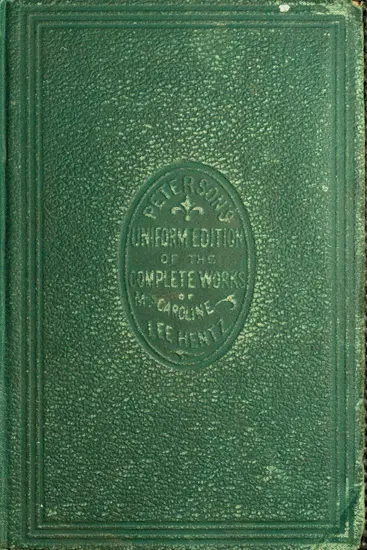
THE CLASSIC COLLECTION · 1857
"Love After Marriage; and Other Stories of the Heart" by Caroline Lee Hentz is a collection of short stories written in the late 19th century. The anthology appears to delve into themes related to love, relationships, and societal expectations, particularly focusing on the emotional intricacies surrounding marriage. The opening story introduces us to key characters whose fates become intertwined, setting the stage for the exploration of affection and social perceptions. At the start of the opening portion, readers are introduced to Augusta Temple, who is anxiously awaiting the arrival of her betrothed, Sydney Allison. However, their first encounter unfolds humorously, as Augusta reacts with dismay to Sydney's changed appearance, a result of illness, leading to feelings of disappointment and disdain. As Sydney, unaware of her reaction, contemplates his own acceptance of their union, both characters grapple with the emotional nuance of their situation. The narrative foreshadows a complex dynamic as they navigate their obligations, expectations, and personal feelings, ultimately hinting at deeper themes of love and emotional growth amidst societal pressures and personal struggles.
Introduction adapted from the source catalogue; source summaries may be automatically generated.
Free to read · English · 100,134 words · No account needed
MAKE TIME FOR A GOOD BOOK
On by default. Untick to stop anonymous reading totals. Each page counts after 10 seconds in view. How this works.
Anonymous counting is on unless you have switched it off.
My first cause of sorrow was parting with my brother--"my guide, my companion, my familiar friend." He was sent to a distant college, and I felt for a while as if I were alone in the world, for my father was in public life, and it was only at evening he had leisure to indulge in the tenderness of domestic feeling. He had never given up the hope that I might recover my sight. When I was very small there was an operation performed upon my eyes, but it was by an unskilful oculist, and unsuccessful. After this I had an unspeakable dread of any future attempt,--the slightest allusion to the subject threw me into such nervous agitation, my father at last forbore to mention it. "Let me live and die under this shade," I would say, "like the flower that blooms in the cleft of the rock. The sunshine and the dew are not for me." Time glided away. In one year more Henry would complete his collegiate course. I was in the morning of womanhood, but my helpless condition preserved to me all the privileges and indulgences of the child. It was at this era--why did I here dash aside my pen, and press my hands upon my temples to still the throbbings of a thousand pulses, starting simultaneously into motion? Why cannot we always be children? Why was I not suffered to remain blind?--A young physician came into the neighbourhood, who had already acquired some fame as an oculist. He visited in our family--he became almost identified with our household. Philanthropy guided him in his choice of a profession. He knew himself gifted with extraordinary talents, and that he had it in his power to mitigate the woes of mankind. But though the votary of duty, he was a worshipper at the shrine of intellect and taste. He loved poetry, and, next to music, it was my passion. He read to me the melodious strains of the sons of song, in a voice more eloquent, in its low depth of sweetness, than the minstrels whose harmony he breathed. When I touched the keys of the piano, his voice was raised, in unison with mine. If I wandered in the garden, his hand was ever ready to guide, and his arm to sustain me. He brought me the wild-flower of the field, and the exotic of the green-house, and, as he described their hues and outlines, I scarcely regretted the want of vision. Here, in this book, I have pressed each faded gift. I remember the very words he uttered when he gave me this cluster.--"See," said he, "nay, feel this upright stem, so lofty, till bending from the weight of the flower it bears. It is a lily--I plucked it from the margin of a stream, in which it seemed gazing on its white, waxen leaves. Touch gently the briars of this wild rose. Thus heaven guards the innocence and beauty that gladdens the eyes of the wayfaring man. Cecilia, would you not like to look upon these flowers?" "Yes, but far rather on the faces of those I love--my father's--my brother's. Man is made in the image of his Maker, and his face must be divine." "Oh!" added I, in the secrecy of my own soul, "how divine must be the features of that friend, who has unfolded to me such unspeakable treasures of genius and feeling, whose companionship seems a foretaste of the felicities of heaven." It was then, for the first time, he dared to suggest to me a hope that my blindness was not incurable. He told me he had been devoting all his leisure to this one subject, and that he was sure he had mastered every difficulty; that though mine was a peculiar case, and had once baffled the efforts of the optician, he dared to assure himself of complete success. "And if I fail," said he, "if through my means no light should visit your darkened orbs, then," continued he, with an expression of feeling that seemed wholly irrepressible, "suffer me to be a light to your eyes and a lamp to your feet. But if it should be my lot to bestow upon you the most glorious of the gifts of God, to meet from you one glance of gratitude and love, were a recompense I would purchase with life itself." Did I dream? or were these words breathed to me?--me, the helpless, blind girl! to receive the unmeasured devotion of one of the most gifted and interesting of created beings. I had thought that he pitied me, that he felt for me the kindness of a brother, that he found in me some congenial tastes--but that he loved me so entirely, it was a confession as unlooked for as overpowering. My heart ached, from the oppression of its joy. Let not the cold-hearted and vain smile, when I repeat the broken accents of gratitude, trust, and love, that fell from my lips. My helplessness sanctified the offer, and I received his pledge of faith as a holy thing, to be kept holy through time and eternity.
Your reading position is saved on this browser. Take it to another device with a library code. Reading pages adapt to text, rather than matching a printed edition.
Caroline Lee Hentz
Caroline Lee Hentz
BEHIND THE BOOK
This eBook is for the use of anyone anywhere in the United States and most other parts of the world at no cost and with almost no restrictions whatsoever. You may copy it, give it away or re-use it under the terms of the Project Gutenberg License included with this eBook or online at www.gutenberg.org. If you are not located in the United States, you will have to check the laws of the country where you are located before using this eBook. Read the source licence.
The original source file, including credits and licence, is retained by this library. Request an original-format copy at no charge. Please include the book title and Project Gutenberg identifier #43019.
KEEP YOUR CURIOSITY GOING
Coulson Kernahan

Maurice Baring
Frances Wright
Cécile Tormay

Frederic Jesup Stimson

W. H. P. (William Henry Pope) Jarvis