THE CLASSIC COLLECTION✦Helen and Arthur; or, Miss Thusa’s Spinning WheelCLASSIC FREE BOOKS
Helen and Arthur; or, Miss Thusa’s Spinning Wheel
Caroline Lee Hentz
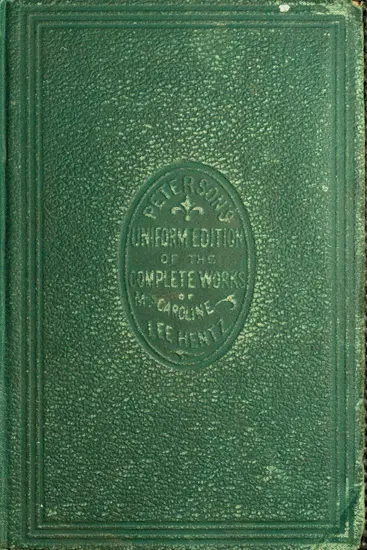
THE CLASSIC COLLECTION · 1857
"Love After Marriage; and Other Stories of the Heart" by Caroline Lee Hentz is a collection of short stories written in the late 19th century. The anthology appears to delve into themes related to love, relationships, and societal expectations, particularly focusing on the emotional intricacies surrounding marriage. The opening story introduces us to key characters whose fates become intertwined, setting the stage for the exploration of affection and social perceptions. At the start of the opening portion, readers are introduced to Augusta Temple, who is anxiously awaiting the arrival of her betrothed, Sydney Allison. However, their first encounter unfolds humorously, as Augusta reacts with dismay to Sydney's changed appearance, a result of illness, leading to feelings of disappointment and disdain. As Sydney, unaware of her reaction, contemplates his own acceptance of their union, both characters grapple with the emotional nuance of their situation. The narrative foreshadows a complex dynamic as they navigate their obligations, expectations, and personal feelings, ultimately hinting at deeper themes of love and emotional growth amidst societal pressures and personal struggles.
Introduction adapted from the source catalogue; source summaries may be automatically generated.
Free to read · English · 100,134 words · No account needed
MAKE TIME FOR A GOOD BOOK
On by default. Untick to stop anonymous reading totals. Each page counts after 10 seconds in view. How this works.
Anonymous counting is on unless you have switched it off.
Mr. Manly first met Anne Weston in a ball-room. It was on the evening of the Fourth of July, and the fairest ladies of the country were assembled to celebrate the national jubilee. He was a lawyer, and had been the orator of the day; an eloquent one, and therefore entitled to distinguished attention. He came from an adjoining town, of which he had recently become an inhabitant, and now found himself in a scene which scarcely presented one familiar countenance. He was a very proud man, and had the air of one who felt himself too superior to the multitude to mingle in the general amusement. He stood with folded arms, as remote as possible from the dancers despising those who were engaged in that exercise on such a sultry night. In vain the obsequious master of ceremonies begged to introduce him to this and that fair lady. He declined the honour with a cold bow, declaring his utter disinclination to dancing. He was told that his disinclination would cease as soon as Miss Weston arrived. She was the belle of the place, the daughter of the richest gentleman in town--had received the most finished education, and refused the most splendid offers. In short, she was irresistible, and it was predicted that he would find her so. It cannot be denied, that the fame of this all-conquering lady had previously reached his ears, but unfortunately he had a detestation of belles, and predetermined to close his eyes, and shut his ears, and steel his heart against her vaunted attractions. He had never yet sacrificed his independence to woman. He had placed his standard of female excellence very high. He had seen no one that reached its altitude. "No," said he to himself, "let me live on in singleness of heart and loneliness of purpose, all the days of my life, rather than unite myself with one of those vain, flimsy, garrulous, and superficial beings who win the smiles, and fix the attention of the many. I despise a weak woman, I hate a masculine one, and a pedantic one I abhor. I turn with fear from the glittering belle, whose home is the crowded hall, whose incense the homage of fools, whose altar the shrine of fashion. Can she sit down contented in the privacy of domestic love who has lived on the adulation of the world, or be satisfied with the affection of one true heart, who has claimed as her due, the vows of all? No, better the fool, the pedant, than the belle. Who can find that woman, whose price is above rubies? Ah! 'tis certain I never shall marry." He was aroused from these reflections, by a movement in the hall, and he felt a conviction that the vaunted lady was arrived. In spite of his boasted indifference, he could not repress a slight sensation of curiosity to see one who was represented as so transcendent. But he moved not, he did not even turn his eyes towards the spot where so many were clustering. "The late hour of her arrival," said he, "shows equal vanity and affectation. She evidently wishes to be conspicuous--studies everything for effect." The lady moved towards that part of the hall where he was stationed. She held the arm of one gentleman, and was followed by some half-dozen others. He was compelled to gaze upon her, for they passed so near, the folds of her white muslin dress fluttered against him. He was pleased to see that she was much less beautiful than he had expected. He scarcely thought her handsome. Her complexion was pale, even sallow, and her face wanted that soft, flowing outline, which is necessary to the perfection of beauty. He could not but acknowledge, however, that her figure was very fine, her motions graceful, and her air spirited and intellectual. "I am glad she is not beautiful," said he, "for I might have been tempted to have admired her, against my sober judgment. Oppressed by the heat of the apartment, he left the hall and sauntered for a long time in the piazza, till a certain feeling of curiosity, to know whether a lady whose bearing expressed so much pride of soul, could be foolish enough to dance, led him to return. The first object he beheld, was the figure of Miss Weston, moving in most harmonious time, to an exhilarating air, her countenance lighted up with an animation, a fire, that had as magical an effect upon her features, as the morning sunbeams on the face of nature. The deepest colour was glowing on her cheek,--her very soul was shining forth from her darkening eyes. She danced with infinite spirit, but equal grace. He had never witnessed anything to compare with it, not even on the stage. "She dances entirely too well," thought he; "she cannot have much intellect, yet she carries on a constant conversation with her partner through all the mazes of the dance. It must be admirable nonsense, from the broad smiles it elicits. I am half resolved to be introduced and invite her to dance--from mere curiosity, and to prove the correctness of my opinion." He sought the introduction, became her partner in the dance, and certainly forgot, while he listened to her "admirable nonsense," that she was that object of his detestation--a belle. Her conversation was sprightly, unstudied, and original. She seemed more eager to listen than to talk, more willing to admire than to be admired. She did not tell him that she admired his oration, but she spoke warmly on the subject of eloquence, and quoted in the happiest manner, a passage of his own speech, one which he himself judged superb. It proved her to have listened with deep attention. He had never received so delicate or gratifying a compliment. His vanity was touched, and his pride slumbered. He called forth those powers of pleasing, with which he was eminently endowed, and he began to feel a dawning ambition to make the conquest of a heart which so many had found indomitable. He admired the simplicity of her dress, its fitness and elegance. A lady's dress is always indicative of her character. Then her voice was singularly persuasive in its tones, it breathed of feminine gentleness and sensibility, with just enough spirit and independence for a woman. Mr. Manly came to these wise conclusions before the end of the first dance--at the termination of the second, he admired the depth, as well as the brilliancy of her mind, and when he bade her adieu for the night, he was equally convinced of the purity of her feelings and the goodness of her heart. Such is the strength of man's wisdom, the stability of his opinions, the steadiness of his purpose, when placed in competition with the fascinations of a woman who has made the determination to please. In after years Mr. Manly told a friend of a dream which that night haunted his pillow. He was not superstitious, or disposed to attach the slightest importance to dreams. But this was a vivid picture, and succeeding events caused him to recall it, as one having the power of prophecy. He lived over again the events of the evening. The winning accents of Miss Weston mingled in his ear with the gay notes of the violin. Still, ever and anon, discordant sounds marred the sweet harmony. The malicious whisper, the stifled, deriding laugh, and the open scoff came from every corner. Sometimes he saw, through the crowd, the slow finger of scorn pointing at him. As he turned, with a fierce glance of defiance, Miss Weston seemed to meet him still, holding a goblet in her hand, which she pressed him to drain. Her cheeks and lips burned with a scarlet radiance, and her eyes sparkled with unnatural brightness. "Taste it not," whispered a soft voice in his ear, "it is poison." "It is the cup of immortality," exclaimed the syren, and she drained the goblet to its last drop. In a few moments her countenance changed--her face became bloated, her features disfigured, and her eyes heavy and sunken. He turned with disgust from the former enchantress, but she pursued him, she wound her arms around him. In the vain struggle of liberating himself from her embrace, he awoke. It was long before he could overcome the sensation of loathing and horror excited by the unhallowed vision, and even when, overcome by heaviness and exhaustion, he again slept, the same bloated phantom presented her intoxicating draught. The morning found him feverish and unrefreshed. He could not shake off the impression of his dream, and the image of Miss Weston seemed deprived of the witchery that had enthralled his imagination the preceding evening. He was beginning to despise himself, for having yielded up so soon his prejudices and pride, when an invitation to dine at Mr. Weston's, interrupted the severe tenor of his thoughts. Politeness obliged him to accept, and in the society of Miss Weston, graceful, animated, and intellectual, presiding with unaffected dignity and ease at her father's board, he forgot the hideous metamorphose of his dream.
Your reading position is saved on this browser. Take it to another device with a library code. Reading pages adapt to text, rather than matching a printed edition.
Caroline Lee Hentz
Caroline Lee Hentz
BEHIND THE BOOK
This eBook is for the use of anyone anywhere in the United States and most other parts of the world at no cost and with almost no restrictions whatsoever. You may copy it, give it away or re-use it under the terms of the Project Gutenberg License included with this eBook or online at www.gutenberg.org. If you are not located in the United States, you will have to check the laws of the country where you are located before using this eBook. Read the source licence.
The original source file, including credits and licence, is retained by this library. Request an original-format copy at no charge. Please include the book title and Project Gutenberg identifier #43019.
KEEP YOUR CURIOSITY GOING
Coulson Kernahan

Maurice Baring
Frances Wright
Cécile Tormay

Frederic Jesup Stimson

W. H. P. (William Henry Pope) Jarvis