THE CLASSIC COLLECTION✦Helen and Arthur; or, Miss Thusa’s Spinning WheelCLASSIC FREE BOOKS
Helen and Arthur; or, Miss Thusa’s Spinning Wheel
Caroline Lee Hentz
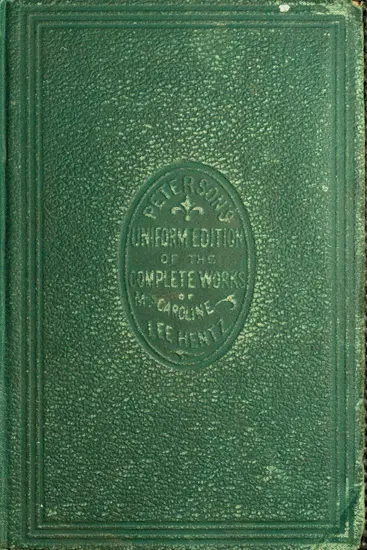
THE CLASSIC COLLECTION · 1857
"Love After Marriage; and Other Stories of the Heart" by Caroline Lee Hentz is a collection of short stories written in the late 19th century. The anthology appears to delve into themes related to love, relationships, and societal expectations, particularly focusing on the emotional intricacies surrounding marriage. The opening story introduces us to key characters whose fates become intertwined, setting the stage for the exploration of affection and social perceptions. At the start of the opening portion, readers are introduced to Augusta Temple, who is anxiously awaiting the arrival of her betrothed, Sydney Allison. However, their first encounter unfolds humorously, as Augusta reacts with dismay to Sydney's changed appearance, a result of illness, leading to feelings of disappointment and disdain. As Sydney, unaware of her reaction, contemplates his own acceptance of their union, both characters grapple with the emotional nuance of their situation. The narrative foreshadows a complex dynamic as they navigate their obligations, expectations, and personal feelings, ultimately hinting at deeper themes of love and emotional growth amidst societal pressures and personal struggles.
Introduction adapted from the source catalogue; source summaries may be automatically generated.
Free to read · English · 100,134 words · No account needed
MAKE TIME FOR A GOOD BOOK
On by default. Untick to stop anonymous reading totals. Each page counts after 10 seconds in view. How this works.
Anonymous counting is on unless you have switched it off.
"Yes, Mina, I have had hours of happiness, such as seldom falls to the lot of woman, but those bright hours were like the shining of the gold that comes forth purified from the furnace of fire. The mother of Alice soon followed her to the grave, and there they sleep, side by side, in the lonely churchyard. Eglantine soothed and comforted me, and endeavoured to stifle the self-upbraidings that ever sounded dolefully to my heart. Alice had been the victim of inexplicable circumstances, and so far from having been cruel, I had been kind and forbearing, considering the weight of evidence against her. Thus reasoned Eglantine, and I tried to believe her, but all my hopes of joy seemed blighted, for how could I mingle the wreath of love with the cypress boughs that now darkened my path? Ronald pressed an immediate union, but I shrunk with superstitious dread from the proposition, and refused the ring, with which he now sought to bind my faith. 'No, no,' I cried, 'the pledges of love are not for me--I will never accept another.'
"My mother grew angry at my fatalism. 'You are nursing phantasies,' said she, 'that are destroying the brightness of your youth. You are actually making yourself old, ere yet in your bloom. See, if there are not actually streaks of gray threading your jetty hair.' I rose and stood before a mirror, and shaking my hair loose from the confining comb, saw that her words were true. Here and there a gleam of silver wandered through those tresses which had always worn that purple depth of hue peculiar to the raven's plumage. The chill that penetrated my heart on the death-bed of Alice, had thus suddenly and prematurely frosted the dark locks of my youth. My mother became alarmed at my excessive paleness, and proposed a journey for the restoration of my spirits and health. Ronald eagerly supported the suggestion, but Eglantine declined accompanying us. She preferred, she said, being alone. With books at home, and Nature, in the glory of its summer garniture, abroad, she could not want sources of enjoyment. I did not regret her determination, for her presence had become strangely oppressive to me, and even Ronald's manners had assumed an embarrassment and constraint towards her very different from their usual familiarity. The night before our departure I felt more melancholy than ever. It was just such a night as the one that witnessed our ill-starred betrothal. The moon came forth from behind a bed of white clouds, silvering every flake as it floated back from her beauteous face, and diffusing on earth the wondrous secret of heavenly communion. I could not sleep; and as I lay gazing on the solemn tranquillity of the night heavens, I thought of the time when 'those heavens should be rolled together as a scroll, and the elements melt with fervent heat,' and I, still thinking, living, feeling, in other, grander, everlasting scenes, the invisible dweller of my bosom's temple assumed such magnitude and majesty in my eyes, the contemplation became overwhelming and awful. The sublime sound of the clock striking the midnight hour--and all who have heard that sound in the dead silence of the night, can attest that it is sublime--broke in on my deep abstraction. Eglantine, who had lain wrapped in peaceful slumbers, here softly drew back the bed-cover, and rising slowly, walked round with stilly steps to the side where I reclined, and stood looking fixedly upon me. 'Eglantine!' I exclaimed, terrified at her attitude and singular appearance. 'Eglantine, what is the matter?' She answered not, moved not, but remained standing, immovable, with her eyes fixed and expressionless as stone. There she stood, in the white moonlight, in her long, loose night-dress, which hung around her, in her stillness, like the folds of the winding-sheet, her hair streaming down her back in long, lifeless tresses, and lighted up on her brow with a kind of supernatural radiance--and then those death-resembling eyes! I trembled, and tried to draw the sheet over my face, to shut out the appalling vision. After a few moments, which seemed interminable to me, she bent over me, and taking my right hand, felt of my wrist again and again. Her fingers were as cold as marble. My very blood seemed to congeal under her touch. 'It is gone,' murmured she, 'but it is safe--I have it safe. It fits my wrist as well as hers.' Terrified as I was at this unexpected apparition, my mind was clear, and never were my perceptions more vivid. The mystery of the bracelet was about to be unravelled. Poor Alice's assertion that she had seen Eglantine standing by my side, and taking the bracelet from my wrist, came back thundering in my ears. 'It is gone,' replied Eglantine, in the same low, deep voice, 'but I know where it is laid; where the bridegroom or the bride can never find it. Perhaps the moon shines too brightly on it, and reveals the spot.' Thus saying, she glided across the floor, with spirit-like tread, and opening the door, disappeared. In the excess of my excitement I forgot my fears, and hastily rising, followed her footsteps, determined to unravel the mystery, if I died in the act. I could catch the glimpses of her white garments through the shadows of the winding staircase, and I pursued them with rapid steps, till I found myself close behind her, by the door which opened into the garden. There she stood, still as a corpse, and again the cold dew of superstitious terror gathered on my brow. I soon saw a fumbling motion about the keyhole, and the door opening, she again glided onward towards the summer-house, my favourite retreat, the place where I had received this mysterious bracelet--the place where Flora had collected all her wealth of bloom. She put aside the drooping vines, sending out such a cloud of fragrance on the dewy air, I almost fainted from their oppression, and stooping down over a white rose-bush, carefully removed the lower branches, while the rose-leaves fell in a snowy shower over her naked feet. 'Where is it?' said she, feeling about in the long grass. 'It isn't in the spot where I hid it. If she has found it, she may yet be a bride, and Ronald still her own.' She stooped down lower over the rose-bush, then rising hastily, I saw, with inexpressible agitation, the lost bracelet shining in the light that quivered with ghostlike lustre on her pallid face. With a most unearthly smile she clasped it on her wrist, and left the arbour, muttering in a low voice, 'I will not leave it here--lest she find out where it lies, and win back her bridal gift. I will keep it next my own heart, and she cannot reach it there.' Once more I followed the gliding steps of Eglantine, through the chill silence of night, till we ascended the stairs, and entered our own chamber. Quietly she laid herself down, as if she had just risen from her knees in prayer, and I perceived by her closed lids and gentle breathing, that a natural sleep was succeeding the inexplicable mysteries of somnambulism."
Your reading position is saved on this browser. Take it to another device with a library code. Reading pages adapt to text, rather than matching a printed edition.
Caroline Lee Hentz
Caroline Lee Hentz
BEHIND THE BOOK
This eBook is for the use of anyone anywhere in the United States and most other parts of the world at no cost and with almost no restrictions whatsoever. You may copy it, give it away or re-use it under the terms of the Project Gutenberg License included with this eBook or online at www.gutenberg.org. If you are not located in the United States, you will have to check the laws of the country where you are located before using this eBook. Read the source licence.
The original source file, including credits and licence, is retained by this library. Request an original-format copy at no charge. Please include the book title and Project Gutenberg identifier #43019.
KEEP YOUR CURIOSITY GOING
Coulson Kernahan

Maurice Baring
Frances Wright
Cécile Tormay

Frederic Jesup Stimson

W. H. P. (William Henry Pope) Jarvis