THE CLASSIC COLLECTION✦Helen and Arthur; or, Miss Thusa’s Spinning WheelCLASSIC FREE BOOKS
Helen and Arthur; or, Miss Thusa’s Spinning Wheel
Caroline Lee Hentz
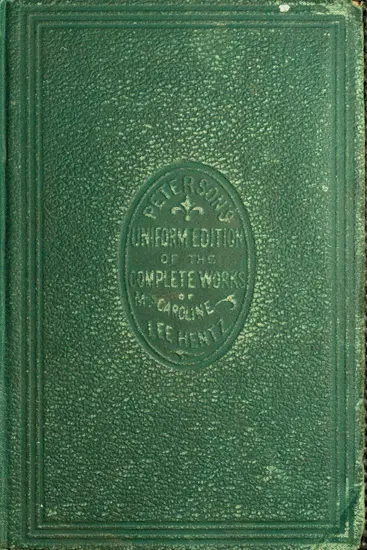
THE CLASSIC COLLECTION · 1857
"Love After Marriage; and Other Stories of the Heart" by Caroline Lee Hentz is a collection of short stories written in the late 19th century. The anthology appears to delve into themes related to love, relationships, and societal expectations, particularly focusing on the emotional intricacies surrounding marriage. The opening story introduces us to key characters whose fates become intertwined, setting the stage for the exploration of affection and social perceptions. At the start of the opening portion, readers are introduced to Augusta Temple, who is anxiously awaiting the arrival of her betrothed, Sydney Allison. However, their first encounter unfolds humorously, as Augusta reacts with dismay to Sydney's changed appearance, a result of illness, leading to feelings of disappointment and disdain. As Sydney, unaware of her reaction, contemplates his own acceptance of their union, both characters grapple with the emotional nuance of their situation. The narrative foreshadows a complex dynamic as they navigate their obligations, expectations, and personal feelings, ultimately hinting at deeper themes of love and emotional growth amidst societal pressures and personal struggles.
Introduction adapted from the source catalogue; source summaries may be automatically generated.
Free to read · English · 100,134 words · No account needed
MAKE TIME FOR A GOOD BOOK
On by default. Untick to stop anonymous reading totals. Each page counts after 10 seconds in view. How this works.
Anonymous counting is on unless you have switched it off.
"'You look very beautiful and romantic, dear Eglantine,' said I, softly approaching her, and throwing my arms round her neck; 'but come down from the stars a little while, my sweet cousin, and share in my earthborn emotions.' My heart was too full of happiness, my spirits too excited, not to overflow in unreserved confidence in her bosom. She wept as I poured into her ears all my hopes, my recent vows, and future schemes of felicity. It was her usual manner of expressing deep sympathy, and I loved her the better for her tears. 'All I wonder at and blame in Ronald is,' and I spoke this in true sincerity, 'that he does not love you better than me. Never, till this evening, was I sure of his preference.'
"Eglantine withdrew herself from my arms, and turned her face to the shadow of the wall. There was something inexplicable in her manner that chilled, and even alarmed me. A thought, too painful to be admitted, darted for a moment to my mind. Could she be jealous of Ronald's love for me? Was my happiness to be built on the ruin of hers? No! it could not be. She probably feared my affections might become alienated from her in consequence of my new attachment. Such a fear was natural, and I hastened to remove it by the warmest professions, mingled with covert reproaches for her doubts and misgivings.
"I had a young waiting-maid, who, next to Eglantine, was the especial object of my regard. She was the daughter of a gentlewoman, who, from a series of misfortunes, was reduced to penury, to which was added the helplessness of disease. To relieve her mother from the pressure of immediate want, the young Alice offered herself as a candidate for a state of servitude, and I eagerly availed myself of the opportunity of securing the personal attendance of one so refined in manner and so winning in appearance. Alice now came forward, as was her custom, to assist me in preparing for my nightly rest. She was about to unclasp the bracelet from my wrist, but I drew back my arm. 'No, no, Alice,' said I, 'this is an amulet. Sweet dreams will come to my pillow, beckoned by its fairy power. I cannot sleep without it. See how beautifully the lilies gleam in the moonlight that gilds my couch.' Alice seemed as if she could never weary in admiring the beauty of the ornament. She turned my arm to shift the rays, and catch the delicate colouring of the pearls, and looped up the sleeve of my night-dress in a fantastic manner, to display it fully to her gaze. Once or twice I thought I saw the eyes of Eglantine fastened upon it with a sad, wistful expression, and the same exquisitely painful thought again darted to my mind. I struggled against its admission, as degrading both to myself and her, and at last fell asleep, with my arm thrown on the outside of the bed, and the bracelet shining out in the pure night-beams. Alice slept in a little bed by the side of mine, for I could not bear that a creature so young and delicate, and so gentle bred, should share the apartments devoted to the servants, and be exposed to their rude companionship. She generally awoke me with her light touch or gentle voice, but when I awoke the next morning, I saw Alice still sleeping, with a flushed cheek and an attitude that betokened excitement and unrest. Eglantine sat at her window, reading, dressed with her usual care by her own graceful fingers. In the school of early poverty she had learned the glorious lesson of independence, a lesson which, in my more luxurious life, I had never acquired. 'Alice must be ill,' said I, rising, and approaching her bedside; 'she looks feverish, and her brows are knit, as if her dreams were fearful.' I bent down over her, and laid my hand upon her shoulder, to rouse her from her uneasy slumbers, when I started--for the precious bracelet was gone. Eglantine laid down her book at my sudden exclamation, and Alice, wakening, looked round her with a bewildered expression. 'My bracelet!' repeated I--'it is gone.' I flew to my couch; it was not there. I looked upon the carpet, in the vain hope that the clasp had unloosed, and that it had fallen during the night. 'Alice,' cried I, 'rise this moment, and help me to find my bracelet. You must know where it is. It never could have vanished without aid.' I fixed my eyes steadfastly on her face, which turned as hueless as marble. She trembled in every limb, and sunk down again on the side of the bed.
Your reading position is saved on this browser. Take it to another device with a library code. Reading pages adapt to text, rather than matching a printed edition.
Caroline Lee Hentz
Caroline Lee Hentz
BEHIND THE BOOK
This eBook is for the use of anyone anywhere in the United States and most other parts of the world at no cost and with almost no restrictions whatsoever. You may copy it, give it away or re-use it under the terms of the Project Gutenberg License included with this eBook or online at www.gutenberg.org. If you are not located in the United States, you will have to check the laws of the country where you are located before using this eBook. Read the source licence.
The original source file, including credits and licence, is retained by this library. Request an original-format copy at no charge. Please include the book title and Project Gutenberg identifier #43019.
KEEP YOUR CURIOSITY GOING
Coulson Kernahan

Maurice Baring
Frances Wright
Cécile Tormay

Frederic Jesup Stimson

W. H. P. (William Henry Pope) Jarvis