THE CLASSIC COLLECTION✦Helen and Arthur; or, Miss Thusa’s Spinning WheelCLASSIC FREE BOOKS
Helen and Arthur; or, Miss Thusa’s Spinning Wheel
Caroline Lee Hentz
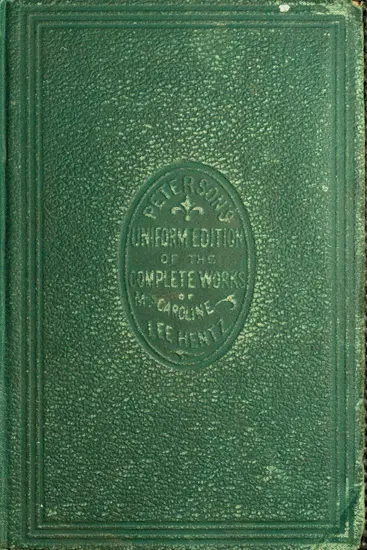
THE CLASSIC COLLECTION · 1857
"Love After Marriage; and Other Stories of the Heart" by Caroline Lee Hentz is a collection of short stories written in the late 19th century. The anthology appears to delve into themes related to love, relationships, and societal expectations, particularly focusing on the emotional intricacies surrounding marriage. The opening story introduces us to key characters whose fates become intertwined, setting the stage for the exploration of affection and social perceptions. At the start of the opening portion, readers are introduced to Augusta Temple, who is anxiously awaiting the arrival of her betrothed, Sydney Allison. However, their first encounter unfolds humorously, as Augusta reacts with dismay to Sydney's changed appearance, a result of illness, leading to feelings of disappointment and disdain. As Sydney, unaware of her reaction, contemplates his own acceptance of their union, both characters grapple with the emotional nuance of their situation. The narrative foreshadows a complex dynamic as they navigate their obligations, expectations, and personal feelings, ultimately hinting at deeper themes of love and emotional growth amidst societal pressures and personal struggles.
Introduction adapted from the source catalogue; source summaries may be automatically generated.
Free to read · English · 100,134 words · No account needed
MAKE TIME FOR A GOOD BOOK
On by default. Untick to stop anonymous reading totals. Each page counts after 10 seconds in view. How this works.
Anonymous counting is on unless you have switched it off.
Margaret, the true, the pure-hearted and upright Margaret, was not destined, like Mary, to gather the thorns and briers of existence. Long did the fragrance of her roses last, for she had not plucked them with too rash a hand. She and Mr. Hall again met. The moral sympathy that had drawn them together, was not weakened by the tragic event that had intervened; it had rather strengthened through suffering and sorrow. Mr. Hall could never forget the death scene of Laura St. Henry. The love expressed for him at a moment when all earthly dissimulation was over had inexpressibly affected him. Her unparalleled sufferings seemed an expiation for her broken faith. It was at her grave that he and Margaret first met after their sad separation, when the falling shades of evening deepened the solemnity of the scene. Sorrow, sympathy, devotion, and truth, form a holy groundwork for love; and when once the temple is raised on such a foundation, the winds and waves may beat against it in vain. Mr. Hall found by his own experience, that the bruised heart can be healed, for Margaret's hand poured oil and balm on its wounds. He could repose on her faith as firmly as on the rock which ages have planted. He knew that she loved him, and felt it due to her happiness as well as his own, to ask her to be the companion of his pilgrimage. If they looked back upon the clouds that had darkened their morning, it was without self-reproach, and remembrance gradually lost its sting. Who will say she was not happier than Mary, who carried in her bosom, through life, that which "biteth like a serpent, and stingeth like an adder?"
Adellan, an Abyssinian youth, approached one of those consecrated buildings, which crown almost every hill of his native country. Before entering, he drew off his shoes, and gave them in charge to a servant, that he might not soil the temple of the Lord, with the dust of the valley; then bending down, slowly and reverentially, he pressed his lips to the threshold, performed the same act of homage to each post of the door, then passed into the second division of the church, within view of the curtained square, answering to the mysterious holy of holies in the Jewish temple. He gazed upon the pictured saints that adorned the walls, long and earnestly, when, kneeling before them, he repeated, with deep solemnity, his customary prayers. He rose, looked towards the mystic veil, which no hand but that of the priest was permitted to raise, and anticipated with inexplicable emotions the time when, invested with the sacred dignity of that office, he might devote himself exclusively to Heaven. From early childhood, Adellan had been destined to the priesthood. His first years were passed mid the stormy scenes of war, for his father was a soldier, fighting those bloody battles, with which the province of Tigre had been more than once laid waste. Then followed the dreadful discipline of famine, for the destroying locusts, the scourge of the country, had followed up the desolation of war, and year succeeding year, gleaned the last hope of man. The parents of Adellan fled from these scenes of devastation, crossed the once beautiful and fertile banks of the Tacazze, and sought refuge in the ample monastery of Walduba, where a brother of his father then resided. Here, he was placed entirely under the protection of his uncle, for his father, sickened with the horrors he had witnessed, and loathing the ties which were once so dear to him, recrossed his native stream, became a gloomy monk in another convent, where, with several hundred of his brethren, he soon after perished a victim to those barbarities, which had robbed him of all that gave value to life. Adellan had never known the joys of childhood. The greenness and bloom of spring had been blotted from his existence. Famine had hollowed his boyish cheek, and fear and distrust chilled and depressed his young heart. After entering the convent of Walduba, where all his physical wants were supplied, the roundness and elasticity of health were restored to his limbs, but his cheek was kept pale by midnight vigils, and long and painful fastings. The teacher, whom his uncle placed over him, was severe and exacting. He gave him no relaxation by day, and the stars of night witnessed his laborious tasks. He was compelled to commit lessons to memory, in a language which he did not then understand, a drudgery from which every ardent mind must recoil. Yet, such was his thirst for knowledge, that he found a pleasure, even in this, that sweetened his toils. All the strains of the devout Psalmist were familiar to his lips, but they were in an unknown tongue, for in this manner are the youth of those benighted regions taught. Often, when gazing on the magnificent jewelry of a tropical sky, shining down on the darkness and solitude of night, had he unconsciously repeated the words of the royal penitent--"The heavens declare the glory of God. The firmament showeth his handy work." He understood not their meaning, but the principle of immortality was striving within him, and every star that gemmed the violet canopy, seemed to him eye-beams of that all-seeing Divinity he then darkly adored.
Your reading position is saved on this browser. Take it to another device with a library code. Reading pages adapt to text, rather than matching a printed edition.
Caroline Lee Hentz
Caroline Lee Hentz
BEHIND THE BOOK
This eBook is for the use of anyone anywhere in the United States and most other parts of the world at no cost and with almost no restrictions whatsoever. You may copy it, give it away or re-use it under the terms of the Project Gutenberg License included with this eBook or online at www.gutenberg.org. If you are not located in the United States, you will have to check the laws of the country where you are located before using this eBook. Read the source licence.
The original source file, including credits and licence, is retained by this library. Request an original-format copy at no charge. Please include the book title and Project Gutenberg identifier #43019.
KEEP YOUR CURIOSITY GOING
Coulson Kernahan

Maurice Baring
Frances Wright
Cécile Tormay

Frederic Jesup Stimson

W. H. P. (William Henry Pope) Jarvis