THE CLASSIC COLLECTION✦Helen and Arthur; or, Miss Thusa’s Spinning WheelCLASSIC FREE BOOKS
Helen and Arthur; or, Miss Thusa’s Spinning Wheel
Caroline Lee Hentz
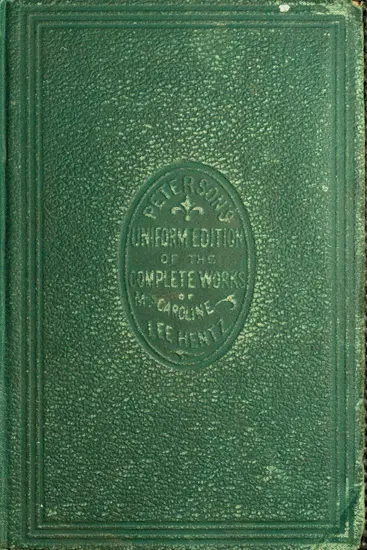
THE CLASSIC COLLECTION · 1857
"Love After Marriage; and Other Stories of the Heart" by Caroline Lee Hentz is a collection of short stories written in the late 19th century. The anthology appears to delve into themes related to love, relationships, and societal expectations, particularly focusing on the emotional intricacies surrounding marriage. The opening story introduces us to key characters whose fates become intertwined, setting the stage for the exploration of affection and social perceptions. At the start of the opening portion, readers are introduced to Augusta Temple, who is anxiously awaiting the arrival of her betrothed, Sydney Allison. However, their first encounter unfolds humorously, as Augusta reacts with dismay to Sydney's changed appearance, a result of illness, leading to feelings of disappointment and disdain. As Sydney, unaware of her reaction, contemplates his own acceptance of their union, both characters grapple with the emotional nuance of their situation. The narrative foreshadows a complex dynamic as they navigate their obligations, expectations, and personal feelings, ultimately hinting at deeper themes of love and emotional growth amidst societal pressures and personal struggles.
Introduction adapted from the source catalogue; source summaries may be automatically generated.
Free to read · English · 100,134 words · No account needed
MAKE TIME FOR A GOOD BOOK
On by default. Untick to stop anonymous reading totals. Each page counts after 10 seconds in view. How this works.
Anonymous counting is on unless you have switched it off.
One greater and purer than the Genius of the Arabian Tale, had placed in his breast a mirror, whose lustre would be instantaneously dimmed by the breath of falsehood or dissimulation. It was in this mirror he saw reflected the actions of his fellow beings, and it pained him to see its bright surface so constantly sullied. Never, since the hour he was so fatally deceived, had he been in the presence of woman, without a melancholy conviction that she was incapable of standing the test of this bosom talisman. Here, however, was one, whose lips cast no cloud upon its lustre. He witnessed the marvellous spectacle of a young, beautiful, and accomplished woman, surrounded by the artifices and embellishments of fashionable life, speaking the truth, in all simplicity and godly sincerity, as commanded by the holy men of old. There was something in the sight that renovated and refreshed his blighted feelings. The dew falling on the parched herbage, prepares it for the influence of a kinder ray. Even so the voice of Margaret Howard, gentle in itself and persuasive, advocating the cause he most venerated, operated this night on the heart of Mr. Hall.
For many weeks the same party frequently met at the dwelling of Mrs. Astor. This lady was a professed patroness and admirer of genius and the fine arts. To be a fine painter, a fine singer, a fine writer, a traveller, or a foreigner, was a direct passport to her favour. To be distinguished in any manner in society was sufficient, provided it was not "bad eminence" which was attained by the individual. She admired Mr. Hall for the stately gloom of his mien, his dark and foreign air, his peculiar and high-wrought sentiments. She sought an intimacy with Margaret Howard, for it was a distinction to be her friend, and, moreover, she had an exquisite taste and skill in drawing and painting. Mary Ellis was a particular favourite of hers, because her own favourite cousin Charles Brown thought her the most fascinating young lady of his acquaintance. Mrs. Astor's house was elegantly furnished, and her rooms were adorned with rare and beautiful specimens of painting and statuary. She had one apartment which she called her Gallery of Fine Arts, and every new guest was duly ushered into this sanctuary, and called upon to look and admire the glowing canvas and the breathing marble. A magnificent pier-glass was placed on one side of the hall, so as to reflect and multiply these classic beauties. It had been purchased in Europe, and was remarkable for its thickness, brilliancy, and fidelity of reflection. It was a favourite piece of furniture of Mrs. Astor's, and all her servants were warned to be particularly careful, whenever they dusted its surface. As this glass is of some importance in the story, it deserves a minute description. Mrs. Astor thought the only thing necessary to complete the furnishing of the gallery, were transparencies for the windows. Miss Howard, upon hearing the remark, immediately offered to supply the deficiency, an offer at once eagerly accepted, and Mrs. Astor insisted that her painting apparatus should be placed in the very room, that she might receive all the inspiration to be derived from the mute yet eloquent relics of genius, that there solicited the gaze. Nothing could be more delightful than the progress of the work. Margaret was an enthusiast in the art, and her kindling cheek always attested the triumph of her creating hand. Mrs. Astor was in a constant state of excitement, till the whole was completed, and it was no light task, as four were required, and the windows were of an extra size. Almost every day saw the fair artist seated at her easel, with the same group gathered round her. Mary Ellis admired everything so indiscriminately, it was impossible to attach much value to her praise; but Mr. Hall criticised as well as admired, and as he had the painter's eye, and the poet's tongue, Margaret felt the value of his suggestions, and the interest they added to her employment. Above all things, she felt their truth. She saw that he never flattered, that he dared to blame, and when he did commend, she was conscious the tribute was deserved. Margaret was not one of those beings, who cannot do but one thing at a time. She could talk and listen, while her hands were applying the brush or arranging the colours, and look up too from the canvas, with a glance that showed how entirely she participated in what was passing around her.
Your reading position is saved on this browser. Take it to another device with a library code. Reading pages adapt to text, rather than matching a printed edition.
Caroline Lee Hentz
Caroline Lee Hentz
BEHIND THE BOOK
This eBook is for the use of anyone anywhere in the United States and most other parts of the world at no cost and with almost no restrictions whatsoever. You may copy it, give it away or re-use it under the terms of the Project Gutenberg License included with this eBook or online at www.gutenberg.org. If you are not located in the United States, you will have to check the laws of the country where you are located before using this eBook. Read the source licence.
The original source file, including credits and licence, is retained by this library. Request an original-format copy at no charge. Please include the book title and Project Gutenberg identifier #43019.
KEEP YOUR CURIOSITY GOING
Coulson Kernahan

Maurice Baring
Frances Wright
Cécile Tormay

Frederic Jesup Stimson

W. H. P. (William Henry Pope) Jarvis