THE CLASSIC COLLECTION✦Helen and Arthur; or, Miss Thusa’s Spinning WheelCLASSIC FREE BOOKS
Helen and Arthur; or, Miss Thusa’s Spinning Wheel
Caroline Lee Hentz
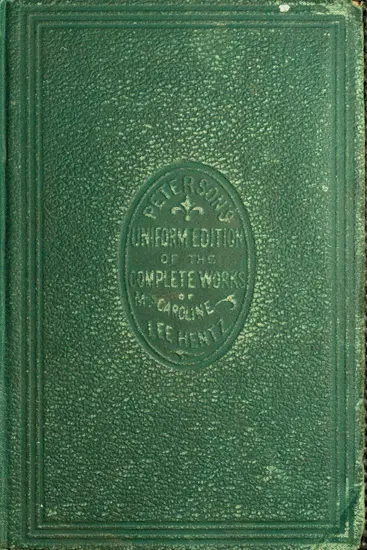
THE CLASSIC COLLECTION · 1857
"Love After Marriage; and Other Stories of the Heart" by Caroline Lee Hentz is a collection of short stories written in the late 19th century. The anthology appears to delve into themes related to love, relationships, and societal expectations, particularly focusing on the emotional intricacies surrounding marriage. The opening story introduces us to key characters whose fates become intertwined, setting the stage for the exploration of affection and social perceptions. At the start of the opening portion, readers are introduced to Augusta Temple, who is anxiously awaiting the arrival of her betrothed, Sydney Allison. However, their first encounter unfolds humorously, as Augusta reacts with dismay to Sydney's changed appearance, a result of illness, leading to feelings of disappointment and disdain. As Sydney, unaware of her reaction, contemplates his own acceptance of their union, both characters grapple with the emotional nuance of their situation. The narrative foreshadows a complex dynamic as they navigate their obligations, expectations, and personal feelings, ultimately hinting at deeper themes of love and emotional growth amidst societal pressures and personal struggles.
Introduction adapted from the source catalogue; source summaries may be automatically generated.
Free to read · English · 100,134 words · No account needed
MAKE TIME FOR A GOOD BOOK
On by default. Untick to stop anonymous reading totals. Each page counts after 10 seconds in view. How this works.
Anonymous counting is on unless you have switched it off.
He looked up to Sydney, with that earnest expression which is never seen except in the eye of the dying, and pressed their hands together in his, already cold and dewy with the damps of death. Sydney sunk upon his knees, unutterably affected. All the happiness of his future life was at stake, but it seemed as nothing at that moment.
"Your daughter, sir?" was all he could utter.
"Augusta," repeated Mr. Temple, in a voice fearfully hollow, "will you
not speak?"
"Oh! my father," she murmured, "do with me as you will, only take me
with you."
The reverend figure of the minister was now added to the group that surrounded that bed of death. Strange and awful was the bridal ceremony, performed at such a moment, and attended by such solemnities. Sydney felt that he was mysteriously and irresistibly impelled on to the fulfilment of his destiny, without any volition of his own; and he supported, with a firm arm, the sinking form of her he was now to call his own. It was with bloodless lips and deadened perceptions Augusta repeated her vows; but low as they were, they fell like music on the ear that was so shortly to close to all earthly sound.
"There is a blessing above, mingling with mine," faintly articulated
the dying man. "I bless you, my dear children, and ye will be
blessed."
These were the last words he ever uttered. Augusta fell almost lifeless on her father's bosom, but what was a moment before the temple of an immortal spirit, was now but dust and ashes. At the same moment an orphan and a bride, she was incapable of comprehending the startling realities of her situation. The images that flitted through her mind, were like the phantasmagoria of a dream--a vague impression of something awful and indescribable having occurred, a wild fear of something more awful still impending, filled her imagination and paralyzed her frame. But Allison had a full and aching sense of the responsibilities so unexpectedly imposed upon him. He mourned for the venerated and generous friend so suddenly snatched away; but he grieved most of all, that his last act had placed in his keeping that to which he felt he had no legitimate right. No selfish repinings filled his heart--but to find himself married, joined irrevocably to a woman who had given him so many proofs of personal aversion; who never, till that evening, had evinced towards him the slightest sensibility--a woman whom he did not love, and whose superior fortune burdened him with a painful sense of obligation--there was something inexpressibly galling and humbling in these circumstances, to the sensitive and high-minded Allison. Tenderness, however, mingled with the bitterness of his reflections; and even then, he could have taken her to his heart, and wept over her tears of sympathy and sorrow, had he not dreaded that she would recoil from his embraces. He did not intrude on the sacredness of her grief, and for days she buried herself in the solitude of her chamber. She admitted no one but her chosen friend, Miss Manning, who represented her as inconsolable, either sunk in a torpor, from which nothing could arouse her, or in a state of nervous excitement still more distressing. He waited, hoping that time would restore her to comparative composure, and that she would be willing to receive from him the consolations of friendship. Finding, at length, that she persevered in her system of solitary grief, and that time, while it must, according to its immutable laws, soften her anguish for her father's death, probably increased her dread of the shackles that bound her, his resolution was taken. In a short time everything was arranged for his departure to a foreign land. The ship, in which he was bound a passenger, was ready to sail, when he requested a parting interview with Augusta. A parting interview!--Augusta was roused at that sound, from the selfishness of her grief. He was going into banishment, and she was the cause. For the first time since the bridal ceremony, the thought forced itself into her mind, that he too might have cause for sorrow, and that his happiness might be sacrificed as well as her own. Allison was greatly shocked, to see the change wrought in her radiant face. He was so much agitated, he forgot everything he purposed to say, and remembered only the strangeness of their situation. He endeavoured to repress his own emotion, that he might not increase hers; while she, unused to self-control, abandoned herself to a passion of tears. He approached her with tenderness and solemnity, and entreated her to listen to him, as a friend, as one willing to promote her happiness by any sacrifice she might require. "I go," said he, "Augusta, to another clime, whose genial influence may restore me again some portion of my former vigour. I go, too, in the hope, that in my absence you will learn submission to a destiny which my presence renders insupportable. If you knew the anguish that fills my heart, when I think of myself as the involuntary cause of your wretchedness, you would pity me, even as much as you abhor. Hear me, Augusta, while I repeat with all the solemnity of the vows that bound us to each other, that I will never claim the name of husband, till your own free affections hallow the sacred title. In the mean time I leave you with one who will be to you as a loving sister, in whose father you will find a faithful and affectionate guardian--will you not part from me, at least in kindness?"
Your reading position is saved on this browser. Take it to another device with a library code. Reading pages adapt to text, rather than matching a printed edition.
Caroline Lee Hentz
Caroline Lee Hentz
BEHIND THE BOOK
This eBook is for the use of anyone anywhere in the United States and most other parts of the world at no cost and with almost no restrictions whatsoever. You may copy it, give it away or re-use it under the terms of the Project Gutenberg License included with this eBook or online at www.gutenberg.org. If you are not located in the United States, you will have to check the laws of the country where you are located before using this eBook. Read the source licence.
The original source file, including credits and licence, is retained by this library. Request an original-format copy at no charge. Please include the book title and Project Gutenberg identifier #43019.
KEEP YOUR CURIOSITY GOING
Coulson Kernahan

Maurice Baring
Frances Wright
Cécile Tormay

Frederic Jesup Stimson

W. H. P. (William Henry Pope) Jarvis