
The Writing of News A Handbook with Chapters on Newspaper Correspondence and Copy Reading
Charles G. (Charles Griffith) Ross
THE CLASSIC COLLECTION · 1919
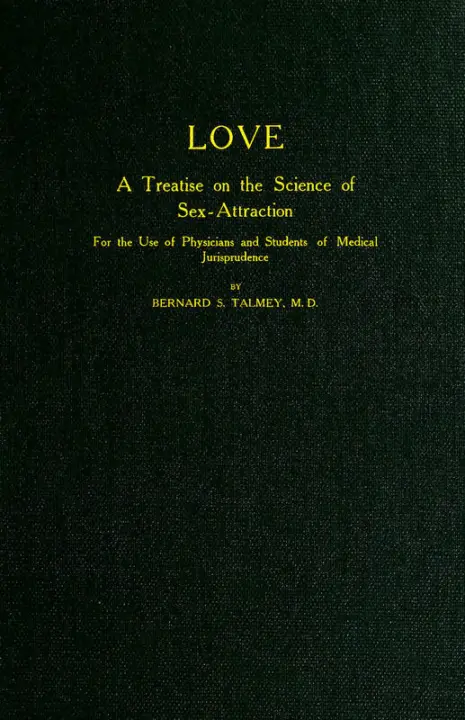
"Love: A Treatise on the Science of Sex-Attraction" by Bernard Simon Talmey is a scientific publication written in the early 20th century. This work offers an in-depth exploration of the nature of love and sexual attraction, aiming to bridge the gap in understanding between the emotional and pathological aspects of sexuality in both men and women. Talmey's intent is not only to analyze the mechanics of sex and love but also to challenge longstanding societal norms regarding the differences in sexual impulses between genders. The opening of the treatise sets the stage for Talmey’s exploration of love as a crucial force in human civilization. He argues that love and the sexual impulse are often misunderstood and subject to cultural taboos, especially when it comes to discussing them openly. Throughout the historical context, he discusses how ancient cultures revered sexuality, contrasting with modern perceptions shaped by prudery and obscenity. Talmey's foundational argument addresses the similarities and identities of the sexual impulses between men and women, positioning his work as an essential guide for both medical professionals and students seeking clarity on the complex interplay between emotion, biology, and societal norms regarding love and sex.
Introduction adapted from the source catalogue; source summaries may be automatically generated.
Free to read · English · 153,744 words · No account needed
MAKE TIME FOR A GOOD BOOK
On by default. Untick to stop anonymous reading totals. Each page counts after 10 seconds in view. How this works.
Anonymous counting is on unless you have switched it off.
The female sex, says Kant, may be characterized by two inclinations, the desire to dominate, and the desire for pleasure. These two tendencies may be mitigated by true love. The truly loving woman will gladly and voluntarily share material misfortune and social degradation with her lover. She will overcome her egotism, she will labor hard to overcome her old faults and cheerfully give up what she once looked upon as necessaries for the love of a true man. But the modern woman looks upon the man only as a slave to provide for her, and as a thing affording her enjoyment. Hence she regards the miserable weakling, whose imbecile brain has not the power of resistance, as touching and charming, while vigorous strength of character, which is schooled in self-control and which places as high a value on the affection afforded as on that received, seems to her repulsive roughness. This blending of her judgment becomes fatal to her love, so important to the female heart.
Love, in its ideal form, must be founded on mental qualities. In man the mental qualities are of the greatest value. The supreme survival value for man is his intelligence. The possessors of artistic or literary composition, of mechanical skill, of calculating ability, of energy or general mental ability are seldom or never endowed at the same time with physical qualities. It was brain not brawn that saved man in his struggle for existence. The cult of the muscle as against intelligence would destroy man. The physically fittest is not always the best of men. Even the animals, in their natural surroundings, live by their wits rather than by force of bone and muscle; and it was man’s wits and will that enabled him to increase and multiply as no other animal. Physical weapons of defense and offense have disappeared in man because his intelligence makes them superfluous. In the human species mind is master of matter. Man has staked his all upon mind. The emergence and dominance of mind have enabled the human species to ascend through struggle and internecine war to the highest scale of animal life, although it is physically one of the feeblest among the species of the higher animals. The increasing dominance of mind over matter is the reason that nowadays mental qualities dominate all else in man’s living activities. Hence ideal love must also be based upon mental qualities. Then it will be everlasting. The soul once allied with its mate can change no more. One of the mysteries of true love is the absolute impossibility to duplicate the lover. The soul is thus the essential part in true love. But when in the selection of the mates the physical factors only, such as stature, beauty, strength and health, play the most important rôle, when the senses form the chief part of the compound feeling, love will not long survive possession, and matrimonial happiness, founded upon monetary or social considerations, will pass like a shadow. The idol is soon destroyed. When, thereupon, the heart is disillusioned by the contact with the grim realities of existence, when it is deadened by the habitude of a fixed affection, coupled with incompatibility of tastes, when hardened by experience with the meanness of the world, then men and women attempt to find elsewhere a soul which they hope will desire to know more of their own, and in which they trust to discover a greater and more lasting happiness. But not being able to ask their own hearts, and guided only by the contradictory ideals they have been imbued with in their youth, the second choice and all the others, following the same, will generally turn out to be also delusions in which the perfect communion of hearts will again be absent. Men will then try to bury their unsatisfied longing for true affection in the exaggerated occupation with business or to drown their vehement unrequited love-yearnings in drink and other narcotics. The fate of the woman is even more tragic. Woman’s idea of happiness is a sort of ecstatic bliss. She is looking for perennial joy and beauty, for a joy as only the angels know. Hence when she learns to know the illusory nature of the heart’s greatest desire, when she makes the discovery of the futility of this desire, the wine of life grows sour. She becomes self-centered and selfish. The fountain ordained to yield such perennial sweets is soon drained and she bestows all her feminine faculties upon mere inanities. Hence the astonishing aspect of restlessness, and agitation which we now behold in her mania for dress, her indulgence in drink and nerve-deadening drugs, and in her quest of other vain luxuries in which she desires to drown the emptiness of her heart and her spiritual isolation.
Your reading position is saved on this browser. Take it to another device with a library code. Reading pages adapt to text, rather than matching a printed edition.
BEHIND THE BOOK
This eBook is for the use of anyone anywhere in the United States and most other parts of the world at no cost and with almost no restrictions whatsoever. You may copy it, give it away or re-use it under the terms of the Project Gutenberg License included with this eBook or online at www.gutenberg.org. If you are not located in the United States, you will have to check the laws of the country where you are located before using this eBook. Read the source licence.
The original source file, including credits and licence, is retained by this library. Request an original-format copy at no charge. Please include the book title and Project Gutenberg identifier #53121.
KEEP YOUR CURIOSITY GOING
Charles G. (Charles Griffith) Ross
Hannah Webster Foster

Emily Lawless
Edwin Hamlin Carr

Charles De Lano Hine
Andrew Ure