THE CLASSIC COLLECTION✦South Australia and Western AustraliaCLASSIC FREE BOOKS
South Australia and Western Australia
Anthony Trollope
THE CLASSIC COLLECTION · 1876
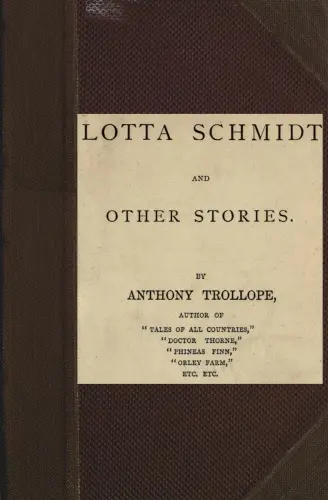
"Lotta Schmidt, and Other Stories" by Anthony Trollope is a collection of short stories written in the late 19th century. The first story, titled "Lotta Schmidt," introduces us to the vibrant city of Vienna and follows Lotta Schmidt, a lively and independent young woman, as she navigates the complexities of her relationships with friends and potential suitors, including a musician named Herr Crippel. At the start of the narrative, we find Lotta and her friend Marie Weber enjoying an evening out after work, discussing their plans for an upcoming gala and their thoughts on various men in their lives. Lotta, characterized as a striking and strong-willed girl, shows a clear affection for Herr Crippel, who leads the orchestra at a local beer hall. As the story unfolds, we glimpse the societal norms of Vienna, the nature of Lotta's budding relationships, and the personal struggles that Herr Crippel faces as he attempts to win Lotta's affection while grappling with his own insecurities. This opening portion sets a rich stage for the exploration of love, aspirations, and the themes of independence and societal expectations within the backdrop of 19th-century Europe.
Introduction adapted from the source catalogue; source summaries may be automatically generated.
Free to read · English · 79,376 words · No account needed
MAKE TIME FOR A GOOD BOOK
On by default. Untick to stop anonymous reading totals. Each page counts after 10 seconds in view. How this works.
Anonymous counting is on unless you have switched it off.
There were candles on the table when they were all assembled in the parsonage drawing-room previous to the marriage. The two gentlemen were there first. Then came Mrs. Granger, who rather frightened Mr. Frew by kissing him, and telling him that she should always regard him as a son-in-law.
“Nora has always been like one of ourselves, you know,” she said,
apologisingly.
“And let me tell you, Master Frew,” said the parson, “that you’re a very lucky fellow to get her.”
“I say, isn’t it cold?” said Bob, coming in--“where are the girls?”
“Here are the girls,” said Miss Foster, heading the procession of three which now entered the room, Nora, of course, being the last. Then Nora was kissed by everybody, including the strange American gentleman, who seemed to have made some mistake as to his privilege in the matter. But it all passed off very well, and I doubt if Nora knew who kissed her. It was very cold, and they were all wrapped close in their brown shawls and greatcoats, and the women looked very snug and comfortable in their ordinary winter bonnets.
“Come,” said the parson, “we mustn’t wait for Charley; he’ll follow us to church.” So the uncle took his niece on his arm, and the two Americans took the two bridesmaids, and Bob took his mother, and went along the beaten path over the snow to the church, and, as they got to the door, Charley rushed after them quite out of breath.
“I haven’t even got a pair of gloves at all,” he whispered to his
mother.
“It doesn’t matter; nobody’s to know,” said Mrs. Granger.
Nora by this time had forgotten the subject of her dress altogether, and it may be doubted if even the Misses Foster were as keenly alive to it as they thought they would have been. For myself, I think they all looked more comfortable on that cold winter morning without the finery which would have been customary than they could have done with it. It had seemed to them all beforehand that a marriage without veils and wreaths, without white gloves and new gay dresses, would be but a triste affair; but the idea passed away altogether when the occasion came. Mr. Granger and his wife and the two lads clustered around Nora as they made themselves ready for the ceremony, uttering words of warm love, and it seemed as though even the clerk and the servants took nothing amiss. Frederic F. Frew had met with a rebuff in the hall of the parsonage, in being forbidden to take his own bride under his own arm; but when the time for action came, he bore no malice, but went through his work manfully. On the whole, it was a pleasant wedding, homely, affectionate, full of much loving greeting; but not without many sobs on the part of the bride and of Mrs. Granger, and some slight suspicion of an eagerly-removed tear in the parson’s eye; but this, at any rate, was certain, that the wedding-clothes were not missed. When they all sat down to their breakfast in the parsonage dining-room, that little matter had come to be clean forgotten. No one knew, not even the Misses Foster, that there was anything extraordinary in their garb. Indeed, as to all gay apparel, we may say that we only miss it by comparison. It is very sad to be the wearer of the only frock-coat in company, to carry the one solitary black silk handkerchief at a dinner-party. But I do not know but that a dozen men so arrayed do not seem to be as well dressed as though they had obeyed the latest rules of fashion as to their garments. One thing, however, had been made secure. That sum of twenty pounds, saved from the milliners, had been duly paid over into Mr. Granger’s hands. “It has been all very nice,” said Mrs. Granger, still sobbing, when Nora went up stairs to tie on her bonnet before she started. “Only you are going!”
Your reading position is saved on this browser. Take it to another device with a library code. Reading pages adapt to text, rather than matching a printed edition.
Anthony Trollope

Anthony Trollope

Anthony Trollope

Anthony Trollope
BEHIND THE BOOK
This eBook is for the use of anyone anywhere in the United States and most other parts of the world at no cost and with almost no restrictions whatsoever. You may copy it, give it away or re-use it under the terms of the Project Gutenberg License included with this eBook or online at www.gutenberg.org. If you are not located in the United States, you will have to check the laws of the country where you are located before using this eBook. Read the source licence.
The original source file, including credits and licence, is retained by this library. Request an original-format copy at no charge. Please include the book title and Project Gutenberg identifier #54424.
KEEP YOUR CURIOSITY GOING
Coulson Kernahan

Maurice Baring
Frances Wright
Cécile Tormay

Frederic Jesup Stimson

W. H. P. (William Henry Pope) Jarvis