THE CLASSIC COLLECTION✦A lovers’ taleCLASSIC FREE BOOKS
A lovers’ tale
Maurice Hewlett
THE CLASSIC COLLECTION · 1913
"Lore of Proserpine" by Maurice Hewlett is a novel written in the early 20th century. This work explores themes of perception, reality, and the nature of existence through a blend of autobiographical reflection and fantastical elements. The narrative features a complex protagonist wrestling with dual aspects of his identity, engaged in a dialogue about the seen and unseen forces in the world. The opening of the novel sets a contemplative tone, beginning with a preface that addresses the nature of truth and reality, suggesting these may take forms beyond mere physical existence. The main character is introduced through an allegorical lens, likening the soul to a house with distinct tenants representing various facets of his personality. The narrative delves into his experiences of perception, particularly how ordinary sights transform when viewed through a 'special' lens, showcasing the interplay between the mundane and the extraordinary. As the story unfolds from the protagonist's thoughts and reflections, readers are invited to explore a metaphysical landscape filled with fairies and symbolic encounters, establishing a rich foundation for the journey ahead.
Introduction adapted from the source catalogue; source summaries may be automatically generated.
Free to read · English · 60,049 words · No account needed
MAKE TIME FOR A GOOD BOOK
On by default. Untick to stop anonymous reading totals. Each page counts after 10 seconds in view. How this works.
Anonymous counting is on unless you have switched it off.
I was not in any sense suited to such a place as this; if I had been sent to travel it had been better for me. I was "difficult," not because I was stiff but because I was lax. I resisted nothing except by inertia. If my parents did not know me--and how should they?--if I did not know myself, and I did not, my masters, for their part, made no attempt to know me nor even inquired whether there might be anything to know. I was unpopular, as might have been expected, made no friends, did no good. My brother, on the other hand, was an ideal schoolboy, diligent, brisk, lovable, abounding in friendships, good at his work and excellent at his play. His career at Spring Grove was one long happy triumph, and he deserved it. He has a charming nature, and is one of the few naturally holy persons I know. Wholesome, thank God, we all are, or could be; pious we nearly all are; but holiness is a rare quality.
If I were to try and set down here the really happy memories which I have of Spring Grove they would be three. The first was the revelation of Greece which was afforded me by Homer and Plato. The surging music and tremendous themes of the poet, the sweet persuasion of the sophist were a wonder and delight. I remember even now the thrill with which I heard my form-master translate for us the prayer with which the Phædrus closes: "Beloved Pan, and all ye other gods who haunt this place...." Beloved Pan! My knowledge of Pan was of the vaguest, and yet more than once or twice did I utter that prayer wandering alone the playing field, or watching the evening mist roll down the Thames Valley and blot up the elm trees, thick and white, clinging to the day like a fleece. The third Iliad again I have never forgotten, nor the twenty-fourth; nor the picture of the two gods, like vulture birds, watching the battle from the dead tree. Nor, again, do I ever fail to recapture the beat of the heart with which I apprehended some of Homer's phrases: "Sandy Pylos," Argos "the pasture land of horses," or "clear-seen" Ithaca. These things happened upon by chance in the dusty class-room, in the close air of that terrible hour from two to three, were as the opening of shutters to the soul, revealing blue distances, dim fields, or the snowy peaks of mountains in the sun. One seemed to lift, one could forget. It lasted but an instant; but time is of no account to the inner soul, of no more account than it is to God. I have never forgotten these moments of escape; nor can I leave Homer without confessing that his books became my Bible. I accepted his theology implicitly; I swallowed it whole. The Godhead of the Olympians, the lesser divinity of Thetis and Alpheios and Xanthos were indisputable. They were infinitely more real to me than the deities of my own land; and though I have found room for these later on in life, it has not been by displacing the others. Nor is there any need for that, so far as I see. I say that out of Homer I took his Gods; I add that I took them instantly. I seemed to breathe the air of their breath; they appealed to my reason; I knew that they had existed and did still exist. I was not shocked or shaken in my faith, either, by anything I read about them. Young as I was and insipient, I was prepared for what is called the burlesque Olympus of the Iliad, so grievous to Professor Murray. I think I recognised then, what seems perfectly plain to me now, that you might as well think meanly of a God of Africa because the natives make him of a cocoanut on a stick, as of Zeus and Hera because Homer says that they played peccant husband and jealous wife. If Homer halted it is rash to assume that Hephaistos did. The pathetic fallacy has crept in here. Mythology was one of the few subjects I diligently read at school, and all I got out of it was pure profit--for I realised that the Gods' world was not ours, and that when their natures came in conflict with ours some such interpretation must always be put upon their victory. We have a moral law for our mutual wellbeing which they have not. We translate their deeds in terms of that law of ours, and it certainly appears like a standing fact of Nature that when the beings of one order come into commerce with those of another the result will be tragic. There is only a harmony in acquiescence, and the way to that is one of blood and tears.
Your reading position is saved on this browser. Take it to another device with a library code. Reading pages adapt to text, rather than matching a printed edition.
Maurice Hewlett

Maurice Hewlett

Maurice Hewlett
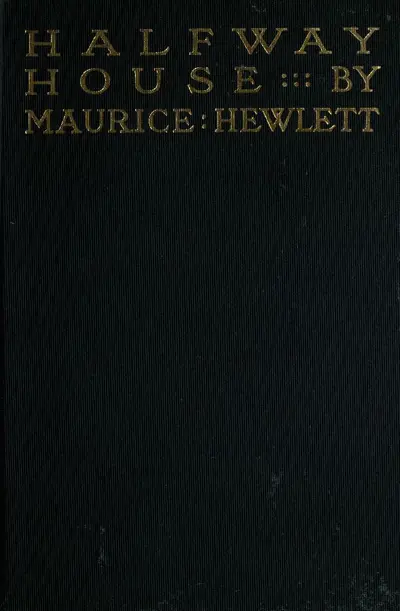
Maurice Hewlett
BEHIND THE BOOK
This eBook is for the use of anyone anywhere in the United States and most other parts of the world at no cost and with almost no restrictions whatsoever. You may copy it, give it away or re-use it under the terms of the Project Gutenberg License included with this eBook or online at www.gutenberg.org. If you are not located in the United States, you will have to check the laws of the country where you are located before using this eBook. Read the source licence.
The original source file, including credits and licence, is retained by this library. Request an original-format copy at no charge. Please include the book title and Project Gutenberg identifier #18730.
KEEP YOUR CURIOSITY GOING
Coulson Kernahan

Maurice Baring
Frances Wright
Cécile Tormay
Francis Greenleaf Allinson & Anne C. E. (Anne Crosby Emery) Allinson

Frederic Jesup Stimson