THE CLASSIC COLLECTION✦A lovers’ taleCLASSIC FREE BOOKS
A lovers’ tale
Maurice Hewlett
THE CLASSIC COLLECTION · 1913
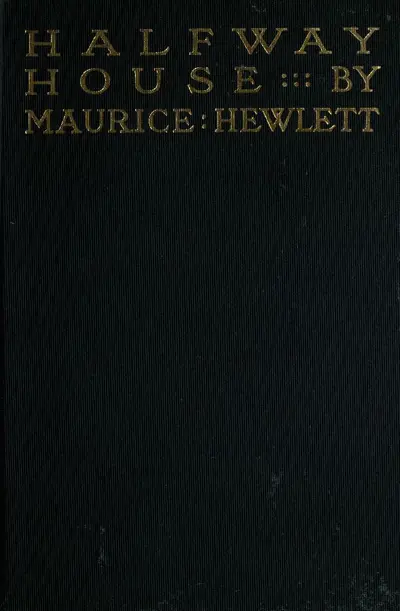
"Lore of Proserpine" by Maurice Hewlett is a novel written in the early 20th century. This work explores themes of perception, reality, and the nature of existence through a blend of autobiographical reflection and fantastical elements. The narrative features a complex protagonist wrestling with dual aspects of his identity, engaged in a dialogue about the seen and unseen forces in the world. The opening of the novel sets a contemplative tone, beginning with a preface that addresses the nature of truth and reality, suggesting these may take forms beyond mere physical existence. The main character is introduced through an allegorical lens, likening the soul to a house with distinct tenants representing various facets of his personality. The narrative delves into his experiences of perception, particularly how ordinary sights transform when viewed through a 'special' lens, showcasing the interplay between the mundane and the extraordinary. As the story unfolds from the protagonist's thoughts and reflections, readers are invited to explore a metaphysical landscape filled with fairies and symbolic encounters, establishing a rich foundation for the journey ahead.
Introduction adapted from the source catalogue; source summaries may be automatically generated.
Free to read · English · 60,049 words · No account needed
MAKE TIME FOR A GOOD BOOK
On by default. Untick to stop anonymous reading totals. Each page counts after 10 seconds in view. How this works.
Anonymous counting is on unless you have switched it off.
You will remember that Socrates considers every soul of us to be at least three persons. He says, in a fine figure, that we are two horses and a charioteer. "The right-hand horse is upright and cleanly made; he has a lofty neck and an aquiline nose; his colour is white and his eyes dark; he is a lover of honour and modesty and temperance, and the follower of true glory; he needs no touch of the whip, but is guided by word and admonition only. The other is a crooked lumbering animal, put together anyhow; he has a short thick neck; he is flat-faced and of a dark colour, with grey eyes of blood-red complexion; the mate of insolence and pride, shag-eared and deaf, hardly yielding to whip and spur." I need not go on to examine with the philosopher the acts of this pair under the whip and spur of love, because I am not going to talk about love. For my present purpose I shall suggest another dichotomy. I will liken the soul itself of man to a house, divided according to the modern fashion into three flats or apartments. Of these the second floor is occupied by the landlord, who wishes to be quiet, and is not, it seems, afraid of fire; the ground-floor by a business man who would like to marry, but doubts if he can afford it, goes to the city every day, looks in at his club of an afternoon, dines out a good deal, and spends at least a month of the year at Dieppe, Harrogate, or one of the German spas. He is a pleasant-faced man, as I see him, neatly dressed, brushed, anointed, polished at the extremities--for his boots vie with his hair in this particular. If he has a fault it is that of jingling half-crowns in his trouser-pocket; but he works hard for them, pays his rent with them, and gives one occasionally to a nephew. That youth, at any rate, likes the cheerful sound. He is rather fond, too, of monopolising the front of the fire in company, and thinks more of what he is going to eat, some time before he eats it, than a man should. But really I can't accuse him of anything worse than such little weaknesses. The first floor is occupied by a person of whom very little is known, who goes out chiefly at night and is hardly ever seen during the day. Tradesmen, and the crossing-sweeper at the corner, have caught a glimpse on rare occasions of a white face at the window, the startled face of a queer creature, who blinks and wrings at his nails with his teeth; who peers at you, jerks and grins; who seems uncertain what to do; who sometimes shoots out his hands as if he would drive them through the glass: altogether a mischancy, unaccountable apparition, probably mad. Nobody knows how long he has been here; for the landlord found him in possession when he bought the lease, and the ground-floor, who was here also, fancies that they came together, but can't be sure. There he is, anyhow, and without an open scandal one doesn't like to give him notice. A curious thing about the man is that neither landlord nor ground-floor will admit acquaintance with him to each other, although, if the truth were known, each of them knows something--for each of them has been through his door; and I will answer for one of them, at least, that he has accompanied the Undesirable upon more than one midnight excursion, and has enjoyed himself enormously. If you could get either of these two alone in a confidential mood you might learn some curious particulars of their coy neighbour; and not the least curious would be the effect of his changing the glass of the first floor windows. It seems that he had that done directly he got into his rooms, saying that it was impossible to see out of such windows, and that a man must have light. Where he got his glass from, by whom it was fitted, I can't tell you, but the effect of it is most extraordinary. The only summary account I feel able to give of it at the moment is that it transforms the world upon which it opens. You look out upon a new earth, literally that. The trees are not trees at all, but slim grey persons, young men, young women, who stand there quivering with life, like a row of Caryatides--on duty, but tiptoe for a flight, as Keats says. You see life, as it were, rippling up their limbs; for though they appear to be clothed, their clothing is of so thin a texture, and clings so closely that they might as well not be clothed at all. They are eyed, they see intensely; they look at each other so closely that you know what they would be doing. You can see them love each other as you watch. As for the people in the street, the real men and real women, as we say, I hardly know how to tell you what they look like through the first floor's windows. They are changed of everything but one thing. They occupy the places, fill the standing-room of our neighbours and friends; there is a something about them all by which you recognise them--a trick of the hand, a motion of the body, a set of the head (God knows what it is, how little and how much); but for all that--a new creature! A thing like nothing that lives by bread! Now just look at that policeman at the corner, for instance; not only is he stark naked--everybody is like that--but he's perfectly different from the sturdy, good-humoured, red-faced, puzzled man you and I know. He is thin, woefully thin, and his ears are long and perpetually twitching. He pricks them up at the least thing; or lays them suddenly back, and we see them trembling. His eyes look all ways and sometimes nothing but the white is to be seen. He has a tail, too, long and leathery, which is always curling about to get hold of something. Now it will be the lamp-post, now the square railings, now one of those breathing trees; but mostly it is one of his own legs. Yet if you consider him carefully you will agree with me that his tail is a more expressive remnant of the man you have always seen there than any other part of him. You may say, and truly, that it is the only recognisable thing left. What do you think of his feet and hands? They startled me at first; they are so long and narrow, so bony and pointed, covered with fine short hair which shines like satin. That way he has of arching his feet and driving his toes into the pavement delights me. And see, too, that his hands are undistinguishable from feet: they are just as long and satiny. He is fond of smoothing his face with them; he brings them both up to his ears and works them forward like slow fans. Transformation indeed. I defy you to recognise him for the same man--except for a faint reminiscence about his tail.
Your reading position is saved on this browser. Take it to another device with a library code. Reading pages adapt to text, rather than matching a printed edition.
Maurice Hewlett

Maurice Hewlett

Maurice Hewlett
Maurice Hewlett
BEHIND THE BOOK
This eBook is for the use of anyone anywhere in the United States and most other parts of the world at no cost and with almost no restrictions whatsoever. You may copy it, give it away or re-use it under the terms of the Project Gutenberg License included with this eBook or online at www.gutenberg.org. If you are not located in the United States, you will have to check the laws of the country where you are located before using this eBook. Read the source licence.
The original source file, including credits and licence, is retained by this library. Request an original-format copy at no charge. Please include the book title and Project Gutenberg identifier #18730.
KEEP YOUR CURIOSITY GOING
Coulson Kernahan

Maurice Baring
Frances Wright
Cécile Tormay
Francis Greenleaf Allinson & Anne C. E. (Anne Crosby Emery) Allinson

Frederic Jesup Stimson