THE CLASSIC COLLECTION✦Stories of Charlemagne and the twelve Peers of FranceCLASSIC FREE BOOKS
Stories of Charlemagne and the twelve Peers of France
Alfred John Church
THE CLASSIC COLLECTION · 1897
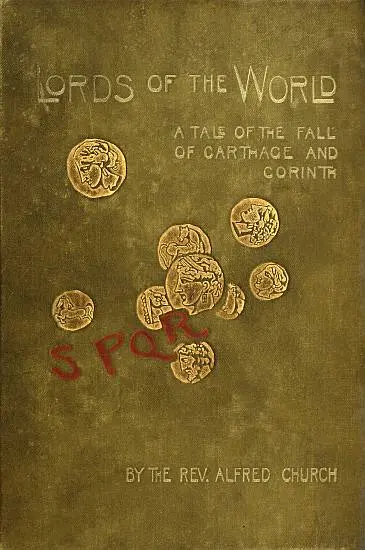
"Lords of the World: A Story of the Fall of Carthage and Corinth" by A. J. Church is a historical account written in the late 19th century. The narrative is focused on the dramatic events surrounding the fall of Carthage and Corinth in 146 B.C. and the struggles of the characters, particularly a young Greek named Cleanor, against the rise of Roman power." The opening of this work introduces readers to the fateful voyage of the "Melcart", a sacred Carthaginian ship, tasked with a vital mission despite the looming threat from the Romans. The ship's captain, Hanno, and his nephew, Mago, spot a Roman warship that threatens their return to Carthage. This tense encounter serves as a backdrop to depict the dire situation of Carthage as it faces imminent destruction. Following the fate of the "Melcart", the narrative shifts to the city of Chelys, where Lysis, a leading citizen, learns of Rome's brutal terms that threaten his family. The chapter ends with a poignant decision made by Lysis and his children, foreshadowing the sacrifices they must make amidst the chaos of their changing world.
Introduction adapted from the source catalogue; source summaries may be automatically generated.
Free to read · English · 91,511 words · No account needed
MAKE TIME FOR A GOOD BOOK
On by default. Untick to stop anonymous reading totals. Each page counts after 10 seconds in view. How this works.
Anonymous counting is on unless you have switched it off.
"Yes, yes, I knew him well," replied Polybius, "and have excellent reasons for remembering him. As you say, he was of a very different stamp, and belonged to quite another age. He was of a time when scarcely a Roman had ever set his foot outside Italy, or even imagined that anything good could come from beyond the seas. Yet it was strange how the new spirit had succeeded in touching even him in his old age. Do you know that I had the honour of having him for a pupil? He must have been close upon eighty years of age when he found that it put him at a disadvantage not to know what other men knew, and he actually took to learning Greek. He had long been able to speak it in a way, but he took to reading it, and I had the pleasure of being his teacher. I used to stay at his country house, for it was only there that he had leisure for his lessons. It was a curious experience. He used to entertain his neighbours, the country-side folk, farmers and the like, in the friendliest fashion. They were fine, sturdy folk, and I soon understood, when I saw them, how Rome seems likely to conquer the world. And what heads they had! The wine-cup didn't halt in its rounds, I can tell you, and if I hadn't missed my turn as often as I could, the end would have been disaster. As for the old man, he never shirked.[43] But there was a very harsh side to his character. Nothing could be harder than his dealings with his slaves. They were mere beasts of burden to him, not one whit of more account than his horses and oxen,--not indeed of so much, seeing that they gave more trouble. He gave them just as much food as would keep them alive, not a morsel more. When they grew too old for work, he turned them out of doors to starve. However, he behaved very well to me, and if I gave him any help, he repaid me many fold. He was won over somehow to take the part of the exiles. Of course Scipio and his friends had a great deal to do with it, but I always thought that he had also a kindness for me. I was in the senate-house when the question came on--should the Greek exiles be allowed to go home? There was a hot debate, and a close division was expected. The old man rose to speak quite at the end of the sitting. I must say that what he said was not flattering, but it was certainly effective. 'Are we going to waste any more time about these trumpery Greeks? If we don't settle the matter to-day we shall have the whole discussion over again.' Then he sat down. The senators laughed; and the motion was carried easily. I went to thank him the next day. He was very friendly, and I took courage to say that if we were allowed to go back, we might also be restored to our rank and honours. He smiled very grimly. 'Friend,' he said, 'when a man is lucky enough to get out of the Cyclops' cave, I take it that he would be a fool to go back after his hat or his cloak.' I took the hint, and was off before two days had passed. But before I went, he sent a message that he wanted to see me. He was then at his country house, and he was busy making some alterations in a book that he had written about agriculture. He was dictating, and a slave, a wretched Greek, who looked, as he probably was, half-starved, was writing down. 'I bought him at Magnesia[44],' he said, 'for £20, and an excellent bargain it was, but he is getting past his work now.' I saw the poor fellow flush up, but Cato cared no more for his feelings than if he had been a dog. 'But now for what I wanted to say to you. I don't suppose that I shall see the end of Carthage, though it will not be for want of urging my countrymen to bring it about.[45] But you probably will, for it can hardly be postponed for another ten years. Well, there is one thing in Carthage that I have always wished to see, and that is, Mago's work on agriculture. I have never been able to get anything like a complete copy of it. Only two or three of the books--there are twenty-eight in all--have come into my hands, and I have found them quite admirable, and have made all the use of them that I could for my own treatise. What I wanted to say to you was to bear this matter in mind if you should chance to be at hand when the end comes. Books often fare very badly at such times. What, indeed, does the common soldier know about their value? But, depend upon it, this one will be worth a whole ship-load of gold and silver. Keep your eyes open, then, and warn all whom you know to be on the look-out for Mago's book.' That was the last time I saw him. He lived two years longer, and died happy, I suppose, because war had been declared against Carthage."
Your reading position is saved on this browser. Take it to another device with a library code. Reading pages adapt to text, rather than matching a printed edition.
Alfred John Church
Alfred John Church
Alfred John Church & Homer

Alfred John Church
BEHIND THE BOOK
This eBook is for the use of anyone anywhere in the United States and most other parts of the world at no cost and with almost no restrictions whatsoever. You may copy it, give it away or re-use it under the terms of the Project Gutenberg License included with this eBook or online at www.gutenberg.org. If you are not located in the United States, you will have to check the laws of the country where you are located before using this eBook. Read the source licence.
The original source file, including credits and licence, is retained by this library. Request an original-format copy at no charge. Please include the book title and Project Gutenberg identifier #41464.
KEEP YOUR CURIOSITY GOING
Cécile Tormay

Moritz Busch
Coulson Kernahan
John L. Ransom

Maurice Baring
Frances Wright