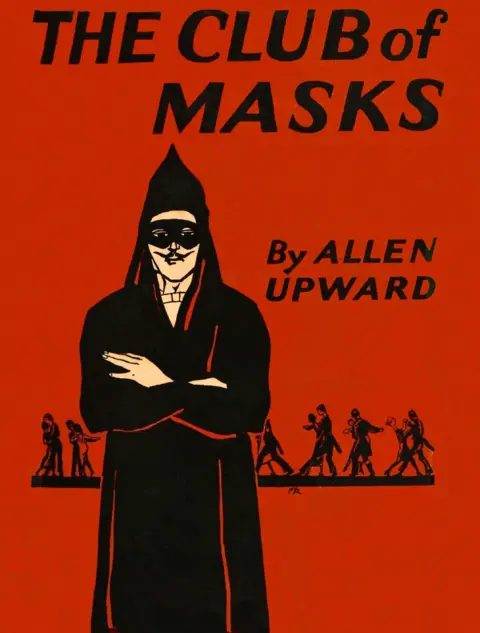
The club of masks
Allen Upward
THE CLASSIC COLLECTION · 1910
"Lord Alistair's Rebellion" by Allen Upward is a novel written in the early 20th century. It presents a compelling narrative centered on Lord Alistair Stuart, a young man grappling with his failures and tumultuous relationship with the enigmatic Molly Finucane. As society watches from the sidelines, the story delves into themes of identity, morality, and the struggles against societal pressures within the backdrop of early 20th-century England. At the start of the story, London is vividly described at night, mirroring the contrasts in Alistair's life as he stands on Westminster Bridge. He contemplates his failures and the burden of his familial legacy while external tensions reflect the divide between the affluent north bank and the deprived south. The narrative introduces Alistair as a man facing public disgrace over his bankruptcy, which coincides with the success of his brother, the Duke of Trent. Alistair is emotionally intertwined with Molly Finucane, a woman of dubious reputation, whose influence complicates his journey toward self-discovery and societal redemption. Their complex romance, coupled with familial expectations, sets the stage for the unfolding consequences of Alistair's choices as he seeks to understand his place in a world steeped in moral ambiguity.
Introduction adapted from the source catalogue; source summaries may be automatically generated.
Free to read · English · 94,225 words · No account needed
MAKE TIME FOR A GOOD BOOK
On by default. Untick to stop anonymous reading totals. Each page counts after 10 seconds in view. How this works.
Anonymous counting is on unless you have switched it off.
An altercation between mistress and maid followed, high words being used on both sides. Stuart went on with his dinner in silent disgust, trying not to listen. He had sat through similar scenes often enough before, but they had not made the same impression on him. It was as though his whole nature had been set throbbing like a bell with a certain note, with which his surroundings were all out of tune.
The dinner was not only badly cooked, but it quickly appeared that there was not enough of it. On seeing a few slices of ham set before her in the place of a joint, the mistress of the house lost her temper.
“Go and tell the cook to make an omelette,” she ordered angrily. “It’s disgraceful that we can’t have enough to eat.”
The parlour-maid departed. A minute or two afterwards the door was flung open violently, and the cook advanced into the middle of the dining-room.
“You can’t have an omelette. I’ve no eggs, and the fire’s gone out,” she remarked loudly and aggressively.
“What do you mean, cook?” said Molly, evidently rather alarmed.
The cook saw her mistress quailing, and raised her voice.
“I mean that I’ve cooked as much as I mean to, and I’m not going to do any more. I’m tired of it.”
“This is disgraceful!” exclaimed her mistress, appealing to Stuart. “You ought to be ashamed of yourself, to come in and talk like that, simply because I asked for an omelette.”
“Well, you can’t have it, then,” the cook returned, with a ring of
triumph.
“Very well; that’s enough. Go downstairs!” commanded Molly.
The cook tossed her head, and marched out of the room, slamming the
door behind her.
“Do you owe the woman any wages?” Stuart asked, as soon as she was gone. He knew by experience that it was useless to interfere in these periodical scenes between Molly and her household.
“Not a farthing,” Molly protested. “And I’ve always treated her kindly, too. I can’t think what makes her presume like that.”
The cook went down fuming and snorting into the kitchen, and gave the explanation to her sympathizing sisters.
“I’ll teach her to send haughty messages out to me, and me a respectable woman whose father had a farm, and six men under him; and her out of the gutter, and no better than a street-walker, if you come to that, though she do ride in her carriage, and wear as many jewels as a Martinet.”
“You mean a Marchioness, don’t you, Eleanor?” inquired the housemaid, who had moved in higher spheres.
Your reading position is saved on this browser. Take it to another device with a library code. Reading pages adapt to text, rather than matching a printed edition.
Allen Upward
Allen Upward
Allen Upward
Allen Upward
BEHIND THE BOOK
This eBook is for the use of anyone anywhere in the United States and most other parts of the world at no cost and with almost no restrictions whatsoever. You may copy it, give it away or re-use it under the terms of the Project Gutenberg License included with this eBook or online at www.gutenberg.org. If you are not located in the United States, you will have to check the laws of the country where you are located before using this eBook. Read the source licence.
The original source file, including credits and licence, is retained by this library. Request an original-format copy at no charge. Please include the book title and Project Gutenberg identifier #66617.
KEEP YOUR CURIOSITY GOING
Coulson Kernahan

Maurice Baring
Frances Wright
Cécile Tormay

Frederic Jesup Stimson

W. H. P. (William Henry Pope) Jarvis