THE CLASSIC COLLECTION✦An outlaw’s diary: the CommuneCLASSIC FREE BOOKS
An outlaw’s diary: the Commune
Cécile Tormay
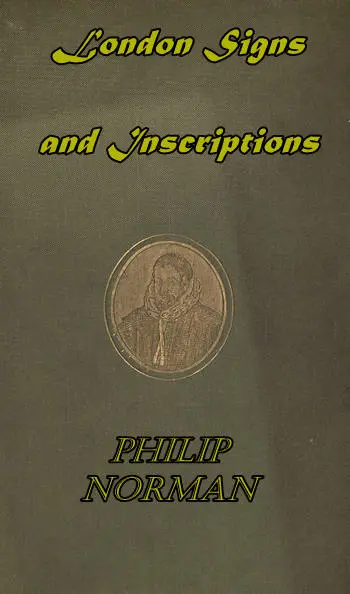
THE CLASSIC COLLECTION · 1893
"London Signs and Inscriptions" by Philip Norman is a historical account written in the late 19th century. The book explores the unique and artistic sculptured signs that mark various buildings and places throughout London, shedding light on the city's architectural history and cultural heritage. It delves into the significance of these signs, illustrating how they represent ownership, history, and the ambiance of the urban landscape. The opening of the work introduces the fascinating world of London's signs and inscriptions, revealing their importance as markers of identity for traders, establishments, and localities in the 18th century and earlier. Philip Norman, an artist and antiquary, provides a historical context for these signs, sharing stories and connections with past traditions. He discusses specific examples, such as the sculptured sign of the Boy and Panyer and the connections of various signs to local history and trade practices, setting the stage for a detailed exploration of thousands of unique signs across the city in subsequent chapters.
Introduction adapted from the source catalogue; source summaries may be automatically generated.
Free to read · English · 54,888 words · No account needed
MAKE TIME FOR A GOOD BOOK
On by default. Untick to stop anonymous reading totals. Each page counts after 10 seconds in view. How this works.
Anonymous counting is on unless you have switched it off.
Concerts were, no doubt, among the attractions the house afforded, till the Great Fire in September, 1666, destroyed all. It has been suggested that on the rebuilding of the premises, the new tenant, to ridicule the character of the former business, chose as his sign a goose stroking the bars of a gridiron with her foot, and wrote below, ‘The Swan and Harp.’ Larwood and Hotten think that it was a homely rendering of a charge in the coat of arms of the Musicians’ Company. That the Swan and Harp was an actual sign, I learn from the Little London Directory of 1677, where one is mentioned in Cheapside.
At the Goose and Gridiron, Sir Christopher Wren presided over the St. Paul’s Lodge of Freemasons for upwards of eighteen years.[51] It is said that he presented the Lodge with three carved mahogany candlesticks, and the trowel and mallet which had been used in laying the first stone of the Cathedral. In the ‘Vade Mecum for Malt-worms,’ there is a rude drawing of the sign, and we are told in doggerel as rude that,
‘Dutch carvers from St. Paul’s adjacent dome,
Hither to whet their whistles daily come.’
Also that ‘the rarities of the house are; 1, the odd sign; 2, the pillar which supports the chimney; 3, the skittle ground upon the top of the house; 4, the watercourse running through the chimney; 5, the handsome maid, Hannah.’ Foote mentions the Goose and Gridiron in his ‘Comedy of Taste.’
Yet another Mitre sign exists in London, probably far older than any of those I have described. In Mitre Court, a narrow passage between Hatton Garden and Ely Place, stands a comparatively modern public-house, let into the front wall of which is a Mitre carved in bold relief; on it is cut or scratched the date 1546, which, however, appears to be a modern addition. This is said to have formed part of the town residence of the Bishops of Ely, the remains of which, with the ground attached to it, were conveyed to the Crown in 1772. The site was afterwards sold to an architect named Cole, who levelled everything except the chapel. This last building stands hard by, and is dedicated to St. Etheldreda. The Rev. W. J. Loftie considers that it is the most complete relic of the fourteenth century in London. Since he wrote, however, the restorer has, alas! been busy. In 1772 it stood in an open space of about an acre, planted with trees and surrounded by a wall; at that time the hall, seventy-two feet long, and a quadrangular cloister existed. Over the chief entrance the sculptured arms of the see, surmounted by a mitre, were still visible, and it is likely that this mitre was afterwards converted into the sign I am considering. The rural character of the neighbourhood in early days may be judged by the records of it which have come down to us. In 1327 Bishop Hotham purchased a house and lands, including vineyard, kitchen-garden and orchard contiguous to his manor of Holborn, which, with other properties, he settled on the church of Ely, dividing them between his successors the Bishops, and the convent. Again, as late as 1576, when Sir Christopher Hatton, Queen Elizabeth’s handsome Lord Chancellor, became tenant of part of the house and garden, the rent was a red rose, ten loads of hay and £10 a year; Bishop Cox, on whom the bargain was forced by the Queen, reserving to himself and his successors the right of walking in the gardens and gathering twenty bushels of roses annually. Shakespeare, too, praises the quality of the strawberries in Ely Garden, though little more than sixty years afterwards we have John Evelyn complaining in his ‘Fumifugium’ that smoke is ‘suffering nothing in our gardens to bud, display themselves, or ripen; so as our anemones and many other choycest flowers, will by no industry be made to blow in London or the precincts of it.’ Ely Place seems to have been let by the see to John of Gaunt, ‘time-honoured Lancaster,’ and here in 1399 he breathed his last. The present town residence of the Bishops of Ely, No. 37, Dover Street, has been occupied by them since 1772. It has a mitre carved over one of the first-floor windows; Sir Robert Taylor, R.A., was the architect.
Your reading position is saved on this browser. Take it to another device with a library code. Reading pages adapt to text, rather than matching a printed edition.
BEHIND THE BOOK
This eBook is for the use of anyone anywhere in the United States and most other parts of the world at no cost and with almost no restrictions whatsoever. You may copy it, give it away or re-use it under the terms of the Project Gutenberg License included with this eBook or online at www.gutenberg.org. If you are not located in the United States, you will have to check the laws of the country where you are located before using this eBook. Read the source licence.
The original source file, including credits and licence, is retained by this library. Request an original-format copy at no charge. Please include the book title and Project Gutenberg identifier #53105.
KEEP YOUR CURIOSITY GOING
Cécile Tormay

Moritz Busch
John L. Ransom
Frances Wright
Cécile Tormay

Mabel Potter Daggett