THE CLASSIC COLLECTION✦An outlaw’s diary: the CommuneCLASSIC FREE BOOKS
An outlaw’s diary: the Commune
Cécile Tormay
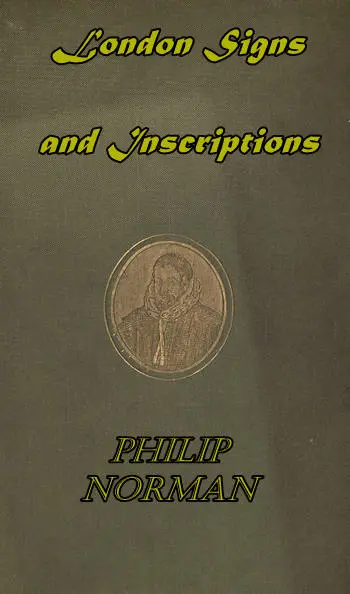
THE CLASSIC COLLECTION · 1893
"London Signs and Inscriptions" by Philip Norman is a historical account written in the late 19th century. The book explores the unique and artistic sculptured signs that mark various buildings and places throughout London, shedding light on the city's architectural history and cultural heritage. It delves into the significance of these signs, illustrating how they represent ownership, history, and the ambiance of the urban landscape. The opening of the work introduces the fascinating world of London's signs and inscriptions, revealing their importance as markers of identity for traders, establishments, and localities in the 18th century and earlier. Philip Norman, an artist and antiquary, provides a historical context for these signs, sharing stories and connections with past traditions. He discusses specific examples, such as the sculptured sign of the Boy and Panyer and the connections of various signs to local history and trade practices, setting the stage for a detailed exploration of thousands of unique signs across the city in subsequent chapters.
Introduction adapted from the source catalogue; source summaries may be automatically generated.
Free to read · English · 54,888 words · No account needed
MAKE TIME FOR A GOOD BOOK
On by default. Untick to stop anonymous reading totals. Each page counts after 10 seconds in view. How this works.
Anonymous counting is on unless you have switched it off.
The nationality of the Three Kings has been as much discussed as the time taken on their journey. The natural inference would appear to be that they belonged to the priestly caste of Persia; Cornelius à Lapide considers that they were Eastern Arabians. He says: ‘The more common opinion of the Fathers and Doctors is that the Magi came on the thirteenth day from the first appearance of the star and the birth of Christ, whence the Church celebrates the mystery on the twelfth day after Christmas.’[17] In their old age they were said to have been baptized by St. Thomas, and to have associated with him in preaching the Gospel. Lastly, some have asserted that they were slain by idolaters; L. Dexter in his chronicle, under A.D. 70, adds: ‘In Arabia Felix, in the City of Sessania, took place the martyrdom of the three royal Magi; Gaspar, Balthazar, Melchior.’
We are told that early in the fourth century their bodies were discovered, and moved to Constantinople by the pious Empress Helena. Thence they found their way to Milan, being enshrined in the church of San Eustorgio. A few years later their fame was increased by the institution of the Feast of the Three Kings, which has been ascribed to Pope Julius, the first of that name. After the taking of Milan[18] by the Emperor Frederick Barbarossa, in the year 1162, the precious relics were granted to Reinaldus, Archbishop of Cologne, who brought them to that city, which proved to be their final resting-place. Cologne, proud of the honour, adopted as her arms, argent, on a chief gules, three royal crowns or; and so we have an interesting heraldic record of this event.
In course of time, however, each of these Three Kings[19] has had a shield of arms assigned to him. Perhaps the earliest examples yet known are on the roof of Norwich Cathedral. Here we find three bosses which date from the time of Bishop Lehart, who ruled that see from 1446 to 1472; on one is a blazing star, the next has seven stars, the third a star and crescent moon. The first and last of these appear on bosses at Winchester, placed there in the days of Richard Foxe, successively Bishop of Exeter, Durham and Winchester, and founder of Corpus Christi College, Oxford. He also gave relics of the three Epiphany Kings to Portchester Old Church.[20] Lord Ashburnham’s picture of the Adoration, exhibited at Burlington House in 1891, may be considered one of the most noteworthy examples illustrating this branch of the subject. It is attributed to Mabuse, and in Mr. Weale’s opinion was evidently painted about the year 1509, under strong Franciscan influence. In it are three processions in the background, of the Three Kings meeting at the Jordan. Each procession has an azure banner; on one is a blazing star, on another seven stars, and on the third a star and crescent moon. These same charges are embroidered on their robes in the foreground of the picture, and as on two of the Kings the names of Jasper[21] and Balthazar appear, we see that the star and crescent are assigned to Jasper, the blazing star to Balthazar, and the seven stars to Melchior. Different versions of the arms exist; for instance, those in a manuscript book of heraldry, which Sir David Lyndsay of the Mount, Lyon King of Arms in Scotland, caused to be executed in the year 1522, and of which Mr. David Laing published a facsimile in 1878. Here Balthazar is called King of Saba, whose assigned shield of arms is, or, on a mount vert an Ethiopian proper, habited in a tunic per pale, azure and gules, holding in the dexter hand a spear with a pennon per pale, gules and azure, and wreathed round the temples, argent and azure. Jasper is called King of Tarshish; his shield is azure, with an estoile on the dexter, and a large crescent moon on the sinister, both proper. Melchior is called King of Araby, and on his azure shield are six estoiles proper. In the British Museum, on a superb jug of stoneware, made at Raaren near Achen, about 1590, are the three shields of arms of the Three Kings of Cologne. On this jug, Balthazar has the star and crescent moon; Casper, as he is here called, the seven stars; and the Ethiopian is assigned to Melchior. A work of art truly delightful, but conveying no heraldic lesson, is the long fresco of the journey of the Three Kings by Bennozzo Gozzoli, in the Riccardi Palace at Florence, wherein the rich cavalcade is shown, winding about by rock and river and wooded landscape, on which the painter has lavished all his poetry of invention and feeling for fresh nature.
Your reading position is saved on this browser. Take it to another device with a library code. Reading pages adapt to text, rather than matching a printed edition.
BEHIND THE BOOK
This eBook is for the use of anyone anywhere in the United States and most other parts of the world at no cost and with almost no restrictions whatsoever. You may copy it, give it away or re-use it under the terms of the Project Gutenberg License included with this eBook or online at www.gutenberg.org. If you are not located in the United States, you will have to check the laws of the country where you are located before using this eBook. Read the source licence.
The original source file, including credits and licence, is retained by this library. Request an original-format copy at no charge. Please include the book title and Project Gutenberg identifier #53105.
KEEP YOUR CURIOSITY GOING
Cécile Tormay

Moritz Busch
John L. Ransom
Frances Wright
Cécile Tormay

Mabel Potter Daggett