THE CLASSIC COLLECTION✦An outlaw’s diary: the CommuneCLASSIC FREE BOOKS
An outlaw’s diary: the Commune
Cécile Tormay
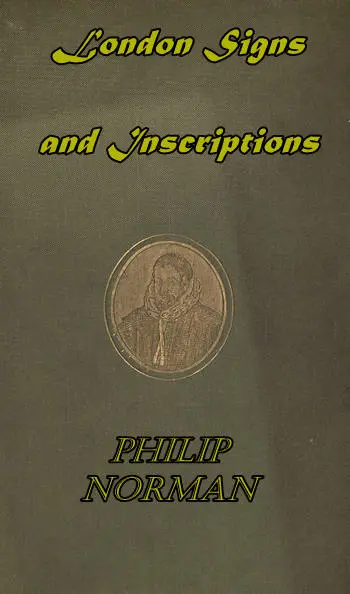
THE CLASSIC COLLECTION · 1893
"London Signs and Inscriptions" by Philip Norman is a historical account written in the late 19th century. The book explores the unique and artistic sculptured signs that mark various buildings and places throughout London, shedding light on the city's architectural history and cultural heritage. It delves into the significance of these signs, illustrating how they represent ownership, history, and the ambiance of the urban landscape. The opening of the work introduces the fascinating world of London's signs and inscriptions, revealing their importance as markers of identity for traders, establishments, and localities in the 18th century and earlier. Philip Norman, an artist and antiquary, provides a historical context for these signs, sharing stories and connections with past traditions. He discusses specific examples, such as the sculptured sign of the Boy and Panyer and the connections of various signs to local history and trade practices, setting the stage for a detailed exploration of thousands of unique signs across the city in subsequent chapters.
Introduction adapted from the source catalogue; source summaries may be automatically generated.
Free to read · English · 54,888 words · No account needed
MAKE TIME FOR A GOOD BOOK
On by default. Untick to stop anonymous reading totals. Each page counts after 10 seconds in view. How this works.
Anonymous counting is on unless you have switched it off.
[60] The gatehouse had only been finished in the year 1728, having replaced a previous one damaged by a great fire on the bridge in 1725. Mist’s Weekly Journal, for Saturday, September 11, tells us that about sixty houses were consumed on that occasion.
[61] Burke’s ‘Armory General.’ This seems correct; but Burke’s ‘Extinct Peerages’ gives it, ‘gules, a chevron between three cross crosslets or.’
[62] From early days, however, the fair had increased beyond church limits, and the City had acquired certain rights. In the fourth edition of Stow, 1633, we are told how, on Bartholomew Eve, the Aldermen in their violet gowns met the Lord Mayor and Sheriffs at the Guildhall chapel, and how they rode into Cloth Fair, and made a proclamation, riding back through the churchyard and home to the Lord Mayor’s house.
[63] In Allen’s ‘History of London,’ published in 1827, vol. iii., p. 658, we are told that the district called Cloth Fair was still chiefly occupied by clothiers, tailors, etc.
[64] Stow’s ‘Survey of London,’ edited by W. J. Thoms, p. 141.
[65] The rebus was invented before Prior Bolton’s time; as early as 1443 the White Friars had a grant of the ‘Hospitium vocatum Le Bolt en ton,’ in Fleet Street. This became a great coaching inn; the site is marked by a railway office. The tun occurs in the rebus of Beckington, of Castleton, and of Bishop Langton in Winchester Cathedral.
[66] They were drawn and described for Nelson’s ‘History of Islington,’
2nd edition, 1823.
[67] I have not been able to find proof positive that a Fowler owned this property. The house, though of respectable antiquity, is much more modern than the arms. By a lease dated 1722, a messuage called the Bell, with its stables, etc., and two other messuages or tenements on either side, adjoining and fronting High Street, Holborn, ‘formerly one capital mansion or messuage called the Bell or Blue Bell Inn, together with all shops, stables, and other appurtenances,’ were bought by Christ’s Hospital for £2,113 15s. Together with the adjoining house, it still belongs to the Hospital. There is a rent-charge of 45s. (originally 30 sacks of charcoal) on the Blue Bell Inn, for the use of the poor of St. Andrews, in which parish the houses are situated; it was bequeathed by Richard Hunt, who died in 1559.
[68] Named after the Berners family, who held the estate from the Conquest till 1422, when it passed by marriage to John Bourchier, created Lord Berners.
[69] In Nelson’s ‘History of Islington,’ 2nd edition, 1823, facing p. 260, there is an illustration of the building.
Your reading position is saved on this browser. Take it to another device with a library code. Reading pages adapt to text, rather than matching a printed edition.
BEHIND THE BOOK
This eBook is for the use of anyone anywhere in the United States and most other parts of the world at no cost and with almost no restrictions whatsoever. You may copy it, give it away or re-use it under the terms of the Project Gutenberg License included with this eBook or online at www.gutenberg.org. If you are not located in the United States, you will have to check the laws of the country where you are located before using this eBook. Read the source licence.
The original source file, including credits and licence, is retained by this library. Request an original-format copy at no charge. Please include the book title and Project Gutenberg identifier #53105.
KEEP YOUR CURIOSITY GOING
Cécile Tormay

Moritz Busch
John L. Ransom
Frances Wright
Cécile Tormay

Mabel Potter Daggett