THE CLASSIC COLLECTION✦An outlaw’s diary: the CommuneCLASSIC FREE BOOKS
An outlaw’s diary: the Commune
Cécile Tormay
THE CLASSIC COLLECTION · 1893
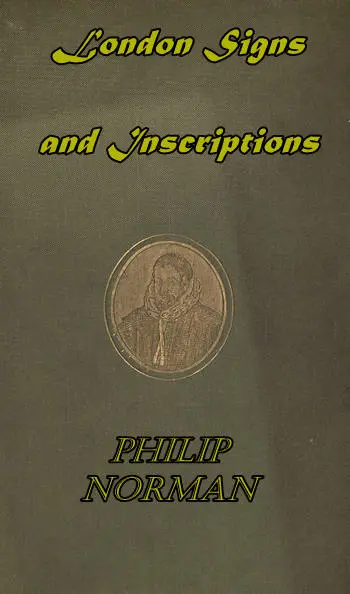
"London Signs and Inscriptions" by Philip Norman is a historical account written in the late 19th century. The book explores the unique and artistic sculptured signs that mark various buildings and places throughout London, shedding light on the city's architectural history and cultural heritage. It delves into the significance of these signs, illustrating how they represent ownership, history, and the ambiance of the urban landscape. The opening of the work introduces the fascinating world of London's signs and inscriptions, revealing their importance as markers of identity for traders, establishments, and localities in the 18th century and earlier. Philip Norman, an artist and antiquary, provides a historical context for these signs, sharing stories and connections with past traditions. He discusses specific examples, such as the sculptured sign of the Boy and Panyer and the connections of various signs to local history and trade practices, setting the stage for a detailed exploration of thousands of unique signs across the city in subsequent chapters.
Introduction adapted from the source catalogue; source summaries may be automatically generated.
Free to read · English · 54,888 words · No account needed
MAKE TIME FOR A GOOD BOOK
On by default. Untick to stop anonymous reading totals. Each page counts after 10 seconds in view. How this works.
Anonymous counting is on unless you have switched it off.
[36] From the ‘Archæologia,’ vol. 32, I learn that ‘the seal of Bartholomew Elys, of Great Yarmouth, 17 Rich. II., is remarkable as giving the family arms with the substitution of his merchant’s mark in place of the cinqfoil in base.’ Mr. Waller says that at Standon, in Herts, is the mark of John Feld, alderman of London 1474; but his son, on the same brass, an esquire in armour, has his shield of arms.
[37] ‘Proceedings of the Society of Antiquaries,’ November 24, 1887. A highly interesting article in the ‘Archæologia,’ vol. 37, by Mr. B. Williams, shows that in early times simple marks, not unlike merchants’ marks, were used to distinguish property, both here and in Germany. Our modern swan marks are a survival.
[38] At a Common Council held July 14, 33 Henry VIII., it was ordered that the seal of the Bridge House should be changed, because the image of Thomas à Becket, sometime Archbishop of Canterbury, was graven thereon, and it was agreed that a new seal should be made, devised by Mr. Hall, to whom the old seal was delivered.
[39] But see Mr. Billson’s paper on ‘The Easter Hare,’ in Folklore,
vol. iii.--[ED.]
[40] It is told in considerable detail in a ‘Life of Sir Walter Raleigh,’ 8vo., 1740, p. 152.
[41] ‘I remember one citizen, who having thus broken out of his house in Aldersgate Street, or thereabout, went along the road to Islington. He attempted to have gone in at the Angel Inn, and after that at the White Horse, two inns still known by the same signs, but was refused; after which he came to the Pied Bull, an inn also still continuing the same sign.’--‘Journal of the Plague Year,’ by Daniel Defoe, 1722.
[42] This was probably one of the ducking-ponds.
[43] Its site is also marked in Ogilby’s Map of London to Holyhead. Here is now the Belvidere Tavern.
[44] Peter Cunningham says that Alderman Boydell, before he removed to No. 90, Cheapside, at the corner of Ironmonger Lane, lived at the Unicorn, at the corner of Queen Street, Cheapside.
[45] ‘Historic Devices, Badges, and War Cries,’ by Mrs. Bury Palliser.
[46] Another record of him is a stone from Allhallows Church, now imbedded in the western wall of the Church of St. Mary-le-Bow, which has on it the well-known lines by Dryden, beginning: ‘Three poets in three distant ages born,’ etc., also the dates of Milton’s birth and baptism.
[47] Additional MS. in British Museum, 3890.
Your reading position is saved on this browser. Take it to another device with a library code. Reading pages adapt to text, rather than matching a printed edition.
BEHIND THE BOOK
This eBook is for the use of anyone anywhere in the United States and most other parts of the world at no cost and with almost no restrictions whatsoever. You may copy it, give it away or re-use it under the terms of the Project Gutenberg License included with this eBook or online at www.gutenberg.org. If you are not located in the United States, you will have to check the laws of the country where you are located before using this eBook. Read the source licence.
The original source file, including credits and licence, is retained by this library. Request an original-format copy at no charge. Please include the book title and Project Gutenberg identifier #53105.
KEEP YOUR CURIOSITY GOING
Cécile Tormay

Moritz Busch
John L. Ransom
Frances Wright
Cécile Tormay

Mabel Potter Daggett