THE CLASSIC COLLECTION✦An outlaw’s diary: the CommuneCLASSIC FREE BOOKS
An outlaw’s diary: the Commune
Cécile Tormay
THE CLASSIC COLLECTION · 1893
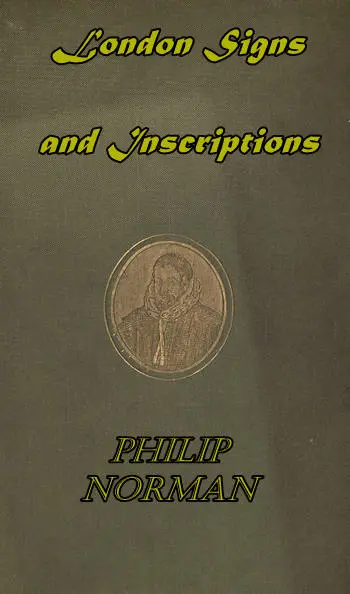
"London Signs and Inscriptions" by Philip Norman is a historical account written in the late 19th century. The book explores the unique and artistic sculptured signs that mark various buildings and places throughout London, shedding light on the city's architectural history and cultural heritage. It delves into the significance of these signs, illustrating how they represent ownership, history, and the ambiance of the urban landscape. The opening of the work introduces the fascinating world of London's signs and inscriptions, revealing their importance as markers of identity for traders, establishments, and localities in the 18th century and earlier. Philip Norman, an artist and antiquary, provides a historical context for these signs, sharing stories and connections with past traditions. He discusses specific examples, such as the sculptured sign of the Boy and Panyer and the connections of various signs to local history and trade practices, setting the stage for a detailed exploration of thousands of unique signs across the city in subsequent chapters.
Introduction adapted from the source catalogue; source summaries may be automatically generated.
Free to read · English · 54,888 words · No account needed
MAKE TIME FOR A GOOD BOOK
On by default. Untick to stop anonymous reading totals. Each page counts after 10 seconds in view. How this works.
Anonymous counting is on unless you have switched it off.
[24] King Richard II. had two badges: the Sun in splendour, and the White Hart. The former is shown on the mainsail of the vessel in which he returned from Ireland, in an illumination to a manuscript account of Richard, by a gentleman of his suite (Harl. MS. 1319). It is also mentioned by the poet Gower. The Sun in splendour, encircled with a cloud distilling drops of rain, is a charge in the arms of the Distillers’ Company. I may add that the Three Crowns appear in the arms of the Skinners’ Company, which according to Strype were granted in the 4th year of Edward VI.
[25] ‘Some Account of the Parish of St. Clement Danes,’ by John Diprose. 1868. Vol. i., p. 257.
[26] Guillim intimates the reason for representing the bear muzzled in heraldry: ‘The beare by nature is a cruell beast, but this here demonstrated unto you, is (to prevent the mischief it might otherwise do, as you may observe) as it were, bound to the good behaviour with a muzle.’--‘Heraldry,’ sec. iii., chap. xv., p. 199. 1660.
[27] Hicks Hall was a session-house for Middlesex. At the corner of St. John Street, Clerkenwell, and Peter’s Lane, affixed to the wall of the Queen’s Head tavern, is a stone tablet with the following inscription:
‘Opposite this Place Hicks Hall formerly stood, 1 mile 1 furlong from the Standard in Cornhill, 4 furlongs 205 yards from Holborn Barrs down Holborn, up Snow Hill, Cow Lane and through Smithfield.’
A Jacobean chimney-piece from Hicks Hall, and a portrait of Sir Baptist, are in the Sessions House, Clerkenwell Green. See an amusing article on Suburban Milestones, in Knight’s ‘London.’
[28] Whitechapel Mount was an elevation of ground generally thought to have been composed, in part at least, of rubbish from the Great Fire: Lysons, however, denies this. Another idea is, that it was a great burial-place for victims of the Plague of 1665. A fort was built here in 1642, one of the series then thrown round London. The Mount is shown in Strype’s map of 1720, and in a view of London Hospital, by Chatelain. Towards the end of last century it was a place of resort for pugilists and dog-fighters. Mount Street and Mount Place, immediately west of the London Hospital, Whitechapel Road, now occupy the ground, which is still slightly raised.
[29] This letter is among the Remembrancia at the Guildhall, and is noted on page 355 of the Analytical Index, published in 1878.
[30] ‘Life of William Wilberforce,’ by his son Samuel Wilberforce, Bishop of Oxford. Revised and condensed from the original edition. 8vo., 1868.
[31] Gentleman’s Magazine, January, 1834.
[32] It formed part of his benefactions, through Bishop Waynflete, to
Magdalen College, Oxford.
Your reading position is saved on this browser. Take it to another device with a library code. Reading pages adapt to text, rather than matching a printed edition.
BEHIND THE BOOK
This eBook is for the use of anyone anywhere in the United States and most other parts of the world at no cost and with almost no restrictions whatsoever. You may copy it, give it away or re-use it under the terms of the Project Gutenberg License included with this eBook or online at www.gutenberg.org. If you are not located in the United States, you will have to check the laws of the country where you are located before using this eBook. Read the source licence.
The original source file, including credits and licence, is retained by this library. Request an original-format copy at no charge. Please include the book title and Project Gutenberg identifier #53105.
KEEP YOUR CURIOSITY GOING
Cécile Tormay

Moritz Busch
John L. Ransom
Frances Wright
Cécile Tormay

Mabel Potter Daggett